
DeepSeek V4.1-Flash-1017 Explained: What Changed for Coding and AI Agents?


DeepSeek V4.1-Flash-1017 is the October 17, 2026 update to V4.1-Flash. DeepSeek reports improved task performance with less execution time and shorter output. For a personal-cloud workflow, the useful next step is to test complete tasks while keeping model access, tools, and private file permissions separately defined.
For a home-server setup, keep original files and recoverable copies on your own storage, send only task-relevant content to a remote model, and verify the result before widening access. A faster model does not change which files a workflow should be allowed to read or modify.
What exactly is DeepSeek V4.1-Flash-1017?
The dated name identifies an update to the Flash model, rather than a complete personal-agent application. DeepSeek’s October 17 release notes describe the change and its availability across official access channels. The open-weight checkpoint is also published on DeepSeek-AI’s model repository.
A model supplies reasoning and generation. A harness supplies the surrounding execution loop, tool calls, workspace, and controls. Your NAS supplies neither of those automatically merely by storing a project folder.
What changed for coding and agent tasks?
The release emphasizes reasoning, coding, agent tasks, and visual evaluation. Treat the published results as vendor-reported measurements with specific benchmark and harness conditions. They are useful signals for selecting a pilot, rather than predictions for every repository.
| Release signal | What to examine in your own work |
|---|---|
| Stronger reported task scores | Does the final artifact meet your acceptance criteria? |
| Reduced task runtime | Is end-to-end completion faster, including tools and review? |
| Shorter output | Are essential explanations, tests, and evidence still present? |
| Harness-oriented optimization | Does your current tool and plugin setup remain compatible? |
Use the Flash-1017 versus earlier Flash comparison to separate a benchmark improvement from a change you can actually observe in your own tasks.
Do API users need a new model name?
The release notes retain deepseek-flash as the API identifier for the updated model. An unchanged identifier can therefore route to changed behavior. Record the observation date and provider configuration whenever you compare runs.
Review our workflow regression-testing guide before assuming an existing integration needs no attention. A successful API response proves connectivity, not unchanged formatting, tool use, or task quality.
Do faster and shorter responses always reduce costs?
They can reduce part of a workload, but the useful measure is cost per accepted result. Retries, long inputs, tool charges, and human corrections can offset a smaller output. Define a result that passes review before comparing spending.
| Metric | Record alongside the bill |
|---|---|
| Accepted completion | A test, required fields, or another explicit quality check |
| Wall-clock duration | From the initial request to a reviewable artifact |
| Usage | Input, output, caching, and tool activity where available |
| Intervention | Manual fixes, repeated prompts, and failed attempts |
The guide to shorter outputs and task cost explains why a token reduction alone is an incomplete efficiency claim.
Can a home NAS run the full model locally?
Open weights establish access to a checkpoint, not a small-hardware deployment requirement. Verify weight size, inference support, memory overhead, and the exact model or quantization you intend to serve. Storage capacity and inference capacity are different planning questions.
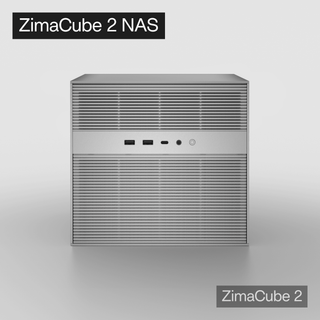
A ZimaCube 2 can retain original project files and accepted outputs, or support compatible services within its configuration. Do not assume it can serve the complete checkpoint. Use the API versus self-hosted model decision guide before assigning an inference workload to home hardware.
What should a ZimaSpace user do first?
Choose a small coding or document task, define an acceptance test, preserve its source inputs, and run the workflow with limited permissions. Save the output, test results, usage, and date in the same project record. Expand the pilot when the evidence supports it.
For a clear file boundary, follow our existing NAS working-set preparation guide. It helps preserve a usable archive even when the agent or model changes.
Frequently asked questions
Is DeepSeek 1017 a separate AI agent?
No. Flash-1017 is a model update. An agent workflow also needs a harness, tools, a workspace, and permissions. Keep those components distinct when evaluating an upgrade.
What API model name accesses the update?
The October 17 release notes specify deepseek-flash. Record the provider and date because a stable alias does not guarantee an unchanged underlying checkpoint.
Do the published benchmarks prove it will improve my project?
No. The results reflect particular tests and harness settings. Evaluate your own representative tasks with fixed inputs and explicit acceptance criteria.
Does a NAS need to host the model to be useful?
No. It can preserve original inputs, project records, and accepted outputs for an API-based workflow. Any remote processing should be tracked separately from local storage.
Explore ZimaCube 2 Personal Cloud Home NAS for private storage and compatible self-hosted services. Model-serving requirements and remote data processing should be assessed for the chosen workflow.
Continue the DeepSeek 1017 series
- Why Shorter AI Outputs Matter: DeepSeek 1017 and the Cost of Getting Work Done
- DeepSeek’s Search and Fetch API: What It Means for Personal AI Workflows
- How to Test Your AI Agent Workflow After the DeepSeek 1017 Update
- How to Use DeepSeek with Private NAS Documents While Controlling What Leaves Your Network
- How to Prepare Your DeepSeek Harness Workflow for Flash-1017
- DeepSeek V4.1-Flash-1017 vs V4.1-Flash: What Should You Compare Beyond Benchmarks?
- DeepSeek API vs Self-Hosted Models: Which Fits Your Personal AI Workflow?
- Web Search vs Private Document RAG: What Does Your AI Agent Actually Need?
Cover image: DeepSeek-AI model page on Hugging Face. Editorial illustration; no integration or endorsement is implied.
Sources and scope
Official sources checked October 23, 2026. Performance statements attributed to DeepSeek are vendor reports; ZimaSpace has not independently benchmarked these models. Procedures and decision tables are editorial guidance and should be matched to your actual software and access policies.

Recommended products
Tech & AI HUB
More to Read
LFM2.5-24B-A2B Explained: What Total and Active Parameters Mean for Local AI Agents
LFM2.5-24B-A2B combines 24B total and 2B active parameters. Understand memory, agent tooling, local execution, and how a NAS fits the workflow.
IBM Granite Speech 5.0 Explained: What Compact ASR Means for Private Audio Archives
Granite Speech 5.0 TurboCTC is a compact ASR model with a multilingual update. Learn how local transcription can fit a NAS-backed audio archive.

Claude Duet Explained: Proactive Tasks, Connected Apps, and Personal Files
Claude Duet is a proactive-agent research preview. Learn about background tasks, connected accounts, review boundaries, and NAS-backed personal files.


