
LFM2.5-24B-A2B Explained: What Total and Active Parameters Mean for Local AI Agents


LFM2.5-24B-A2B is a mixture-of-experts reasoning model with 24 billion total parameters and about 2 billion active parameters per token. The smaller active figure helps explain its computational design; it does not turn the checkpoint into a 2-billion-parameter memory requirement. Plan storage and serving capacity using the full artifact and runtime.
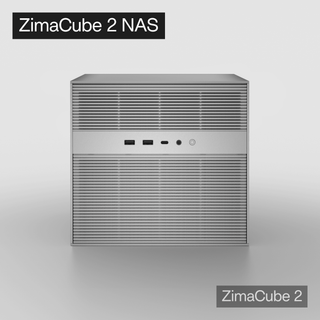
For a home-server agent, the useful opportunity is a locally operated model on suitable compute with tightly scoped tools. ZimaSpace storage can retain original files and reviewed results, while an appropriate worker handles inference. Local model execution is only one part of controlling where an agent’s data goes.
What do the total and active parameter counts mean?
| Term | How to interpret it |
|---|---|
| 24B total parameters | The model’s complete parameter set |
| 2B active parameters | Approximate parameters used per token’s computation |
| Weight representation | Precision and quantization affecting payload size |
| Context and concurrency | Additional serving demands beyond weights |
| Agent execution | A separate tool loop and permission boundary |
Mixture-of-experts routing changes which parts of the model are active. It does not imply that every serving implementation stores only that active subset.
What does Liquid AI emphasize for agent work?
The release and documentation describe a reasoning model trained for tool use and multi-step tasks. A supported model can participate in an agent harness, but it still needs an execution environment that defines tools, checks arguments, and decides what actions to permit.
Use the harness preparation guide to distinguish the inference model from file, browser, and terminal access. A successful chat example does not establish a working autonomous tool loop.
How much memory should I expect?
Start with the actual weight artifact and supported serving route. Ideal arithmetic puts 24 billion 16-bit weights at about 48 GB decimal and 4-bit weights at about 12 GB decimal. Those are weight-payload illustrations, not installation requirements: metadata, unquantized components, buffers, context, and runtime overhead add to the total.
The memory and runtime guide explains how to turn that starting point into a feasible configuration. Do not buy hardware using the active count or an ideal bit calculation alone.
Does local inference keep the whole agent private?
Only if the rest of the workflow stays within the intended boundary. Remote search, external tools, cloud logging, and a fallback model can transmit content. A local service exposed broadly on a network can also expand access beyond what the files need.
Follow the agent permission checklist and NAS document data-control guide. Keep the worker’s input folder narrow and output separate from originals.
What should I evaluate first?
Choose an artifact supported by your hardware and runtime, then run a short text task followed by one bounded tool task. Check the final answer, tool arguments, resource use, and time to a usable result. Save the exact revision and configuration with your notes.
If an API route is also acceptable, read the LFM2.5 versus DeepSeek API comparison. ZimaCube 2 can remain the storage layer whichever inference route meets your actual requirements.
Frequently asked questions
Does 2B active mean the model needs the memory of a 2B dense model?
No. Account for the total artifact, serving strategy, context, runtime overhead, and concurrency.
Is the ideal 4-bit weight calculation a complete RAM requirement?
No. It excludes quantization metadata, components retained at other precision, buffers, and other serving allocations.
Does the model automatically have access to my NAS?
No. A client or harness must supply file tools or mounts and their permissions.
Can a local model still send private data away?
Yes. External tools, fallback services, logs, and later processing steps can transmit content.
Related reading
- How to Check Memory and Runtime Requirements Before Running LFM2.5-24B-A2B
- LFM2.5-24B-A2B vs DeepSeek API: Which Fits Your Home Server Agent Workflow?
Sources
- Official announcement and model documentation — www.liquid.ai
- Technical documentation and reference — docs.liquid.ai
Cover: Liquid AI LFM2.5-24B-A2B official announcement image. Image source.

Recommended products
Tech & AI HUB
More to Read
IBM Granite Speech 5.0 Explained: What Compact ASR Means for Private Audio Archives
Granite Speech 5.0 TurboCTC is a compact ASR model with a multilingual update. Learn how local transcription can fit a NAS-backed audio archive.

Claude Duet Explained: Proactive Tasks, Connected Apps, and Personal Files
Claude Duet is a proactive-agent research preview. Learn about background tasks, connected accounts, review boundaries, and NAS-backed personal files.
GitHub Agentic Autofix Explained: From Security Alerts to Reviewable Pull Requests
GitHub Agentic Autofix turns eligible code-scanning alerts into draft pull requests. Learn what it validates and what still needs review before deployment.


