
How to Use DeepSeek with Private NAS Documents While Controlling What Leaves Your Network


Use DeepSeek with private NAS documents by selecting a task-specific input set, minimizing unnecessary information, and choosing an authorized transfer or retrieval path. If a remote API processes document text, that content has left the local storage boundary. Keep original files, working copies, and accepted results separately identifiable.
For a home-server setup, keep original files and recoverable copies on your own storage, send only task-relevant content to a remote model, and verify the result before widening access. A faster model does not change which files a workflow should be allowed to read or modify.
Which parts of the workflow can leave your network?
Trace the path beyond the original file. Extracted text, OCR results, embeddings sent to a hosted service, prompts, tool requests, and logs can carry information. A NAS copy at home does not determine where these other steps run.
| Component | Question to answer before use |
|---|---|
| Original files | Where is the authoritative copy stored? |
| Extraction and indexing | Which machine or service processes the content? |
| Model inference | What text or images are sent to the model? |
| Tool requests | Do queries include private names or details? |
| Logs and outputs | Where are traces and derived documents retained? |
The API versus self-hosted model comparison helps separate local orchestration from local inference.
How do you select and minimize NAS documents?
Define one output, such as a maintenance table from selected manuals. Copy only relevant records into a project input folder and record their versions. Remove unrelated pages, comments, or hidden sheets when that does not undermine the task.
Use the existing NAS file preparation procedure as a practical staging pattern. Folder labels organize the work; accounts and permissions enforce access.
Should you upload files or build private retrieval?
For a few documents, a selected export may be easier to audit than a new retrieval service. For a larger maintained collection, retrieval can select passages at question time, but its extraction, index, access checks, and refresh process require ownership.
| Approach | Useful situation | Boundary to inspect |
|---|---|---|
| Selected file or text transfer | A small one-off task | The complete selected content sent remotely |
| Authorized private retrieval | Repeated questions over a maintained collection | Passage selection, source permissions, and inference destination |
| Local processing path | A task requiring a local boundary | Every tool and model dependency, not only the file location |
Compare private document RAG with public web search before mixing public and household evidence.
How should access and API credentials be scoped?
Give the workflow only the inputs it requires and a deliberate output destination. Use supported secret handling for API keys. Avoid placing credentials in a source folder, chat transcript, or example configuration committed with project files.
Complete the agent permissions and account checklist before enabling tool execution or access through a connected computer. Inspect mounted NAS shares as part of that account’s actual reach.
How do you verify the answer against private sources?
Require the source filename, revision date, and relevant passage or page reference for important extracted facts. Keep unknown values marked as unknown. Include a question whose answer is absent to check that the workflow reports the gap.
Run a small test set using the DeepSeek workflow evaluation guide. An answer that sounds plausible can still cite the wrong document version or mix a public source into a private-record claim.
What should happen after the task finishes?
Review the output before moving it into the authoritative archive. Preserve the input manifest and an independent recovery point. Review temporary copies, access grants, and retention controls separately.
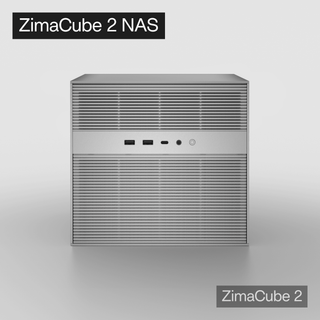
ZimaCube 2 can hold the original collection and project record, with the processing location chosen deliberately. Use the file recovery guide before introducing repeated edits or synchronization between working locations.
Frequently asked questions
Does keeping documents on a NAS make API inference local?
No. Any selected text or images sent to a remote model are processed outside the local storage boundary. Map all extraction, retrieval, model, tool, and logging steps.
Is private document retrieval always better than selected uploads?
No. A small task can be easier to audit with a selected export. A maintained retrieval system becomes useful when repeated access, source updates, and permissions justify its operation.
Can public Search replace access to my NAS library?
No. Public search and authorized private retrieval have different sources and access boundaries. Keep them separate and identify which source supports each claim.
What should an answer cite from a private document?
Ask for a recognizable filename, relevant version or date, and a passage or page reference. Verify important facts against the actual source and preserve unresolved items.
Explore ZimaCube 2 Personal Cloud Home NAS for private storage and compatible self-hosted services. Model-serving requirements and remote data processing should be assessed for the chosen workflow.
Continue the DeepSeek 1017 series
- How to Test Your AI Agent Workflow After the DeepSeek 1017 Update
- Web Search vs Private Document RAG: What Does Your AI Agent Actually Need?
- DeepSeek API vs Self-Hosted Models: Which Fits Your Personal AI Workflow?
- DeepSeek’s Search and Fetch API: What It Means for Personal AI Workflows
- How to Prepare Your DeepSeek Harness Workflow for Flash-1017
Cover image: ZimaSpace product media. Editorial illustration; no integration or endorsement is implied.
Sources and scope
Official sources checked October 23, 2026. Performance statements attributed to DeepSeek are vendor reports; ZimaSpace has not independently benchmarked these models. Procedures and decision tables are editorial guidance and should be matched to your actual software and access policies.

Recommended products
Support & Tips
More to Read
How to Check Memory and Runtime Requirements Before Running LFM2.5-24B-A2B
Check LFM2.5-24B-A2B weight format, memory overhead, runtime versions, context, and tool compatibility before attempting a home-server deployment.
How to Test Granite Speech 5.0 with English Audio Files Stored on Your NAS
Test Granite Speech 5.0 on a short English recording from your NAS. Verify checkpoint revision, runtime, sample rate, transcript quality, and output handling.

How to Prepare Files and Permissions for a Claude Duet Workflow
Prepare a Claude Duet task with selected files, scoped connected accounts, separate drafts, reviewable outputs, and a clear connection-removal plan.


