
IBM Granite Speech 5.0 Explained: What Compact ASR Means for Private Audio Archives


IBM Granite Speech 5.0 TurboCTC can turn recordings into searchable text on supported local compute. The current 470-million-parameter model card describes an October 21 multilingual update, so older English-only descriptions no longer cover the latest checkpoint. For a private audio archive, its appeal is the possibility of choosing where transcription runs.
Keep the original audio on your NAS, process an approved working copy, and store the reviewed transcript alongside the recording. Local processing can avoid uploading audio to a transcription service, but only if the entire workflow—including inference, logs, and later summarization—stays within the intended boundary. NAS storage and transcription compute are separate choices.
What does Granite Speech 5.0 TurboCTC do?
It performs automatic speech recognition: converting speech audio into text. The current model card identifies a compact CTC-based model and documents the supported usage. Do not assume that transcription also supplies reliable speaker labels, translation, or a factual summary unless those are separately implemented.
Think of the transcript as a derived artifact. It should remain linked to the recording and be corrected where names, numbers, or technical terms matter.

Which language and revision details matter?
The updated model card lists English, French, German, Spanish, Portuguese, Italian, and Japanese. It also links an earlier English-only revision. Record the exact revision when evaluating or reproducing results; a stable repository name can point to an updated checkpoint.
Use the current model card as the starting point for runtime requirements. A generic model-family documentation page may describe an older sibling or example.
Why is a compact CTC model different from a general audio assistant?
CTC speech recognition maps an acoustic sequence to text without requiring the same left-to-right text generation loop as a general conversational model. That can support an efficient transcription pipeline, but it does not itself provide speaker attribution, a meeting summary, or a reliable interpretation of the conversation. IBM’s current TurboCTC model card is the source for the checkpoint’s architecture and supported usage.
A 470M parameter count gives an ideal 16-bit weight payload of about 940 MB decimal. That arithmetic excludes buffers, frontend processing, framework overhead, and other allocations. It is a useful scale reference, not a promise that the complete application fits in 940 MB or reaches a particular speed on your NAS.
How does a NAS-backed transcription workflow fit together?
| Step | Where the responsibility belongs |
|---|---|
| Retain audio | Authoritative storage with a separate recovery plan |
| Prepare input | Working copy with supported format and sample rate |
| Run ASR | Compatible runtime on suitable compute |
| Review transcript | Check important names, numbers, and unclear passages |
| Archive result | Link transcript, recording, revision, and processing date |
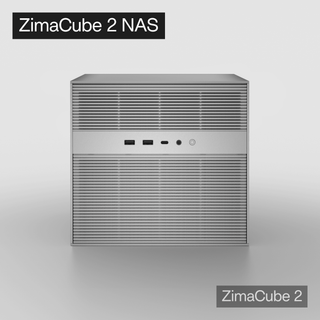
ZimaCube 2 can provide the storage layer while a workstation handles inference. Do not assume the NAS has a ready-made app or verified inference performance for this exact checkpoint.
Does local ASR solve all audio privacy concerns?
It changes the inference location when run locally, but the surrounding workflow still needs review. An external summarization API can receive the transcript; monitoring and logs may retain sensitive text; a broadly shared output folder can expose it. Voice recordings may also contain information about other people.
Use the input preparation guide and file permission checklist to limit access. Keep temporary files and transcripts subject to the same care as the original audio.
How should a private audio archive preserve the meaning of a transcript?
Keep the transcript associated with its recording, checkpoint revision, processing date, and review status. Mark uncertain passages instead of silently inventing words. A transcript can be searchable while still containing errors in names, product codes, dates, or negation that change its practical meaning.
| Derived artifact | What to retain |
|---|---|
| Raw transcript | Source recording and model revision |
| Corrected transcript | Which important passages were reviewed |
| Speaker labels | The separate method or manual review used |
| Summary | The source transcript and any remote processing |
| Search index | The transcript revision it contains |
Use the checked-audio pilot before indexing an archive, and the source-aware retrieval guide if transcripts become RAG inputs. The worker’s read-only input scope can protect the original recording from writes, but the generated text needs its own access and retention policy. Local transcription is an architectural choice; useful, trustworthy records also depend on provenance and review.
What should I test before processing an archive?
Begin with a short representative recording and a manually checked reference segment. Check transcription quality, wall-clock time, memory use, and file handling. Include the kinds of audio you actually retain, such as distant speech or technical vocabulary, instead of assuming a published benchmark predicts your archive.
Follow the NAS audio testing guide, and use the local ASR versus cloud transcription comparison to decide whether operating a local runtime is worthwhile.
Frequently asked questions
Is Granite Speech 5.0 TurboCTC still English-only?
The current model card documents an October 21 multilingual update. An older English-only revision remains separately referenced.
Does it automatically identify each speaker?
Do not assume so. Speaker diarization is a separate capability unless explicitly supplied by the workflow.
Can ZimaCube 2 store audio for a separate transcription machine?
Yes. Storage can remain on the NAS while compatible compute processes approved working copies.
Does local transcription guarantee that later AI steps stay local?
No. Review summarization services, logs, tools, and output sharing separately.
Related reading
- How to Test Granite Speech 5.0 with English Audio Files Stored on Your NAS
- Granite Speech 5.0 vs Cloud Transcription: Privacy, Hardware, and Accuracy Compared
Sources
- IBM Granite Speech TurboCTC: revision, usage, and evaluation
- IBM Granite model-family documentation: speech models
Cover: IBM Granite Speech 5.0 official announcement image. Image source.

Recommended products
Tech & AI HUB
More to Read
How to Test Whether Agent Permissions Cover Only Required Tool Actions
A mechanism-first explanation of whether agent permissions cover only required tool actions, its shared-resource tradeoffs, three query-fanout FAQs, and a.
How to Measure NAS Write Amplification During Vector Index Ingest
A mechanism-first explanation of nas write amplification, its shared-resource tradeoffs, three query-fanout FAQs, and a practical verification protocol.
How to Test Restore-Point Consistency Across Models, Indexes, and Metadata
A mechanism-first explanation of restore-point consistency, its shared-resource tradeoffs, three query-fanout FAQs, and a practical verification protocol.


