
Granite Speech 5.0 vs Cloud Transcription: Privacy, Hardware, and Accuracy Compared


Choose local Granite Speech 5.0 when controlling the processing location matters and you can operate a compatible runtime. Choose a cloud transcription service when managed infrastructure and its verified features better fit the workload. Compare the actual transcript quality and data terms for your audio rather than assuming local is always better or cloud is always easier.
A NAS can retain recordings and reviewed text in either workflow. The key distinction is where an approved copy is processed and what happens to it afterward. If a local transcript is later sent to a cloud summarizer, that later step creates its own data-transfer decision.
How do local and cloud workflows differ?
| Decision | Local Granite Speech 5.0 | Cloud transcription |
|---|---|---|
| Processing location | Your chosen compatible compute host | Service infrastructure under its terms |
| Setup | Install and maintain runtime and checkpoint | Configure account, API, and supported uploads |
| Hardware | Your capacity and observed throughput | Provider capacity and service limits |
| Quality | Evaluate the exact revision and recordings | Evaluate the actual model or endpoint |
| Costs | Compute, energy, operations, and review | Usage, transfer where relevant, and review |
| Archive | NAS can retain originals and results | NAS can retain originals and results |
The Granite overview provides the current checkpoint context, including the multilingual update.
Which option is more private?
Local inference can avoid uploading audio to a transcription provider if the worker and its dependencies stay inside the intended boundary. Cloud service privacy depends on the actual retention, access, training-use, and deletion terms available to your account. Check these rather than relying on a generic “private” label.
In either setup, manage temporary files, logs, and output permissions. The file and account checklist applies to the transcript as well as the audio.
Which option will be more accurate?
Use the same authorized audio segment and compare both outputs with a checked reference. Evaluate names, numbers, technical language, and difficult acoustics relevant to your archive. A public benchmark does not establish performance on your meetings or family recordings.
Check separately for features such as speaker labels, timestamps, language handling, or translation. Do not credit a basic ASR model with a feature provided by a larger pipeline.
Which is easier to operate?
Cloud services can remove model installation and compute provisioning, but introduce account configuration, upload limits, network dependence, and service changes. Local operation adds runtime compatibility, checkpoint updates, resource management, and batch monitoring. Both still require handling failed or inaccurate outputs.
The small local transcription pilot helps establish whether the operational burden is reasonable before committing an archive to the workflow.
What is a practical decision for ZimaSpace users?
Keep the recording archive and reviewed transcripts on independent storage, then choose inference per task. Local processing may suit a sensitive recurring archive; a cloud route may suit occasional work when its terms and features are acceptable. A mixed workflow should mark which files may use which route.
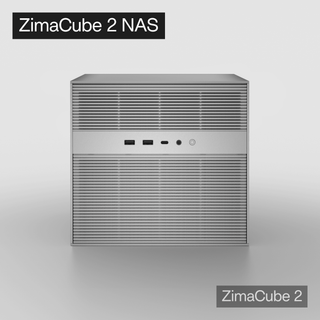
Our cloud storage versus NAS workflow comparison helps keep storage ownership separate from model choice. ZimaCube 2 can hold the archive without implying that every transcription engine is locally supported on it.
Frequently asked questions
Is local ASR free to operate?
Model access does not eliminate hardware, energy, maintenance, and transcript-review costs. Check the exact model license as well.
Does cloud transcription require moving my only audio copy?
No. Retain the original and send an approved copy if the service terms and task permit remote processing.
Can a cloud service include features that the ASR model alone lacks?
Yes. Verify speaker labels, timestamps, translation, and summaries separately for each actual offering.
What is the best first comparison?
Use the same short representative recording, check it against a reference, and record quality, processing time, costs, and data handling.
Related reading
- IBM Granite Speech 5.0 Explained: What Compact ASR Means for Private Audio Archives
- How to Test Granite Speech 5.0 with English Audio Files Stored on Your NAS
Sources
- Official announcement and model documentation — huggingface.co
- Technical documentation and reference — www.ibm.com
Cover: IBM Granite Speech 5.0 official announcement image. Image source.

Recommended products
Product Comparisons
More to Read
LFM2.5-24B-A2B vs DeepSeek API: Which Fits Your Home Server Agent Workflow?
Compare LFM2.5-24B-A2B local inference with the DeepSeek API for home-server agents: privacy boundaries, hardware, maintenance, quality, and costs.

Claude Duet vs ChatGPT Dots: Ongoing Work, File Access, and Approvals Compared
Compare Claude Duet and ChatGPT Dots for ongoing tasks, connected apps, computer access, file boundaries, and review controls in personal-cloud workflows.
GitHub AI Scan vs Agentic Autofix: Detection and Remediation Compared
GitHub AI Scan and Agentic Autofix address different stages: PR security detection and candidate remediation. Compare scope, evidence, controls, and deployment.


