
Why Are First-Time Self-Hosters Starting With Compact x86 Servers Instead of Full NAS Appliances?


First-time self-hosters often start with a compact x86 server because their first problem is usually not “How do I build a finished NAS?” It is “Which service do I actually want to run every week?” A small dedicated server lets them test file sharing, media streaming, photo backup, Home Assistant, DNS, or a few Docker apps without sizing a multi-bay storage appliance around needs they have not measured.
The choice is not compact server versus NAS in absolute terms. It is an app-first starting point versus a storage-first starting point. A compact x86 server fits beginners who need a reversible place to learn and expand. A full NAS should lead when several people already depend on shared files, drive redundancy, clear permissions, and predictable recovery.
The First Goal Is Usually One Useful Service, Not a Finished NAS
Most beginners arrive through a specific frustration: a laptop must stay awake to run a service, cloud photo storage is becoming expensive, media is scattered across drives, or a smart-home tool needs a permanent host. In beginner self-hosting discussions, the first workload is commonly a short list such as Jellyfin, Immich, Home Assistant, ad blocking, or a small Docker stack—not a fully specified storage platform.
That distinction matters because the first repeatable task should determine the first machine. Someone learning containers and running three lightweight services has a different setup problem from a household moving several terabytes of irreplaceable files into shared storage. Starting with the actual task keeps the system understandable and makes later upgrades evidence-based rather than speculative.
Why a Compact x86 Server Makes the First Setup Reversible
A compact x86 server gives beginners a dedicated machine without turning the first experiment into permanent infrastructure. They can install a lightweight server OS, deploy one app stack, reset the system, and try again without disturbing the computer they use every day. The node becomes a safe place to learn accounts, storage paths, ports, updates, logs, and local network access.
This reversibility is more useful than maximum drive count during the first month. The practical question is usually how much should run on one small box and whether the next step should be Docker, a simple server interface, or virtualization. A compact node lets the owner answer that with a real workload instead of a parts list built around imagined future needs.
Start With Server Roles, Not Drive Bays
A beginner-friendly setup should have one primary role and no more than two secondary roles. The primary role defines what must stay stable. Secondary roles are experiments that can be removed without breaking the main service. This keeps a small server from becoming a tightly coupled stack after the first weekend.
| First priority | Good compact-server role | What can remain experimental | Signal that storage should lead |
|---|---|---|---|
| Learn self-hosted apps | Docker host with one or two services | Dashboards, DNS tools, test databases | Important files are becoming the main workload |
| Private media | Jellyfin or Plex server with modest storage | Metadata tools and automation | The library needs several drives, redundancy, and family access |
| Phone photo backup | Immich test deployment with an independent copy | AI search, sharing, and remote access | The server will hold the only trusted family photo library |
| Home automation | Dedicated automation and monitoring node | Ad blocking, dashboards, and test integrations | Bulk storage and multi-user file services are equally important |
This is a responsibility map, not a performance ranking. The compact server fits when learning and application flexibility lead the project. A full NAS fits when durable shared storage is already the primary responsibility.
Separate the Boot Drive, App Data, and Bulk Storage From Day One
An app-first setup still needs a clear data model. Container images can be downloaded again, but account databases, configuration, photo indexes, and service settings may not be replaceable. Docker describes volumes as persistent data stores for containers, so a starter system should make persistent app data visible and back it up independently from the operating system.
The cleanest first layout has three layers. The boot drive holds the OS and should be replaceable. Persistent app data lives in documented paths with a simple backup route. Bulk files such as media and photo originals live on attached SATA storage or another storage target. Before synchronization or remote access is enabled, the owner should know which location is authoritative and which copies are disposable.
App-First and Storage-First Setups Solve Different Problems
An app-first setup minimizes the cost of experimentation. It favors flexible compute, easy redeployment, and the ability to change roles as the owner learns. A storage-first setup minimizes the risk of managing important shared data. It favors integrated drive bays, user accounts, shared folders, monitoring, disk replacement, and recovery.
Neither path is more advanced. They answer different first problems. A compact x86 server is useful when the owner is still deciding whether the long-term system will center on apps, VMs, media, automation, or private cloud services. A full NAS is useful when years of photos, paid creative work, or team files already need a stable home. ZimaSpace’s guide to DIY NAS versus integrated systems reaches the same boundary: flexibility is valuable only when the owner is prepared to manage the extra decisions.
Where a Compact Server Reaches Its Practical Limit
A compact x86 node is not a smaller version of every NAS appliance. Limited native drive connections, fewer hot-swap options, external power and drive cabling, fixed memory on some models, and a less integrated recovery path can become real constraints. The machine may continue to run apps well even while storage growth becomes awkward.
The limit appears when capacity planning replaces experimentation. Warning signs include adding several USB enclosures, depending on improvised drive cabling, serving irreplaceable data to multiple people, needing predictable disk replacement, or spending more time maintaining storage than using the services. At that point, the compact server can remain useful, but storage should move to a system designed around drive management and recovery.
A Two-Stage Setup Lets the First Server Keep a Useful Role
The strongest beginner path treats the first compact server as a future node, not a temporary toy. In stage one, it runs a few services and uses modest local storage while the owner learns which data is active, which services are replaceable, and what needs backup. In stage two, a storage-first NAS is added only when capacity, users, or recovery requirements justify it.
| Stage | Compact x86 server | Storage system | Decision to verify |
|---|---|---|---|
| Learn | Runs one app stack and local administration | One or two noncritical drives | Which services are used every week? |
| Stabilize | Hosts documented containers and monitoring | Separate app-data and bulk-data paths | Can the system be rebuilt without losing data? |
| Expand | Becomes compute, gateway, or automation node | Multi-bay NAS becomes the shared source of truth | Do users, capacity, and recovery justify the appliance? |
| Protect | Runs only roles that can tolerate its failure | NAS plus an independent backup destination | Has a restore been tested outside the live system? |
This staged design prevents the compact server from becoming the only copy of important data. CISA recommends offline, encrypted backups and that organizations regularly test backup availability and integrity. A home setup does not need enterprise complexity, but it does need an independent copy and a restore test before family files depend on it.
When a Full NAS Should Be the First Purchase
Start with a full NAS when storage is already the product, not a side effect of learning. A household importing years of photos, a creator protecting paid work, or a small team sharing large files should define drive layout, permissions, snapshots, replacement procedures, and backup before adding experimental apps.
A full NAS should also lead when several users need one shared source of truth from the first day. In that situation, the cost of unclear permissions or improvised recovery is higher than the value of maximum flexibility. ZimaSpace’s first-time home NAS setup guide follows that storage-first sequence: secure the account, confirm the storage layout, test sharing, and define backup before adding complexity.
What a First Compact x86 Server Must Be Able to Do
Once the app-first path is chosen, the fit criteria are straightforward: enough memory for the first services, native storage connections that match the initial plan, wired networking, an operating system the owner can maintain, and a physical design suitable for continuous use. Expansion matters only when there is a likely second role. Buying every possible option in advance recreates the overbuilding problem the compact server was meant to avoid.
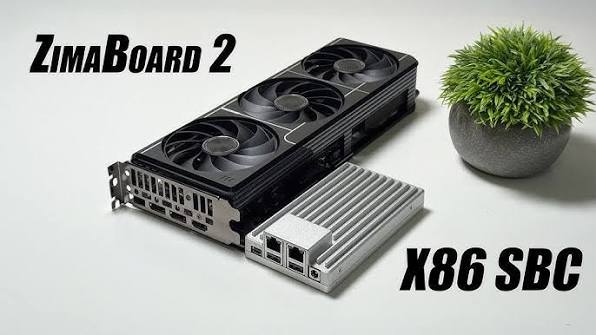
ZimaBoard 2 is one example of this compact x86 category. Its current specifications include an Intel N150 processor, 8GB or 16GB of memory, dual 2.5GbE, two SATA ports, a PCIe expansion slot, and a fanless enclosure. That combination fits a first app server, lightweight NAS, media node, or learning lab. The two-drive limit also makes the growth boundary clear instead of implying that one compact board replaces every multi-bay NAS.
Beginners still deciding between app-first, storage-first, and virtualization-first systems can use the home server OS decision guide to compare those starting points without turning this setup article into an installation manual.
Frequently Asked Questions
Is a compact x86 server cheaper than a full NAS?
Sometimes, especially when the first setup uses one or two drives and the owner already has backup storage. It can become more expensive if separate enclosures, adapters, switches, and replacement parts are added later. Compare the complete setup rather than the compute box alone.
Should a beginner start with Docker or a NAS interface?
Start with the interface that makes the main responsibility understandable. An app-first interface suits a few services and simple file sharing. A NAS-first interface is safer when drive layout, shared folders, snapshots, and recovery are the primary responsibilities.
Can the first compact server remain useful after adding a NAS?
Yes. It can become a Docker host, monitoring node, Home Assistant appliance, DNS server, VPN gateway, or test machine. Its long-term value comes from keeping one clear role rather than duplicating every service on both systems.
How do I know when I have outgrown it?
You have outgrown the starter node when storage expansion requires improvised hardware, several people depend on the data, recovery is unclear, or routine maintenance interrupts the services you wanted to use. Keep the compact server while it makes learning and operation easier; move storage to a full NAS when capacity and recovery become the main job.

Recommended products

NAS & Server Setup
More to Read
A Local RAG Setup for Research Papers, Notes, and Private Documents
Keep original documents authoritative, make indexing repeatable, require citations, and separate replaceable models from private source data.
Why Are Developers Using a Gateway Node for Private DNS, VPN, and Test Apps?
A gateway node gives private apps one controlled name and access path, while compute nodes stay unexposed and replaceable.
How to Build a Reproducible App Stack With Compose Files, Secrets, and Persistent Data Separated
Keep Compose definitions portable, secrets protected, and app data independently backed up so the stack can be rebuilt on a clean host.


