
Higher-Capacity Drives vs Another Enclosure for the Next 20TB: Which Expansion Should Come First?


Replace current drives with higher-capacity models when the existing enclosure, network, cooling, and storage platform still fit the workload and the old disks can be retired or reused safely. Add another enclosure when the current drives have useful life, the next 20TB needs independent bays or a separate role, and the host can support another power, cable, bandwidth, and recovery path. The right first move depends on usable capacity and migration risk, not raw drive labels.
Step 1: Define What “The Next 20TB” Means
Twenty terabytes of raw capacity is not the same as 20TB of safe usable space. A mirror may require roughly 40TB of new raw capacity, while parity layouts reserve one or more drives and also need free space for snapshots, applications, metadata, and future growth. Begin with the usable target and protection level.
The ZimaSpace guide to planning usable NAS capacity recommends working backward from three-to-five-year demand rather than selecting drive labels first. That calculation may reveal that the immediate target is larger or smaller than another nominal 20TB.
Step 2: Check Whether the Current Enclosure Is Still the Right System
Larger drives are the cleaner route when the existing device has enough CPU, memory, networking, filesystem support, cooling, and backup integration for the next stage. Replacing media preserves one management interface, one network identity, one set of permissions, and one monitoring path.
Another enclosure becomes more attractive when the current device has run out of bays, cannot accept the required drive size, lacks enough bandwidth, or mixes incompatible roles. It can also create a deliberate second pool for backup, archive, media, or colder data instead of expanding one increasingly important failure domain.
This is the first decision gate: if the current platform itself is the limit, buying larger drives only postpones the enclosure decision. If the platform remains adequate, adding a second chassis may create unnecessary operational complexity.
| Decision condition | Higher-capacity replacement drives | Another enclosure |
|---|---|---|
| Current bays | Best when all bays are occupied but the chassis remains suitable | Best when more independent bays are genuinely needed |
| Existing-drive reuse | Old drives must be sold, repurposed, or kept as spares | Existing drives can remain active if still healthy |
| Migration | Requires sequential replacement, rebuild, clone, or full restore | Allows copy-and-verify migration to a separate target |
| Management | One system and one pool remain simpler | Creates another controller, power supply, cable, fan, and alert path |
| Failure domains | Capacity remains concentrated in the original system | Can create separation, or merely add another dependency to the same host |
| Performance | Fewer larger disks may reduce spindle count | More drives can add I/O paths but may share one uplink |
| Next expansion | May leave no bay-level growth after replacement | Adds bay headroom if the host and interface scale |
Step 3: Compare Migration Risk
Replacing drives inside the existing pool may require one-at-a-time rebuilds, a complete backup-and-restore, or a platform-specific expansion sequence. The system can remain exposed for days while large drives rebuild, especially if every current bay is already busy. The exact path must be validated before buying the disks.
Adding another enclosure can provide a clean destination. Copy the data, verify it, switch services, and retain the old pool temporarily as rollback. The migration is often easier to understand, but only if the new enclosure is connected through a stable interface and the destination has its own protection.
A USB or Thunderbolt enclosure attached to the same host is not automatically an independent server. Host failure, operating-system mistakes, power events, and shared credentials may still affect both pools. The ZimaSpace comparison of DAS and NAS failure boundaries helps distinguish an added chassis from a separate storage system.

Step 4: Calculate the Cost of Keeping the Old Drives
An additional enclosure appears economical because it preserves current disks, but those disks continue consuming bays, power, cooling, and monitoring attention. Older low-capacity drives may create more failure points and less usable capacity per watt than replacing them with fewer larger models.
NASCompares’ larger-drives versus more-drives framework highlights the recurring trade-off: more disks can add performance and incremental growth, while fewer larger disks reduce power, heat, noise, and device count.
Do not count the resale value of old drives until their health, hours, warranty, and realistic market value are known. Drives reused for backup must still be large enough to hold the protected dataset and should not become the only recovery copy merely because they are already owned.
Step 5: Decide Whether You Need Another Failure Domain
A second enclosure can improve resilience when it stores an independent copy, uses separate credentials, and can be disconnected or placed elsewhere. It does not improve resilience when the original pool is simply stretched across an expansion cable and the entire filesystem depends on both chassis remaining online.
Expansion units also add cable and power dependencies. A loose cable, failed bridge, incompatible sleep behavior, or accidental power-off may affect several disks at once. How-To Geek’s overview of ways to add capacity after internal bays are full shows that external enclosures are easy to attach, but the resulting topology still needs deliberate protection and management.
If the goal is backup separation, another enclosure should not be treated merely as pool expansion. Give it a distinct retention policy and test whether the primary system can be restored when the original enclosure is unavailable.
Step 6: Check Bandwidth, Power, Noise, and Placement
Larger drives preserve the existing cable and network path. Another enclosure adds an interface whose bandwidth may be shared among all new disks. That can be adequate for archive and backup but restrictive for active VMs, databases, editing, or several simultaneous clients.
More disks and another fan also increase power, heat, and noise. In a bedroom office or small cabinet, four reused drives may be less desirable than two higher-capacity replacements even when the acquisition cost looks lower. Placement and electrical capacity are part of the storage decision.
Conversely, a second enclosure can move noisy or cold storage away from the primary system. The benefit depends on whether the connection remains reliable and whether remote placement creates a real failure boundary instead of a longer vulnerable cable.
Use This Expansion Decision Framework
- Calculate the protected usable capacity required for the next three to five years.
- Confirm the maximum supported drive size and expansion method of the current platform.
- Document the complete migration path for larger replacement drives.
- Calculate enclosure, drives, cabling, power, cooling, and backup cost together.
- Decide whether the second enclosure is expansion, migration, archive, or backup.
- Model the next expansion after this 20TB addition, not only the immediate purchase.
- Choose the route that can be restored after the original enclosure fails completely.
Which Expansion Should Come First?
Replace With Higher-Capacity Drives First When
Choose larger drives when the current enclosure remains capable, management simplicity matters, and the migration can be completed with a verified backup or supported one-at-a-time replacement process. This route is especially strong when old drives are small, noisy, power-hungry, or near retirement.
Add Another Enclosure First When
Choose another enclosure when current drives remain valuable, the host supports a stable expansion path, and the new chassis has a defined role. It should add useful bays, a clean migration destination, or a separate protection layer rather than merely postponing drive replacement.
Choose a New Primary System Instead When
If the current platform lacks drive support, bandwidth, cooling, memory, or a safe expansion model, neither route fixes the underlying limitation. Build or buy a new primary system, migrate and verify the data, then assign the old device a backup or archive role.
FAQs
Do Larger Drives Increase Rebuild Risk?
Larger members can take longer to rebuild because more data may need to be read and written. Risk depends on actual used capacity, drive health, layout, workload, error rates, and whether another valid backup exists during the rebuild.
Can an Expansion Enclosure Be Part of the Same Pool?
Some platforms support it, but spanning one pool across chassis increases dependence on the expansion link and both power domains. A disconnected enclosure can affect the entire pool, so compatibility and failure behavior must be tested explicitly.
Should Old Drives Become the Backup?
They can hold an additional copy if they pass health tests and have enough capacity, but age and reuse do not create independence automatically. Keep another recovery copy and verify restores before relying on repurposed disks.
Final Verdict
Choose higher-capacity drives first when the existing enclosure is still the right platform and simplicity outweighs preserving every current disk. Choose another enclosure when it creates useful bays, a safer migration target, or a genuine second storage role. For the next 20TB, the winning route is the one that leaves a clear recovery path and does not make the following expansion harder.

Recommended products

Product Comparisons
More to Read
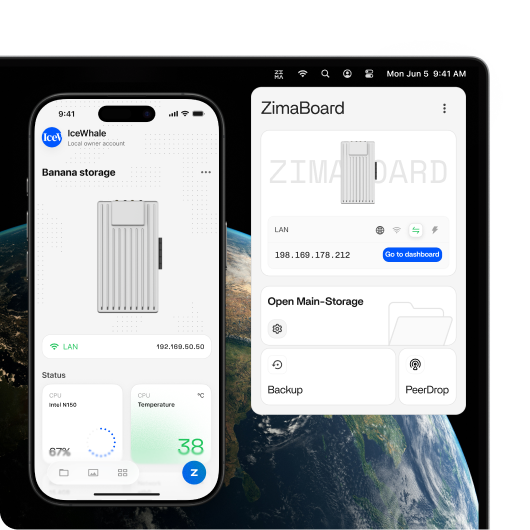
LXC vs Docker on Proxmox for App Updates and Rollbacks
Docker gives app-level version control; LXC gives guest-level rollback. The better fit follows the smallest state unit you can restore safely.
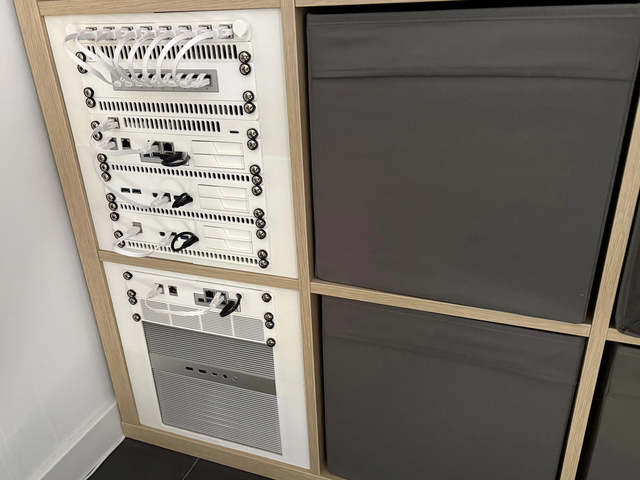
Docker vs LXC Security Boundaries for Privileged Home Services
Docker fits narrowly packaged apps; LXC fits fuller Linux services, but neither replaces a VM when shared-kernel risk is unacceptable.
Turnkey NAS OS vs Modular Linux for a First-Time Builder
Choose turnkey NAS software for guided storage operations; choose modular Linux when learning and explicit control justify more ownership.


