
DeepSeek API vs Self-Hosted Models: Which Fits Your Personal AI Workflow?


Choose DeepSeek API access when a maintained remote inference service meets your data and operating requirements. Consider a self-hosted model when you need control over inference and can support the exact checkpoint and runtime. Compare complete workflows: an open-weight release does not imply that the full model fits a home NAS.
For a home-server setup, keep original files and recoverable copies on your own storage, send only task-relevant content to a remote model, and verify the result before widening access. A faster model does not change which files a workflow should be allowed to read or modify.
What are you actually choosing between?
An API provides access to inference operated by a service. Self-hosting means choosing and operating a model, runtime, hardware, and access policy. A locally running agent can still use a remote API, so local orchestration alone does not establish local processing.
The Flash-1017 explainer identifies the new checkpoint. If you choose a smaller local model instead, label the comparison as a workflow or model-selection decision rather than the same-model deployment on identical terms.
What hardware must be assessed for self-hosting?
Check the actual weight format, runtime support, memory overhead, context budget, and target concurrency. The official Flash-1017 repository contains a large sharded checkpoint; the repository’s storage footprint is not a ready-made GPU memory requirement.
| Resource | Why it matters |
|---|---|
| Storage | Weights, caches, logs, and recovery copies need capacity |
| System and accelerator memory | The runtime must hold its working model and context state |
| Compute and runtime support | Supported kernels and deployment method affect usable performance |
| Network and concurrency | Multiple clients and remote storage can change bottlenecks |
| Operational capacity | Someone must patch, observe, and restore the service |
Validate a representative workload before buying hardware. Do not infer a complete deployment from the model’s active-parameter count or an available download.
How do the operating responsibilities differ?
Use this as a planning comparison rather than a promise about every service or software stack.
| Area | API-based workflow | Self-hosted model workflow |
|---|---|---|
| Inference operation | Provider runs the service within its published scope | You maintain the deployment |
| Data boundary | Selected requests reach the service | Inspect local and external dependencies |
| Updates | Alias and service behavior can change | You control deployment timing and compatibility work |
| Cost categories | Usage, tools, and associated services | Hardware, power, storage, software, APIs if any, and time |
| Recovery | Preserve project records and export results | Also preserve model-serving configuration and state |
Our broader cloud versus self-hosted agent guide covers the difference between choosing a model and operating a complete agent environment.
Does self-hosting automatically improve privacy?
It gives you control over a deployment, but the result depends on configured tools, outbound connections, telemetry, logging, and the model route. A local retrieval index can still send selected private passages to a cloud model.
Map the complete path with the private NAS document control guide. Keep storage location, inference location, and the permission boundary as separate entries.
How should total cost and quality be compared?
Use a workload with known acceptance criteria, then record usage or infrastructure allocation, duration, failures, and supervision. Avoid treating an already-owned machine as having no operating cost or assuming a subscription covers every connected tool.
Use cost per accepted task for the unit of comparison, and disclose that a smaller local model may have different capabilities from the remote service. A useful result must still meet the task’s requirements.
Where can ZimaCube 2 fit without overstating inference capacity?
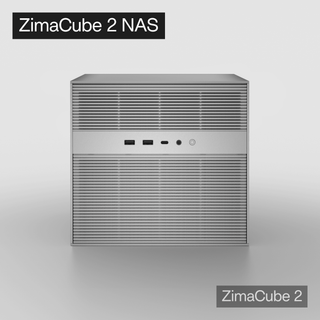
It can store the project collection, model files where appropriate, accepted outputs, and backups, or host compatible services within a validated configuration. Full Flash-1017 serving requires a separate requirements assessment.
Start with one bounded workflow and a recoverable input pack. The NAS staging procedure helps maintain that boundary whether inference is remote or local.
Frequently asked questions
Can I run full Flash-1017 because my NAS has enough disk space?
Disk capacity alone does not establish an inference deployment. Check the exact checkpoint, runtime, working memory, compute support, and intended context and concurrency.
Does using a local agent mean I am self-hosting the model?
No. A locally running harness may call a remote inference API. Document where the model actually processes the request.
Is comparing DeepSeek API with a smaller local model valid?
Yes as a clearly labeled workflow-selection exercise. It is not an identical-model comparison, and capability differences must be included in acceptance testing.
Which option is cheaper for occasional work?
There is no universal result without the workload and current costs. Compare usage, infrastructure, maintenance time, and accepted task quality rather than only a headline rate.
Explore ZimaCube 2 Personal Cloud Home NAS for private storage and compatible self-hosted services. Model-serving requirements and remote data processing should be assessed for the chosen workflow.
Continue the DeepSeek 1017 series
- DeepSeek V4.1-Flash-1017 vs V4.1-Flash: What Should You Compare Beyond Benchmarks?
- DeepSeek V4.1-Flash-1017 Explained: What Changed for Coding and AI Agents?
- How to Use DeepSeek with Private NAS Documents While Controlling What Leaves Your Network
- Why Shorter AI Outputs Matter: DeepSeek 1017 and the Cost of Getting Work Done
- How to Test Your AI Agent Workflow After the DeepSeek 1017 Update
- Web Search vs Private Document RAG: What Does Your AI Agent Actually Need?
Cover image: ZimaSpace product media. Editorial illustration; no integration or endorsement is implied.
Sources and scope
Official sources checked October 23, 2026. Performance statements attributed to DeepSeek are vendor reports; ZimaSpace has not independently benchmarked these models. Procedures and decision tables are editorial guidance and should be matched to your actual software and access policies.

Recommended products
Product Comparisons
More to Read
LFM2.5-24B-A2B vs DeepSeek API: Which Fits Your Home Server Agent Workflow?
Compare LFM2.5-24B-A2B local inference with the DeepSeek API for home-server agents: privacy boundaries, hardware, maintenance, quality, and costs.
Granite Speech 5.0 vs Cloud Transcription: Privacy, Hardware, and Accuracy Compared
Compare local Granite Speech 5.0 with cloud transcription for audio privacy, setup, hardware, accuracy, maintenance, and NAS archive workflows.

Claude Duet vs ChatGPT Dots: Ongoing Work, File Access, and Approvals Compared
Compare Claude Duet and ChatGPT Dots for ongoing tasks, connected apps, computer access, file boundaries, and review controls in personal-cloud workflows.


