
Cloud AI Agents vs Self-Hosted Agents: Convenience, Privacy, and Maintenance Compared


Hosted AI agents reduce platform administration, while self-hosted agent workflows give you more control over deployment and operating policy. The privacy outcome depends on the complete data path: a self-hosted workflow may still call a cloud model. Compare maintenance, access, processing, and recovery together.
Start with a bounded task and a separate working folder. Keep original files recoverable, define which connected accounts the agent may use, and review the output before allowing changes to important data or external actions.
Choose the operating model, not just the model name
Choose a hosted agent when its maintained execution environment and supported connections reduce work you do not want to administer. Consider self-hosting when you need control over the execution environment and can operate the software reliably. A hybrid design can keep source files at home while sending selected material to a hosted service.
Those choices do not by themselves determine where every piece of data is processed. Trace the workflow from storage through tools and model inference before making a privacy claim.
Compare responsibilities
| Area | Hosted agent | Self-hosted agent workflow |
|---|---|---|
| Initial setup | Provider manages the core execution environment | You deploy and configure the stack |
| Model processing | Follow the provider's documented service terms | May use local models, remote APIs, or both |
| Tool access | Supported provider connections and controls | Connections and network policies you configure |
| Maintenance | Provider owns platform updates within its scope | You own deployment updates and monitoring |
| Recovery | Export and persistence depend on service rules | You design and test state recovery |
| Cost categories | Plan fees, usage, and connected-service costs | Hardware, power, storage, APIs, and operating time |
Compare a complete workload, including supervision, rather than treating either model as automatically free or private.
Separate the storage decision from execution using our cloud storage vs NAS comparison for AI workflows.
Self-hosted orchestration is not necessarily local inference
An agent running on your own server can still send prompts and documents to a remote model API. A locally stored vector index can also contain data previously extracted by a cloud service. Document each processing step separately.
If a local model is required, verify its hardware, memory, context, and throughput needs against the actual task. A model runner such as Ollama is one component; tools, scheduling, credentials, logs, and recovery still need an operating design. Do not equate installing a runner with reproducing a commercial personal agent.
For a hosted-service shortlist, compare Grok Bot, ChatGPT Dots and Meta Muse by workflow.
Hosted convenience still needs access management
A provider-managed environment can spare you server administration, but you still choose accounts, file scope, and authorized actions. Review the current privacy and retention terms, keep an export of important deliverables, and establish a practical way to stop ongoing work.
For a first project, use a small non-sensitive input set and a draft-only deliverable. That lets you test the service without relying on broad account access or an unverified archive migration.
Self-hosted flexibility creates operating work
Plan updates, network restrictions, secrets, execution logs, and resource limits. In a container setup, inspect privileges and mounted paths; a container can affect host files you deliberately expose to it. Use documented isolation controls rather than assuming the deployment format supplies a complete boundary.
Maintain a restoration record for workflow definitions and persistent state. A server that is inexpensive to run can still be expensive to recover when nobody knows which configuration is authoritative.
Operational control includes recovery: use the AI agent file backup and restoration guide before giving a self-hosted worker write access.
Where ZimaCube 2 fits the decision
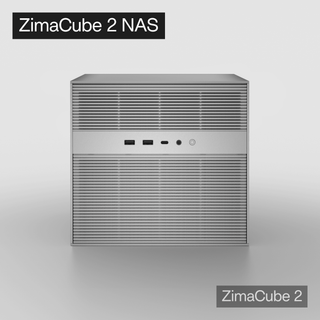
ZimaCube 2 can provide storage and a platform for compatible self-hosted services, or preserve project files used with hosted agents. Confirm the requirements of the chosen software and hardware configuration before assigning local inference to it.
It does not install Grok Bot, Dots, or Muse as local replacements. Begin with one workload, choose the execution model that meets its needs, and keep original data and reviewed results portable enough to change your approach later.
Explore ZimaCube 2 Personal Cloud Home NAS for your private storage and compatible self-hosted workloads. Access to hosted agents depends on each service and the connection you configure.
Frequently asked questions
Does self-hosting an AI agent keep all data local?
Not automatically. A self-hosted workflow can call remote model APIs or external tools. Trace storage, inference, connectors, logs, and outputs before describing the complete workflow as local.
Can a NAS replace a hosted personal AI agent?
A NAS can provide storage and run compatible services, but reproducing a hosted agent requires software, model access, tool connections, scheduling, permissions, and ongoing administration. Hardware alone does not supply that complete service.
Is self-hosting always cheaper than a cloud agent?
No. Include hardware, power, storage, backup, model or API usage, and administration time. Compare the cost of a defined workload rather than only the subscription fee or a server purchase.
When does a hybrid AI agent workflow make sense?
It can fit when you want to keep authoritative files in your personal cloud while using selected copies with a hosted agent. Define transfers, processing boundaries, reviewed outputs, and recovery ownership explicitly.
Continue the personal AI agent series
Cover image: ZimaSpace product media. Illustrative editorial material; no integration or endorsement is implied.
Sources and scope
Official documentation checked October 22, 2026. Product capabilities, supported connections, and access requirements can change. Workflow recommendations are editorial guidance; no hands-on benchmark or native ZimaCube integration is claimed.

Recommended products
Product Comparisons
More to Read
LFM2.5-24B-A2B vs DeepSeek API: Which Fits Your Home Server Agent Workflow?
Compare LFM2.5-24B-A2B local inference with the DeepSeek API for home-server agents: privacy boundaries, hardware, maintenance, quality, and costs.
Granite Speech 5.0 vs Cloud Transcription: Privacy, Hardware, and Accuracy Compared
Compare local Granite Speech 5.0 with cloud transcription for audio privacy, setup, hardware, accuracy, maintenance, and NAS archive workflows.

Claude Duet vs ChatGPT Dots: Ongoing Work, File Access, and Approvals Compared
Compare Claude Duet and ChatGPT Dots for ongoing tasks, connected apps, computer access, file boundaries, and review controls in personal-cloud workflows.


