
How to Build a Quiet, Low-Power Plex Server for 24/7 Use


A quiet, low-power Plex server starts by reducing unnecessary conversion work and assigning compute, app data, and media storage roles before choosing a chassis or fan curve.
For a 24/7 home server, noise and power are design constraints that can change the topology. Direct Play reduces compute demand, hardware transcoding can improve efficiency when conversion is required, and separating fast app data from bulk media lets you avoid overbuilding every storage tier.
Define the Quiet-Server Goal Before the Hardware
Write down the required number of local and remote streams, which of them normally Direct Play, whether remote 4K conversion is required, and the maximum noise or heat the room can tolerate. That workload determines how much sustained compute the server must dissipate.
A tested Intel N100 system handled multiple hardware transcodes at modest CPU load, showing why codec support and acceleration can matter more than a broad CPU label; that is the baseline to establish for a quiet 24/7 Plex build.
Assign Roles Before You Pick Drives and Cooling
Treat compute, Plex app data, bulk media, backup, and network as separate roles. App data benefits from responsive persistent storage, media needs capacity and sustained reads, and backup should not share the only copy or the only failure path.
A common quiet topology uses low-power x86 compute with integrated video acceleration, SSD app data, large HDD media storage, and a wired network. The value comes from role separation, not from any one product form factor.
Use Noise, Heat, and Power as Constraint Gates
Measure the actual installation space, ambient temperature, airflow, drive vibration, and available power before finalizing the build. A technically capable server that sits in a closed cabinet can become louder because its cooling system must compensate for trapped heat.
When measuring a quiet 24/7 Plex build, real home-server deployments show that trapped cabinet heat can raise fan demand, so placement and airflow must be tested under sustained load rather than judged at idle.

Validate the Whole Setup Under Peak Playback
Run the heaviest expected stream combination while a typical background job is active. Record playback mode, package power, temperatures, fan speed, drive noise, and whether the network remains stable; the setup passes only if it meets both performance and acoustic goals.
At the failure boundary for a quiet 24/7 Plex build, recent testing shows that hardware versus software transcoding can change CPU load and fan behavior substantially, so acceleration support must be verified on the actual platform.
Scale by Adding a Clear Role, Not Just More Power
Add a separate storage node, accelerator, or backup target only when the new component has a persistent role that removes a measured bottleneck or constraint. More compute that stays idle does not make the 24/7 design quieter or more efficient.
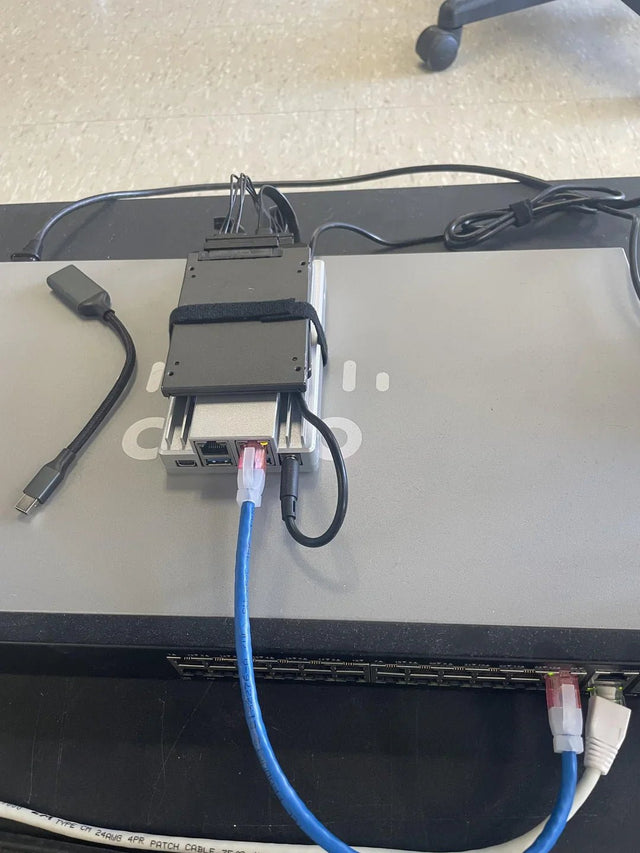
A repeatable compact Plex server topology gives the benchmark a stable reference for storage paths, playback mode, and network assumptions.
- Define peak Direct Play and transcode workloads
- Measure noise and temperature in the real location
- Separate app data, media, and backup roles
- Validate power and thermals during peak streaming

Recommended products

NAS & Server Setup
More to Read
How AI-Like Analysis and Automation Change Jellyfin Storage and Compute Needs
Automation and adjacent AI analysis add scans, derived data, CPU/GPU work, cache, scratch space, and background scheduling beyond ordinary Jellyfin playback.
How to Integrate Jellyfin Into a Small Apartment or Rental Network
Build a rental-friendly Jellyfin network around stable local addressing, minimal wiring, quiet hardware, CGNAT-aware remote access, and reversible changes.
How Many Users and Background Jobs Should One Jellyfin Host Support?
Treat Jellyfin users and background jobs as one shared workload budget; capacity ends when playback latency, queues, or resource pressure becomes repeatable.


