
SC26 2026: What Supercomputing Can Teach a Home AI Lab


SC26 runs November 15–20, 2026, at McCormick Place in Chicago, with exhibits open November 17–19. The International Conference for High Performance Computing, Networking, Storage, and Analysis is a useful place to examine how a computing system works as a whole. For a home AI lab, the relevant lesson is simple: model speed depends on more than the processor or GPU you buy.
This is a preview for readers following the conference from home or planning what to look for on site. It focuses on questions you can apply to your own setup: where data waits, which memory is running out, what a benchmark actually measures, and how to keep an experiment reproducible. A household server operates at a different scale, but careful measurement is useful at both scales.
What Is SC26, and When Does It Take Place?
The official SC26 website brings together the program, exhibits, student activities, and conference updates. Its “HPC Unites” theme reflects the collaboration behind large computing systems and the work they support. Use the official site for current participation and access details.
The organizer's Chicago page confirms McCormick Place as the venue, November 15–20 for the program, and November 17–19 for exhibits. Those are different date ranges. If you are attending, check which registration category covers the sessions you want rather than assuming an exhibit pass includes everything.
As of November 4, the conference is still ahead. This article therefore identifies topics and evaluation questions rather than reporting show-floor results or announcements. Follow the live program for session details and publication availability; a scheduled presentation is not evidence that a new product has shipped or a benchmark has been independently reproduced.
Why Should a Home AI User Pay Attention to Supercomputing?
Large computing systems expose bottlenecks that are easy to overlook on a desk. A fast accelerator can wait for data. A storage system can have ample capacity and still struggle with a workload made of many small reads. A good model can produce poor interactive results when several users compete for memory.
A home lab faces similar categories of questions, although the hardware, software, reliability requirements, and performance targets differ. You might read documents from a NAS, build an index on a workstation, and run inference on a GPU. Each stage has a cost and a failure mode that the GPU's advertised compute rate does not describe.
Use SC26 coverage to improve your questions rather than to copy an enterprise architecture. Ask what the workload was, how the system was configured, and whether a result includes the entire job. Those habits help you judge a home-server upgrade just as much as they help you understand a research presentation.
Which Parts of the System Shape Local AI Performance?
Start by separating capacity from throughput and latency. Capacity tells you whether something fits. Throughput describes how much work completes over time. Latency describes how long an individual request waits. You need enough capacity, but spare capacity alone does not guarantee a responsive application.
| System layer | Question to ask | Practical home-lab check |
|---|---|---|
| Accelerator | Does the runtime use this device for the required operations? | Verify model and runtime support before comparing GPU specifications. |
| GPU memory | Do weights, working memory, and the request's cache fit? | Observe peak usage at the intended context and concurrency. |
| System RAM | What stays in host memory, and is swapping occurring? | Track RAM pressure during loading, indexing, and inference. |
| Storage | Is the job limited by capacity, large transfers, or small-file access? | Time model loading and document ingestion separately. |
| Network | Which steps repeatedly move data between machines? | Measure an actual source-to-destination transfer, not just link speed. |
| Application | What does the user wait for from request to useful result? | Record first response, total completion time, and output correctness. |
Change one variable at a time. If a model loads slowly but responds acceptably afterward, an inference-focused GPU upgrade may not fix the first problem. If every request reprocesses the same documents, an application or caching change may matter more than a faster network adapter.
Why Do Memory and Context Matter More Than a Parameter Count?
Model parameters help describe a model, but they are not a complete memory plan. The weight format, runtime allocations, context length, batch size, and concurrent requests all affect how much memory is needed. Different modalities introduce additional work and memory behavior. A short text prompt and a long document session are not interchangeable tests.
For transformer-based text generation, the attention cache can grow as the processed sequence grows; the exact behavior depends on the architecture and runtime. Longer supported context is a capability limit, not a promise that every machine can serve that context comfortably. Test the workload you intend to use, including the length of the generated response.
Mixture-of-experts models require another distinction: total parameters and parameters active for a token. A lower active count can reduce computation, but it does not mean the remaining weights disappear from storage or memory planning. Offloading and expert-loading strategies have their own performance tradeoffs.
Use our AI model hardware requirements directory to begin with a particular model and deployment format. Then validate the proposed configuration with a representative task. A model that can load is not automatically a model that can serve your users at an acceptable speed.
What Can SCinet Teach You About Moving Data?
SCinet is the conference's volunteer-built networking infrastructure and a platform for networking research and demonstrations. Its relevance goes beyond a headline link rate: applications depend on the path between systems, and a network exists to support actual work.
At home, map that path before upgrading it. A document might move from a shared folder to an indexing service, then into a database, while the model weights are read from a different disk. Some transfers happen once; others repeat on every request. Their frequency changes which bottleneck matters most.
A faster network link cannot exceed the limits of a slow source drive, an overloaded destination, or an application's processing rate. Protocol overhead and the rest of the path also matter. Compare a real file transfer or ingestion job before and after a change, using the same dataset and noting other activity.
Our direct 10GbE link walkthrough is an example of a home-scale networking project. Treat the linked setup as a specific build to inspect, not a promise that every client, disk, or application will reach the link's rated speed.
How Should You Read AI and HPC Benchmark Claims?
A performance number needs a workload and configuration attached. Before comparing results, look for model revision, precision, input size, context, output length, batch size, hardware count, and software version. Check whether the test measures loading, processing, generation, or the complete application.
Single-user responsiveness and aggregate throughput answer different questions. A server can complete more total work while each person waits longer. Similarly, a warm run with files cached in memory can look very different from the first run after a reboot. Neither is inherently wrong, but the distinction must be visible.
For your own lab, keep a short run record with the exact task, configuration, start conditions, and result. Repeat the same test enough to notice obvious variability. Do not turn one favorable run into a universal claim, and check output quality before celebrating a speed increase achieved through reduced precision or a different model.
When following the conference, consult the official session program for the original presentation or paper when available. Product announcements and independent experimental evidence serve different purposes. Keep the source and publication date with any result you plan to use in a purchasing decision.
Where Does a Home Server Fit Beside a GPU Workstation?
A small lab can assign different jobs to different machines. Shared storage holds source material and completed outputs. A service host runs a dashboard or schedules tasks. A GPU workstation performs supported acceleration. Combining these roles can be convenient, but separating them can make resource use and troubleshooting easier to understand.
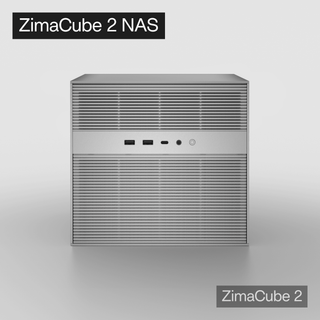
For the shared-storage role, ZimaCube 2 is one product to evaluate against your dataset, applications, client connections, and backup plan. Determine where inference will run and verify the exact hardware configuration separately. Storing a large model file is different from loading and executing it at a useful speed.
A compact NAS is not a substitute for a multi-node accelerator system, high-bandwidth accelerator memory, or the interconnects used in large distributed jobs. Nor does adding several small machines automatically combine their RAM or VRAM into one transparent pool. The runtime must support the intended distribution, and communication costs remain part of the workload.
Keep the original dataset separate from temporary indexes, downloaded weights, and generated outputs. Preserve enough information to recreate the derived material, and use independent backups for what cannot be recreated. Our shared knowledge and local data guide explores why provenance and understandable records matter alongside the storage hardware.
A Practical SC26 Watchlist for Your Home AI Lab
Choose a few questions before the conference rather than trying to follow every announcement. A useful watchlist is tied to an unresolved problem in your own setup. That makes it easier to distinguish relevant developments from impressive systems designed for entirely different work.
- Describe one workload. Name the model or application, input size, user count, and acceptable waiting time.
- Measure the current path. Separate loading, ingestion, processing, and output delivery.
- Pick relevant sessions. Use the official program to find memory, storage, networking, or application topics connected to that problem.
- Save the original evidence. Keep the configuration and source with any benchmark or design idea.
- Try one justified change. Retest the same workload and check correctness, stability, and operating cost.
For an on-site visit, confirm the latest schedule, venue guidance, and access requirements before making plans. If following remotely, check which materials the organizers make available; do not assume every presentation will have an immediate public recording.
Bring Home Better Measurement Habits
SC26 can be useful even if you never operate a cluster. It offers a reason to look past isolated specifications and ask how memory, storage, networking, and software work together. The practical outcome for a home lab is a clearer workload and a more defensible next step.
Keep one baseline, one question, and one reproducible experiment. Whether the answer is a configuration change, a better data layout, or additional hardware, you will know which problem it is meant to solve and how to check whether it helped.
FAQ: SC26 and Home AI Labs
Where and when is SC26?
SC26 takes place at McCormick Place in Chicago, Illinois. The program runs November 15–20, 2026, and exhibits run November 17–19. Check the official schedule for individual activities and access requirements.
Is this article reporting announcements from SC26?
No. It is a pre-conference guide prepared on November 4, 2026. It explains what to investigate and how to evaluate relevant claims, rather than presenting future conference announcements as established results.
Does a small active parameter count mean a MoE model needs little RAM?
No. Active parameters describe computation for a token, while the full weight set still needs a storage and loading strategy. Practical memory depends on the model format, runtime, offloading, context, and concurrency.
Will faster Ethernet make local AI generation faster?
Only if network transfers are a material bottleneck in the workload. Once a model and request data are local to the inference machine, generation may instead be limited by memory bandwidth, compute, or runtime behavior.
Can a ZimaCube replace an HPC cluster?
No. It may have a useful shared-storage or service-host role in a suitably sized home lab. Large distributed training and inference require purpose-built compute, memory, software, and networking beyond that role.
Cover artwork: SC26 official conference website. This independent guide does not imply sponsorship, exhibitor participation, or endorsement by the organizers.

Recommended products
Zima Campaign Hub
More to Read
America Recycles Day 2026: Before You Recycle an Old Computer
Prepare an old PC for America Recycles Day: assess reuse, verify backups, sanitize storage, handle batteries, and choose an electronics recycler.
World Usability Day 2026: Make Home Technology Easier to Use
Mark World Usability Day 2026 with practical checks for family file sharing, accessible interfaces, AI controls, and home-server usability.

From an Xbox 360 Shell to a Proxmox Backup Server
A college project grew into a recycled-hardware homelab, an Xbox 360 enclosure and a separate backup server. Follow the original builder's journey.


