
Which Fits a Home Lab: One Large Server or Multiple Small Nodes?


One large server fits a home lab that needs simple management, generous memory, and room for many virtual machines. Multiple small nodes fit a lab built to learn clustering, failure domains, rolling maintenance, and horizontal growth. Neither design is automatically more resilient or more efficient.
The real tradeoff is pooled capacity versus independent hosts. A large server gives every workload access to one deep resource pool. Small nodes divide that pool into boundaries that the scheduler, network, storage layer, and operator must coordinate.
What the Home Lab Is Actually Trying to Grow
If growth means more virtual machines, larger databases, or memory-heavy test environments, one large server usually keeps the path straightforward. CPU, RAM, and local storage stay in one chassis, so new workloads can use spare capacity without first solving placement across machines.
If growth means practicing deployment across hosts, moving services during maintenance, or surviving a node loss, multiple small nodes create the required topology. The cluster control-plane model distinguishes the machines that manage the cluster from the nodes that run workloads, but hardware count alone does not guarantee those roles are redundant.
When One Large Server Preserves Useful Headroom
A large host makes resource sharing efficient. Several light services can use unused CPU time and memory without each machine carrying its own idle reserve. Linux controlgroup resource allocation can divide CPU, memory, and I/O among workloads while keeping the underlying capacity available to the host.
That concentration helps with VM-heavy labs, build runners, databases, and services that occasionally spike. It also simplifies backups because fewer host configurations and boot devices exist. The practical weakness is obvious: maintenance or hardware failure can stop every guest unless another host can restore or receive them.
A large server is therefore simpler, not inherently safer. Separate backups, tested restore procedures, and a plan for the services that must remain available matter more than the size of the chassis.
What Multiple Small Nodes Teach That One Host Hides
Small nodes force you to describe where a service may run and what it requires. scheduler resource requests influence which node can accept a workload, making capacity planning visible as soon as one machine lacks enough free memory or CPU.
They also make maintenance a system behavior. You can drain one node, patch it, and observe whether replicas remain healthy elsewhere. A lightweight server and agent topology is especially useful for this lesson because it separates control-plane responsibilities from agent-only nodes without pretending that every node has the same job.
That flexibility creates overhead. Each node needs power, storage, networking, monitoring, updates, and a replacement plan. A three-node lab with weak automation can be harder to trust than one well-documented server.
Quorum and Failure Domains Change the Node Count
Two nodes look redundant, but many clustered control planes need a majority to make safe decisions. The reliable quorum requirement is a practical reminder that high availability commonly needs at least three votes or an external quorum device. Losing one of two equal voters can leave the survivor unable to prove it is authoritative.
Failure domains also extend beyond the computers. Several nodes on one power strip, switch, or storage box still share those dependencies. Multiple small machines improve availability only when the service has replicas, the control plane retains quorum, data remains accessible, and traffic can reach a healthy instance.
That difference matters because a cluster can increase operational complexity before it increases uptime. Beginners should model the failure they want to survive, then count the independent components required to survive it.
Storage and Network Coordination Become the Hidden Cost
Local disks are fast and simple, but a workload moved to another node cannot automatically take its local data with it. Shared storage, replicated databases, or application-level synchronization solve different parts of that problem and may add recovery rules of their own.
Network quality becomes part of the storage and control path. inter-node latency limits show why extra hops can reduce performance and affect cluster health. In a home lab, the important lesson is not a universal latency number; it is that cluster traffic now competes with backups, media, and normal household use.
If the main goal is capacity rather than clustering, a compute-plus-storage design may be cleaner than many identical nodes. The server, mini PC, and NAS roles helps separate compute growth from storage growth before you duplicate hardware.
Choose the Topology by the Lesson, Not the Box Count
The table compresses the decision into the first constraint that should control the build.
| Decision Variable | One Large Server | Multiple Small Nodes | Practical Meaning |
|---|---|---|---|
| VM and memory headroom | Strong shared pool | Split across hosts | Large guests fit more easily on one server |
| Host failure testing | Needs another host | Built into the topology | Small nodes expose real machine loss |
| Management effort | Fewer systems | More systems | Automation becomes valuable earlier |
| Quorum learning | Usually simulated | Can be physical | Three voters may be more meaningful than two nodes |
| Storage design | Simple local pool | Requires placement or sharing | Data mobility may dominate the cluster project |
| Incremental growth | Upgrade the host | Add another node | Horizontal growth trades simplicity for flexibility |
A good first build uses one large server when most experiments need capacity. Choose three small nodes when the curriculum explicitly includes quorum, service placement, maintenance, and recovery. Avoid buying two nodes merely because two sounds redundant.
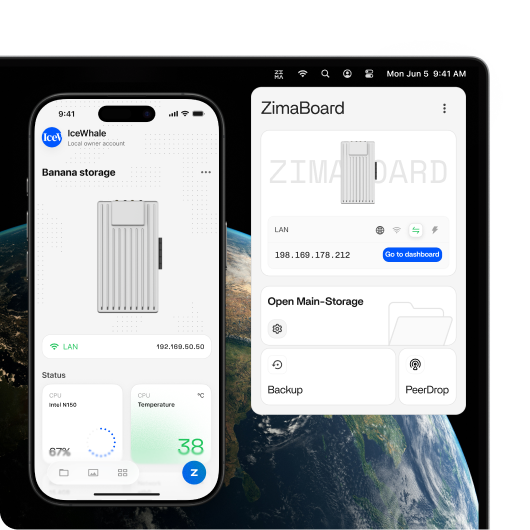
For a compact-node path, the ZimaBoard 2 home server can be evaluated after node count, network, storage, and expansion requirements are known. The product should fit the chosen topology rather than determine it.
FAQ
When does one large server become a single point of failure?
It is a single point of failure whenever all required services depend on that chassis and no tested restore or failover path exists. Virtualization isolates workloads, but it does not create a second physical host.
What happens if two small nodes lose contact?
The result depends on the cluster and its voting model. A two-node control plane may lose quorum or block changes because neither side can prove it holds a majority, even though both machines still run.
Can several small nodes outperform one large server?
They can provide more aggregate throughput for workloads designed to run in parallel. They do not combine memory into one large address space, so a single large VM or database may still fit better on the larger host.
How should a beginner plan storage for multiple nodes?
Start by separating stateless services from stateful data. Keep backups outside the cluster, then decide whether each stateful workload needs shared storage, replication, or a documented restore rather than adopting one storage design for everything.
Final Takeaway
Choose one large server when the lab needs deep shared capacity and simple administration; choose multiple small nodes when independent failure, placement, quorum, and rolling maintenance are the actual subjects. More boxes create a better cluster lesson only when the services are designed to use them.

Recommended products

Product Comparisons
More to Read
LXC vs Docker on Proxmox for App Updates and Rollbacks
Docker gives app-level version control; LXC gives guest-level rollback. The better fit follows the smallest state unit you can restore safely.
Docker vs LXC Security Boundaries for Privileged Home Services
Docker fits narrowly packaged apps; LXC fits fuller Linux services, but neither replaces a VM when shared-kernel risk is unacceptable.

Turnkey NAS OS vs Modular Linux for a First-Time Builder
Choose turnkey NAS software for guided storage operations; choose modular Linux when learning and explicit control justify more ownership.


