
When Should Jellyfin Use a Separate Database or Storage Host?


For most Jellyfin homes, separate the media-storage host before the database host: keep production app state on low-latency local SSD and split bulk media only when capacity, recovery, or placement requires it.
This decision is about data roles rather than the number of machines. Jellyfin has latency-sensitive configuration and database state, rebuildable caches, temporary transcode data, and large mostly sequential media files. Those classes benefit from different storage, backup, and failure boundaries. A second host is useful only when it gives one role a clearer capacity or recovery advantage without turning a previously local dependency into a fragile network path.
Separate Data Roles Before You Separate Machines
Start with four roles: authoritative application state, rebuildable derived data, temporary work space, and media. The database, users, watch state, playlists, configuration, and selected metadata belong to the recovery unit. Cache and transcode segments can normally be recreated. Movie and music files are large source objects whose protection strategy may be completely different from the application database.
A current Jellyfin database maintenance guide describes the unified 10.11 database as live operational state rather than disposable cache. That is why host placement should begin with ownership and recovery requirements instead of putting every directory named “Jellyfin” onto the same share.
Draw those roles before drawing hosts. If the current server has enough SSD space and backup coverage for app state, there is no architectural reward for moving it. If the media library has outgrown local bays, power, cooling, or fault isolation, that role has a concrete reason to move to a NAS or storage server while the application remains local.
Keep the Production Database Local Unless the External Database Path Is Truly Supported
Jellyfin 10.11 completed a major EF Core migration, but that does not make a separate PostgreSQL server the default production topology. Experimental PostgreSQL adapters exist, yet they add another service, credentials, version compatibility, backup order, and network dependency. For a normal household, those costs outweigh the theoretical neatness of a dedicated database host.
The experimental PostgreSQL release itself warns that the adapter is for evaluation rather than a production-ready server. That experimental database boundary is the stop sign: do not design a household recovery plan around an unsupported backend merely to make the topology look more enterprise-like.
For production, local does not mean unprotected. Put application state on reliable SSD storage, back it up to another failure domain, and prove that the backup restores with the matching Jellyfin version. Separate the database service only when the chosen backend is supported for your release, you can operate it independently, and the recovery benefit exceeds the new network and version coupling.
Move Media to a Separate Storage Host When Capacity or Drive Topology Demands It
Bulk media has a different access pattern. Direct Play mainly reads large files sequentially at their playback bitrate, so a NAS can serve media comfortably when the network, mount, and disks sustain the aggregate streams. Separating media also lets the compute node stay compact while the storage host grows through larger pools, more bays, or a different backup design.
A recent home setup with Jellyfin keeps Docker data on SSD while media lives on HDD, showing a practical SSD-app and HDD-media split. The tradeoff is visible at playback start: sleeping HDDs can add wake latency even though browsing stays fast from SSD-resident app data.
Choose a separate storage host when drive expansion, acoustic placement, redundancy, or multi-service storage justifies the extra path. Keep media local when one chassis already meets capacity and backup needs. Splitting for its own sake adds DNS, mounts, permissions, network failure, and startup-order work without changing the actual user outcome.

Treat the Storage Network as a Required Dependency, Not an Invisible Cable
Once media moves to another host, Jellyfin depends on a mount being present before scans and normal operation. A missing NAS can leave an empty mountpoint that still looks like a valid directory, while a slow or unstable network can turn a storage problem into delayed playback. The topology therefore needs a fail-closed startup rule and a measurable bandwidth target.
Community experience shows that serving media from a separate NAS over normal home networking can work well when the network is sized correctly; one recent discussion found many users doing exactly that without playback problems. The useful lesson from separate NAS media storage is that network placement is viable, but it must be treated as part of the media path rather than assumed free.
Validate the slowest segment: storage pool, NAS NIC, switch, server NIC, mount protocol, and simultaneous stream demand. Stop Jellyfin or suspend destructive library maintenance when the expected media mount is absent. A second host is a reliability improvement only when its failure is obvious and contained rather than silently converted into an empty library.
Use Recovery and Expansion Tests as the Split Decision
Before adding another host, rehearse two events: loss of the Jellyfin compute node and loss of the media-storage node. A tested restore-first recovery workflow shows why configuration, persistent data, versioned service definitions, and restore order must be proven together rather than assumed from the existence of backup files. The storage-host test should likewise make Jellyfin degrade predictably without rewriting or deleting authoritative media state.
ZimaSpace's Jellyfin storage recovery audit uses the same ownership test: every persistent path should have a named role, backup scope, and restore method before an incident.
Keep one host when app state, media capacity, backup, and normal peak I/O all fit comfortably. Split media storage when capacity or storage lifecycle becomes the constraint. Treat a separate database host as an advanced exception until the database provider is production-supported and independently recoverable. The stop condition is a topology whose roles you can name and restore—not the maximum number of boxes you can add.

Recommended products

NAS & Server Setup
More to Read
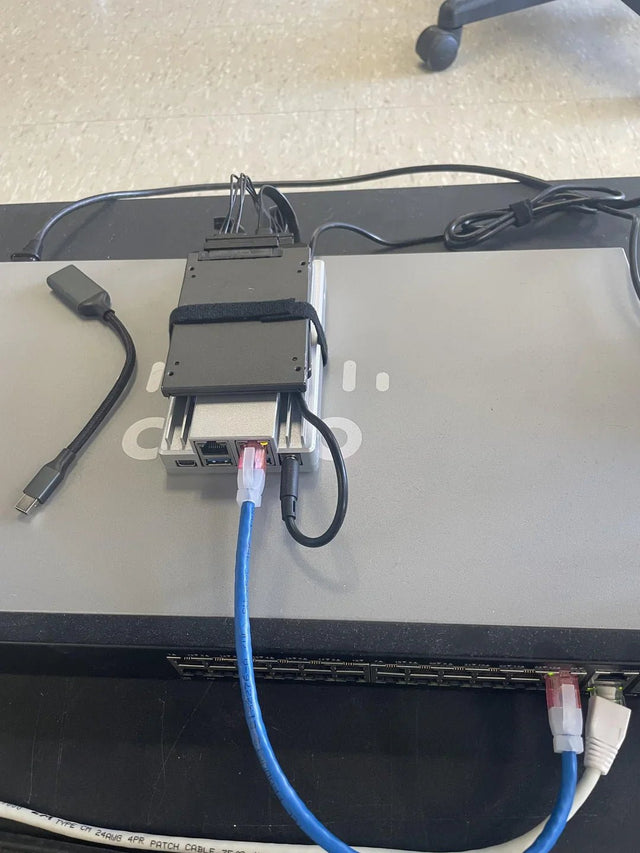
How AI-Like Analysis and Automation Change Jellyfin Storage and Compute Needs
Automation and adjacent AI analysis add scans, derived data, CPU/GPU work, cache, scratch space, and background scheduling beyond ordinary Jellyfin playback.
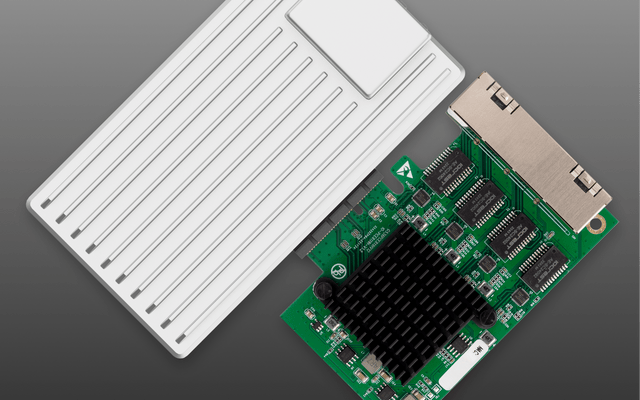
How to Integrate Jellyfin Into a Small Apartment or Rental Network
Build a rental-friendly Jellyfin network around stable local addressing, minimal wiring, quiet hardware, CGNAT-aware remote access, and reversible changes.
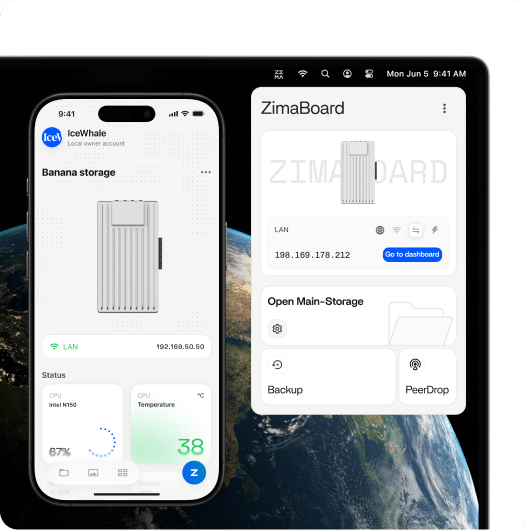
How Many Users and Background Jobs Should One Jellyfin Host Support?
Treat Jellyfin users and background jobs as one shared workload budget; capacity ends when playback latency, queues, or resource pressure becomes repeatable.


