
What GPT-5.6 Means for Local AI, Home Servers, and Private Data


GPT-5.6 is not just another model name for AI fans to argue about. It signals a larger shift: frontier AI is becoming more capable at reasoning, coding, long-running tasks, agent workflows, and security-related work.
But for home users, small teams, and local AI builders, the practical takeaway is not “run GPT-5.6 at home.” The takeaway is that cloud frontier models are getting stronger while your private data still needs a place you control. That is where local AI, home servers, private RAG, and hybrid workflows become more important.
GPT-5.6 Is a Frontier Cloud Model, Not a Home Server Download
The first misconception is simple: GPT-5.6 does not mean you can download a GPT-5.6 model file and run it on a home server. OpenAI describes GPT-5.6 as a model family that includes Sol, Terra, and Luna, with Sol positioned as the flagship and most capable model, Terra as a lower-cost option, and Luna as the fastest and most cost-efficient option.
OpenAI’s Help Center also makes the availability boundary clear: during the preview, Sol, Terra, and Luna are available through OpenAI API and Codex for a limited group of trusted partners and organizations, while GPT-5.6 is not available in standard ChatGPT conversations during the preview. That makes GPT-5.6 availability in ChatGPT and API a cloud-access question, not a home-download question.
| Misread | Better Interpretation |
| GPT-5.6 means local GPT-5.6 at home | GPT-5.6 is a cloud frontier model family |
| Home server replaces GPT-5.6 | Home server protects local data and workflows |
| Bigger local GPU is always the answer | Hybrid routing is usually smarter |
| Private data can go anywhere if the model is good | Stronger models make data boundaries more important |
Misconception: GPT-5.6 does not make every home server a frontier AI server. It makes the local data layer more valuable.
The Real Shift Is From Chatbot to Agentic Work
GPT-5.6 matters because frontier models are moving beyond short chat answers. OpenAI’s preview of GPT-5.6 Sol, Terra, and Luna frames the model family around stronger software engineering, computer use, professional knowledge work, scientific research, cybersecurity, and longer chains of work.
That changes the local AI discussion. When models become more agentic, they do not just answer questions. They read files, call tools, inspect logs, write code, trigger workflows, revise outputs, and keep project state across steps. That makes the boundary around private data and tool access more important.
| Old AI Pattern | Newer Agentic Pattern |
| Ask one question | Give a multi-step goal |
| Read short prompt | Read files, logs, and context |
| Produce one answer | Use tools and iterate |
| Manual copy-paste | Connected workflow |
| Temporary chat | Persistent project state |
As models become more agentic, the question changes from “what can it answer?” to “what data and tools should it be allowed to touch?”
Function Calling Shows Why Tools Matter as Much as Models
The practical meaning of agentic AI is tool access. OpenAI’s function calling for model tools and actions explains how developers can connect a model to custom code, external data, and application actions through defined functions.
For home users and small teams, that is the real bridge between cloud frontier models and local infrastructure. The model can reason, but the tools decide what it can actually do: read a folder, check a backup job, summarize a NAS log, call a script, query a database, or create a draft action for approval.
| Tool Access | Home Server Example |
| Read-only file search | Find documents without exposing full archives |
| Backup status check | Summarize failed jobs |
| Log analysis | Explain container or server errors |
| Script execution | Run low-risk maintenance tasks |
| Approval workflow | Draft changes before applying them |
| RAG retrieval | Send selected context instead of raw files |
Misconception: the model is not the whole agent. The agent is the model plus tools, permissions, memory, and logs.
Local AI Matters More Because Access Is Not the Same as Control
Cloud frontier AI gives you the strongest reasoning, coding, and tool-using capabilities. But access is not the same as control. You do not own the model, the pricing, the rate limits, the availability window, the policy constraints, or the service uptime.
Local AI gives you a different kind of value. It may not match GPT-5.6 at frontier reasoning, but it can keep routine workflows, private documents, file search, logs, and automations inside your own environment.
| Cloud Frontier AI Gives You | Local AI Gives You |
| Best reasoning | Data control |
| Strong coding help | Local fallback |
| Advanced agent ability | Predictable private workflows |
| API access | No per-token cost for routine tasks |
| Fast upgrades | Local continuity |
| High-end models | Files stay on your hardware |
Misconception: access to a powerful cloud model is not the same as ownership of your AI workflow.
Your Home Server Becomes the Private Data Layer
The home server’s role becomes clearer in a GPT-5.6 world. It does not need to beat GPT-5.6 at reasoning. It needs to hold the data that should not be casually pushed into external chats or APIs.
That includes documents, PDFs, notes, code repositories, family records, media, server logs, backups, embeddings, vector databases, and agent outputs. GPT-5.6 may be the expert you consult. Your home server should be the memory you own.
| Local Data Type | Why It Belongs on a Home Server |
| Personal documents | Privacy and backup |
| Business files | Access control |
| Code repositories | Local context |
| Home server logs | Troubleshooting memory |
| Media library | Large storage |
| RAG embeddings | Private semantic index |
| Agent outputs | Persistent workflow history |
| Backups | Recovery path |
Cloud AI can help you think. Local infrastructure decides what it is allowed to know.
Private RAG Is the First Practical Home AI Upgrade
The most practical upgrade is not running the largest model possible. It is private RAG: keeping your source documents local, indexing them into a searchable memory layer, and using AI to answer from your own files.
In a private RAG workflow, the home server or NAS stores the source files. A local tool generates embeddings. A vector database stores the semantic index. A local assistant handles routine questions. GPT-5.6 is used only when the task needs frontier reasoning, and only after the context is selected or redacted.
| RAG Layer | Local Role |
| Source documents | Stored on NAS or home server |
| Embeddings | Generated locally or selectively |
| Vector DB | Private semantic memory |
| Permissions | Controls who can query what |
| Local model | Handles routine Q&A |
| Cloud model | Optional advanced reasoning |
| Backup | Protects the knowledge base |
Misconception: private AI does not start with the biggest model. It starts with keeping the right data local.
Hybrid AI Is the Real GPT-5.6 Home Strategy
The smart answer is not local-only or cloud-only. It is hybrid. Keep private context, repetitive tasks, document search, file organization, logs, and routine agents local. Use GPT-5.6 only when the task is difficult enough to justify the privacy, cost, and dependency trade-off.
This is especially important for coding, research, architecture planning, debugging, and security-related education. GPT-5.6 may be much stronger than your local model, but it does not need to see your entire home archive, raw logs, full codebase, family documents, or financial records to help.
| Task | Better Local | Better GPT-5.6 / Cloud |
| Search personal PDFs | Yes | Only selected context |
| Summarize NAS logs | Yes | Rarely needed |
| Complex code architecture | Sometimes | Strong fit |
| Private RAG Q&A | Yes | Optional final reasoning |
| Sensitive financial files | Yes | Avoid raw upload |
| General research | Maybe | Strong fit |
| Routine automation | Yes | Not necessary |
| High-stakes reasoning | Maybe | Strong fit with redaction |
Hybrid AI means local-first for private context, cloud-selective for frontier reasoning.
Stronger Models Make Private Data More Sensitive, Not Less
A stronger model can infer more from less. That is useful, but it also means prompts become more revealing. File names, logs, code snippets, folder structures, meeting notes, family records, business contracts, and error traces can contain more private context than users realize.
The safer pattern is to keep raw source data local, summarize or redact locally, and send only the minimum context needed for cloud reasoning. The goal is not paranoia. The goal is data boundaries that match the power of the model.
| Data Type | Safer Pattern |
| Family records | Keep local |
| Financial documents | Local summary first |
| Business contracts | Redact before cloud |
| Source code | Send only minimal snippet |
| Home server logs | Strip secrets |
| Health-related notes | Keep local |
| Raw photo archive | Local indexing |
| Passwords / API keys | Never send |
Misconception: a stronger cloud model does not make sensitive data safer to upload.
Hardware Expectations Need to Stay Realistic
GPT-5.6 will make some users dream about giant GPU rigs at home. That is understandable, but it is not the right starting point for most people. A home server does not need to copy GPT-5.6 to be useful.
Different local hardware layers solve different problems. A low-power server can run automations and log summaries. A mini PC can run local apps, small models, and private RAG tools. A workstation can handle stronger local inference. A NAS can store documents, media, embeddings, models, and backups. The cloud model handles frontier reasoning when needed.
| Hardware Level | Realistic Local AI Role |
| Low-power home server | Automation, logs, light tools |
| Mini PC | Local apps, small models, RAG |
| Mac / workstation | Better local inference |
| GPU box | Larger models and agents |
| NAS | Private data, models, embeddings, backup |
| Cloud GPT-5.6 | Frontier reasoning and hard tasks |
Do not design a home server around copying GPT-5.6. Design it around owning your private AI workflow.
Home Servers Are Becoming AI Hubs, Not Just Storage Boxes
Home servers are no longer only about shared folders. They are becoming small AI hubs: places where documents live, embeddings are stored, local tools run, automations execute, media is indexed, logs are summarized, and backups protect the AI memory layer.
This does not mean every NAS should run huge models. It means the home server becomes the stable local foundation behind the model. The model may run locally, in the cloud, or both. The data layer should still be under your control.
| Home Server Role | AI Value |
| File storage | Keeps source data local |
| Docker host | Runs local AI tools |
| Vector database | Private RAG memory |
| Backup target | Protects AI data |
| Media library | Enables local tagging/search |
| Log store | Agent troubleshooting context |
| Automation node | Runs repeatable workflows |
| Remote access | Controlled private access |
In the GPT-5.6 era, storage becomes memory, and memory becomes part of the AI system.
Where Local Models Still Win Even After GPT-5.6
Local models still win when privacy, cost stability, offline access, repeated tasks, and local files matter more than frontier reasoning. They are not better because they are smarter. They are better because they are closer to your data and under your control.
A small local model can classify files, summarize logs, draft routine notes, tag documents, run long agent loops, or answer from a private RAG index without sending each step to a cloud API.
| Local Model Wins When... | Why |
| Data is private | Files stay local |
| Task repeats often | No token bill per loop |
| Output is low-risk | Good enough model is enough |
| Internet is unavailable | LAN/offline workflow |
| Workflow uses local files | Avoid repeated uploads |
| Agent loops are long | Local cost control |
| Logs are sensitive | Keep troubleshooting local |
Local AI wins when control matters more than maximum intelligence.
Where GPT-5.6 Still Wins
GPT-5.6 still wins when the task needs the strongest available reasoning: difficult debugging, complex coding, scientific synthesis, architectural planning, security education, advanced tool use, or high-value analysis.
The goal is not to avoid GPT-5.6. The goal is to use it where it is worth the privacy and cost trade-off. Let the local layer prepare clean context, strip sensitive details, and store the final output back where your workflow actually lives.
| GPT-5.6 Fits When... | Local Layer Should Still... |
| Hard reasoning is needed | Provide redacted context |
| Complex code review | Keep repos local where possible |
| Architecture planning | Send summary, not full archive |
| Security education | Avoid exposing secrets |
| Scientific synthesis | Keep private datasets local |
| Long-running work | Log outputs back locally |
Frontier models are strongest when they see the right context, not necessarily the most context.
A Practical Private AI Architecture for Home Users
A practical home AI setup starts with storage and boundaries. The NAS or home server stores private files. A local model handles routine search, classification, and summaries. A vector database stores embeddings. Agent tools run locally where possible. GPT-5.6 receives only selected, redacted context when the task truly needs frontier reasoning.
This structure also makes outputs easier to manage. Instead of leaving valuable AI results inside scattered chats, save summaries, reports, code notes, and agent logs back to local storage where they can be searched, backed up, and reused.
| Layer | Practical Choice |
| Storage | NAS or home server |
| Local model runtime | Local LLM tool or lightweight inference stack |
| Interface | Private dashboard or local AI UI |
| RAG database | Vector database for private retrieval |
| Automation | Scripts, workflows, or home-server tools |
| Cloud frontier model | GPT-5.6 for hard tasks |
| Data filter | Redaction and summarization |
| Backup | Local + offsite copy |
For users building a private local AI data layer, an AI NAS such as ZimaCube 2 fits best as the storage and memory side of the workflow: documents, media, embeddings, model archives, outputs, and backups stay local, while GPT-5.6 is reserved for selected high-value reasoning rather than raw private data upload.
Decision Checklist
| Question | Local AI / Home Server | GPT-5.6 / Cloud | Hybrid |
| Is the data private? | Strong fit | Use carefully | Best |
| Is the task hard reasoning? | Maybe | Strong fit | Best |
| Is the task repeated daily? | Strong fit | Can get costly | Strong |
| Is the workflow file-heavy? | Strong fit | Use selected context | Best |
| Do you need offline access? | Strong fit | No | Local fallback |
| Do you need frontier quality? | Limited | Strong fit | Best |
| Are logs or secrets involved? | Strong fit | Avoid raw upload | Redact |
| Do you need agent loops? | Good for routine loops | Good for hard steps | Best |
Final Takeaway
GPT-5.6 does not make home servers obsolete. It makes their role clearer. Frontier models will keep getting stronger in the cloud, but your private files, logs, embeddings, media, documents, and agent memory still need a place you control.
The practical answer is hybrid: keep private data and routine AI workflows local, then use GPT-5.6 selectively for hard reasoning, advanced coding, and high-value tasks. Your home server is not competing with GPT-5.6. It is the local foundation that decides what GPT-5.6 should and should not see.
FAQ
Can GPT-5.6 run locally on a home server?
No. GPT-5.6 is a cloud frontier model family from OpenAI, not an open-weight model you can download and run at home. Local AI uses separate locally runnable models and tools.
Does GPT-5.6 make local AI less useful?
No. It makes local AI more strategically useful because private files, logs, embeddings, agent memory, and routine workflows still need a local data layer you control.
What should run locally instead of in GPT-5.6?
Private document search, local RAG, file classification, log summaries, routine agent loops, media indexing, and sensitive data workflows are good local-first tasks.
When should GPT-5.6 be used?
Use GPT-5.6 for difficult reasoning, complex coding, architecture planning, advanced debugging, scientific synthesis, or high-value tasks where frontier quality matters.
Is hybrid AI better than local-only AI?
Often yes. Hybrid AI keeps private context and routine work local while using cloud frontier models only for selected difficult tasks.
Why does private RAG matter after GPT-5.6?
Private RAG lets your assistant answer from local files without uploading everything to a cloud model. It gives the cloud model selected context instead of full private archives.
Does a home server need a big GPU for local AI?
Not always. Many useful workflows need storage, embeddings, search, automation, and light local models more than a huge GPU. Hardware should match the workload.
What is the safest way to use GPT-5.6 with private data?
Keep raw data local, summarize or redact before sending context, avoid secrets, use cloud reasoning selectively, and save final outputs back to local storage with backups.

Recommended products

AI HUB
More to Read
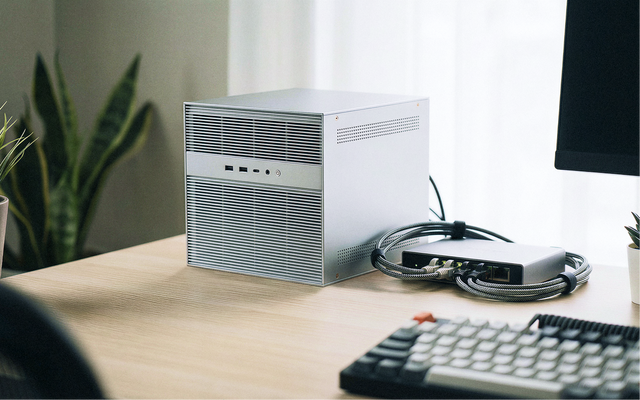
The Home AI Server Demand Forecast 2027: Why Private AI Workloads Are Moving Closer to Home
A 2027 forecast on why home AI server demand may grow as local LLMs, private RAG, media AI, automation, privacy needs, and cloud infrastructure...
AI Agent at Home: What Can It Actually Automate?
A practical guide to home AI agents, covering smart-home control, local files, private RAG, server reports, approval gates, and safe automation.
Mac + NAS for Local AI: A Better Private Workflow Than One Device Alone
Build a private Mac + NAS local AI workflow that separates Mac compute from NAS storage for RAG, models, outputs, backups, and agents.


