
Jev Use Cases: 7 Things People Are Already Building With TypeSafe’s Decision Model


Jev becomes easier to understand when you stop asking what it can say and start asking what software can let it decide. Developers are already using TypeSafe's decision model inside agent stacks, browser automation, ad analysis, lead scoring, games, content evaluation, and research triage.
The pattern is more important than any individual demo. Jev is not replacing code or frontier LLMs. It is targeting the fuzzy middle layer: decisions that are too subjective for a simple rule, too repetitive for humans, and too small to justify expensive generation every time. For the underlying model architecture and limitations, see our earlier explanation of decision models for AI agents.
What Makes a Good Jev Use Case?
The strongest public Jev builds share several characteristics: the valid outputs are known before inference, the same judgment happens repeatedly, latency matters, free-form text adds little value, and uncertain cases can be escalated elsewhere.
A useful test is simple: if you can define the valid answer space before the model runs, a decision model may be worth evaluating.
| Workload | Better Fit |
|---|---|
| Which agent should handle this? | Decision model |
| Which button should the browser click? | Decision model |
| Write the final customer email | Generative model |
| Explain a complex research paper | Generative / reasoning model |
This distinction becomes clearer in the projects people are already building.
1. OpenClaw: A Dedicated Decision Model Inside the Agent Stack
OpenClaw is one of the strongest signals that Jev is moving beyond experimental demos. Its current decision-model documentation separates the primary conversational model from a dedicated decision-model role.
The bundled TypeSafe plugin lets developers select Jev independently of the main LLM. A larger model can still plan, code, explain, and use tools while Jev handles narrower questions such as which agent should receive a task, whether evidence satisfies a condition, or whether a workflow should continue.
This is an important architectural shift. Instead of treating every ambiguous step as another prompt to the main LLM, an agent can reserve one model specifically for bounded judgments.
OpenClaw also preserves an important separation between deciding and acting. A Jev result can provide evidence that an action appears appropriate, but it should not automatically grant permission to publish content, send a message, or change durable state. Those actions still need to cross a separate tool-execution trust boundary.
That makes the decision model less like a smaller chatbot and more like another infrastructure component beside the primary agent model.
2. Browser Agents: Choosing the Next Click Instead of Describing the Page
Browser automation is naturally decision-heavy. At many steps, the agent already knows which elements are available and only needs to choose the next action.
Gregor Zunic published a Browser Use experiment where the browser provides DOM state, Jev selects the next action, and a smaller generative model handles cases that actually require text. In the public flight-search demo, the author reported roughly 7 seconds and $0.0039 total cost. These are builder-reported figures rather than an independent benchmark. See the Browser Use + Jev example.
| Browser Work | Best Role |
|---|---|
| Select next clickable element | Jev |
| Judge whether the goal is satisfied | Jev |
| Write an open-ended form response | Generative model |
The distinction matters because much of a browser loop is not asking the model to create language. It is repeatedly asking which action best advances the current goal.
That suggests a more efficient browser-agent design: use generation when the browser actually needs new text, and use bounded decisions when the next step already comes from a known set of actions.
3. Ad Analysis: Score the Whole Dataset Instead of Sampling It
Matthew Berman reported using Jev to classify 724 live ads from 37 brands across dimensions including hook, format, offer, CTA, awareness stage, and landing-page mismatch. The reported run took around 40 seconds and cost roughly $0.09. The figures are author-reported and collected on the public ad-analysis case.
The more interesting consequence is what happens when first-pass judgments become cheap enough.
| Expensive Analysis | Cheap Decision Layer |
|---|---|
| Collect 1,000 ads | Collect 1,000 ads |
| Sample 50 | Score all 1,000 |
| Infer patterns from the sample | Filter by structured signals |
| Spend expert time broadly | Inspect unusual or high-value clusters |
Analysts often sample because evaluating every record is too expensive. If a decision model can cheaply score every ad across the same dimensions, the workflow changes. Instead of using AI only to inspect a small sample, the complete dataset can receive a first-pass classification before a human looks at the most interesting clusters.
That is a larger change than simply making ad analysis cheaper: some sampling problems can become exhaustive-scoring problems.
4. Lead Scoring: Put the Cheap Decision Before Expensive Generation
A similar pattern appears in lead scoring. Romàn reported processing 700 leads in roughly 40 seconds for about $0.09, scoring fit, confidence, and mismatch before deciding which records deserved deeper attention. See the published lead-scoring experiment.
| Layer | Job |
|---|---|
| Jev | Filter, score, classify |
| Confidence rule | Decide what needs escalation |
| Large LLM | Generate high-value personalized output |
The practical value comes from changing where expensive generation happens. Instead of asking a capable LLM to deeply analyze and write personalized outreach for every record, the system can first identify the small subset that appears valuable or uncertain.
This is one reason hybrid AI cost strategy increasingly depends on routing. Cost optimization is not only about finding a cheaper model. It is also about deciding which requests need an expensive model at all.
In that architecture, Jev is most useful as a pre-filter rather than as the final intelligence layer.
5. Real-Time Games: Decision Frequency Changes the Economics
Real-time games look like novelty demos, but they expose why latency matters.
Max Blade published a Subway Surfers experiment running Jev across 50 games simultaneously, with the author reporting less than one cent of total inference cost. The figures are self-reported in the public game demo.
The action space is small: move left, move right, jump, duck, or continue. There is little benefit in producing a detailed natural-language description of every frame before choosing one of those actions.
This introduces a useful way to evaluate decision models: decision frequency.
Saving a few hundred milliseconds on one judgment per day has little practical value. Saving that latency across many decisions per second, multiplied across dozens of parallel environments, changes both response time and inference cost.
This is why fast decision models become more interesting as the same bounded judgment repeats more frequently.
6. Content Scoring: Ask Many Questions About the Same Draft
SuperX demonstrates another dimension of the problem. Instead of making the same decision very frequently, the system asks many different questions about the same input.
The public experiment evaluates a social post against 61 separate questions. The author reports approximately one second and $0.0004 per draft, using historical posts to help identify signals associated with stronger performance. These results are product-author claims rather than independent benchmarks. The project appears in the content-and-growth case directory.
Instead of asking a vague question such as “Is this a good post?”, the application can break the draft into more explicit judgments:
- Is the hook specific?
- Is there a curiosity gap?
- Is the claim concrete?
- Does the copy sound overly promotional?
- Is the CTA too aggressive?
The result is not one opaque AI score. It is a structured profile that software can use to identify which dimension needs rewriting, compare two drafts, or decide whether human review is necessary.
This makes decision dimensionality another important variable. A model can become useful not only because the same judgment happens often, but because dozens of bounded judgments can be applied cheaply to the same state.
7. Research Classification: Triage Everything, Then Read What Matters
A public project called 1kpapers used Jev to classify 1,018 AI research papers. Published figures report about $0.08 total cost and roughly 256ms median end-to-end latency per paper. The project is listed in the Made with Jev sites directory.
This may be one of the more practical examples because many real workflows begin with too many records: papers, emails, support tickets, reviews, documents, logs, or search queries.
The expensive part is often not understanding one item. It is deciding which items deserve deeper attention.
| First Pass | Second Pass |
|---|---|
| Classify topic | Read selected documents deeply |
| Score relevance | Send high-value records to a larger model |
| Detect obvious mismatch | Human reviews ambiguous cases |
| Estimate confidence | Escalate uncertain records |
This becomes especially useful when the source data is private. A private AI assistant can keep retrieval and the raw document library local, while only selected or derived evidence is sent to an external service when necessary.
The model does not need to replace deep reading. Its role is to make deep reading selective.
The Real Pattern: Decision Density
The seven examples look unrelated, but structurally they are very similar. Each starts with messy state and repeatedly asks questions whose answer space is already constrained.
A useful way to describe that is decision density: how many bounded judgments a system needs to make over a given workload.
Two factors matter most:
- frequency: how often the application needs a judgment;
- dimensionality: how many judgments it needs about each state.
| Workload | Decision Density | Jev Fit |
|---|---|---|
| One yes/no check per day | Low | Weak advantage |
| 1,000 emails to classify | High frequency | Strong |
| 61 questions per draft | High dimensionality | Strong |
| Browser action every step | High frequency | Strong |
| Many parallel games | Very high frequency | Very strong structural fit |
| Write a detailed report | Generation-heavy | Poor fit |
A single binary decision is unlikely to justify redesigning an AI stack. Thousands of fuzzy decisions, or dozens of judgments against every input, are a different problem.
The higher the decision density, the more attractive a specialized decision layer becomes.
The Strongest Architecture May Be Jev First, Larger Model Second
Decision models also do not need to solve every case. Confidence can determine when a more capable model should take over.
A public fraud-detection experiment illustrates this pattern. The builder first used Jev on 100 emails, then routed predictions below a 95% confidence threshold to the larger Kimi K3 model. The author reported 31 escalations, 96/100 final accuracy, and roughly $0.07 total cost. These figures remain experimental and self-reported; the case is listed in the Jev engineering directory.
| Stage | Purpose |
|---|---|
| Cheap decision model | Handle obvious cases |
| Confidence threshold | Detect uncertainty |
| Large reasoning model | Handle difficult cases |
| Policy / human layer | Retain authority where errors matter |
This architecture is more interesting than trying to maximize Jev's standalone accuracy. A cheaper model can handle the easy majority while a more expensive model receives only the ambiguous tail.
Even then, confidence should not automatically become authority. read-only agent tools and scoped permissions still matter when a classification can eventually trigger a real-world action.
Cheap Decisions Do Not Make Bad Signals Good
Early Jev discussion has already expanded into areas such as automated labeling and trading. Both fit the decision-model interface, but that does not make every claim around them equally credible.
For data labeling, the strongest near-term design is not necessarily to replace human annotators. High-confidence cases can be labeled automatically, medium-confidence examples can receive a second-model review, and ambiguous records can still go to a human.
That changes which examples humans spend time on rather than assuming humans disappear from the workflow.
Trading has an even clearer limitation. Producing buy, sell, or hold quickly is easy to frame as a bounded decision. The difficult problem is whether the input data contains a real predictive edge.
Jev can make a market decision cheap. It cannot make weak signals predictive.
The same distinction applies to most of the examples above. Low latency and low inference cost show that a decision layer is efficient. They do not, by themselves, prove that the underlying judgment creates business value.
Where Jev Fits in a Local AI Agent
Jev itself is currently a hosted service rather than a public self-hosted checkpoint. That creates an important boundary for local AI.
A local agent may keep files, memory, retrieval, and tools on a home server, but if document content is sent to Jev for classification, that evidence has crossed the network boundary.
| Keep Local | Potential Hosted Decision Input |
|---|---|
| Full private document library | Selected or derived evidence |
| Raw source files | Minimal task state |
| Personal memory | Non-sensitive classification context |
| Credentials and secrets | Should not be required for ordinary classification |
The same principle applies when using cloud tools with local files: a local runtime does not automatically guarantee a local data path.
A stronger hybrid design keeps private retrieval, preprocessing, redaction, and routine local operations close to the data, then sends only the minimum evidence required by the hosted decision or reasoning model.
What the First Jev Builds Actually Tell Us
The first wave of Jev experiments does not show that a small decision model can replace frontier AI.
It shows something more useful: many AI applications are spending generative-model compute on tasks that do not require generation.
Across browsers, ads, leads, games, content, research, and agent orchestration, the same structure keeps appearing. The input is messy, but the possible outputs are constrained. The judgment happens repeatedly, and uncertain cases can be escalated.
| Layer | Best Job |
|---|---|
| Rules / code | Deterministic decisions |
| Decision model | Fuzzy bounded judgments |
| Reasoning model | Difficult ambiguous problems |
| Generative model | Create language, code, or media |
| Policy layer | Decide what is actually allowed to execute |
The most useful Jev demos are therefore not the ones trying to prove that Jev can do everything.
They are the ones showing where a general-purpose LLM does not need to be involved at all.
Jev becomes most useful where software needs thousands of fuzzy but bounded decisions—and almost no words.
Frequently Asked Questions About Jev Use Cases
Can Jev work with OpenClaw?
Yes. OpenClaw supports a dedicated decision-model role and a TypeSafe plugin that can use Jev separately from the primary conversational model.
Can Jev control a browser agent?
Yes. Public Browser Use experiments have used Jev to select the next action from a bounded DOM action space, while generative models handle open-ended text when needed.
Can Jev analyze ads, posts, or large datasets?
Yes. Public builds have used Jev for ad classification, content scoring, email triage, research-paper classification, and other high-volume structured judgments. Most published speed and cost figures are currently builder-reported rather than independently benchmarked.
Can Jev replace human data labeling?
It can potentially automate confident bounded labels, but current evidence does not support precise claims about replacing a particular percentage of human annotators. Confidence-based escalation is a more realistic design.
Can Jev run locally?
TypeSafe has not released public Jev weights for self-hosting. Current Jev integrations use hosted inference, so private-agent designs should control exactly what evidence is sent outside the local environment.

Recommended products

Tech & AI HUB
More to Read

Top 10 Open-Source AI Coding Assistants in 2026
Compare 10 open-source AI coding assistants for IDEs, terminals, local models, self-hosting, Git workflows, and autonomous development.
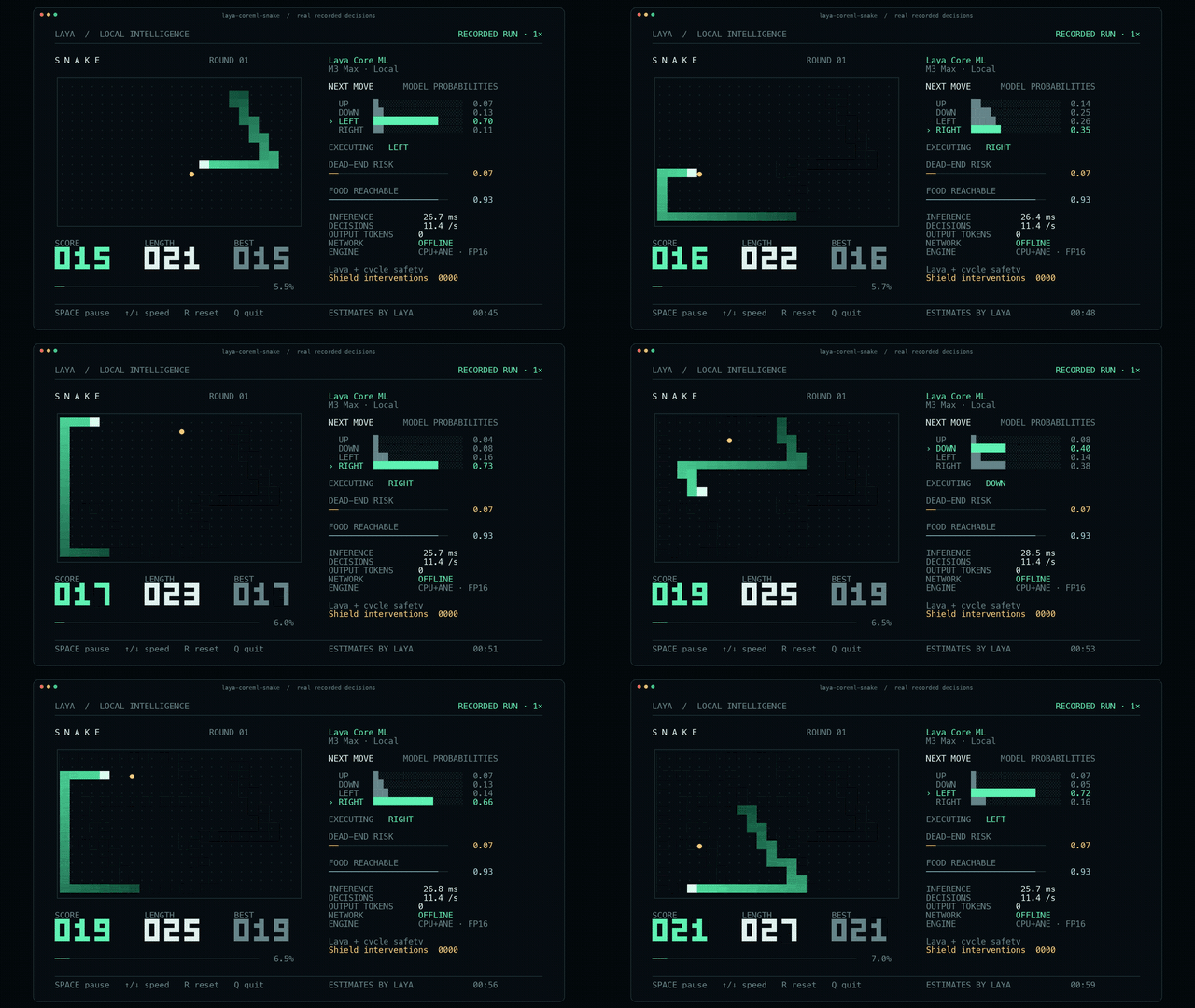
Laya Model Explained: The Open-Source Decision Model You Can Run Locall
Laya is a 421M open decision model for fast local routing and scoring, offering a self-hosted alternative to cloud-based decision APIs.

Why Is Home NVR AI Shifting From Frame Detection to Event Understanding in 2026?
Understand how tracks become events, why temporal context reduces repetitive alerts, and where event-aware video AI still fails.


