


A Dell R710 Runs ZimaOS for Private Git, Files and ZVM


Thank you to u/officerdown_dev for sharing a ZimaOS server with a clear development purpose. A Dell PowerEdge R710 with dual Xeons and 192 GB of RAM serves private Git repositories and general files, while ZVM provides the virtual-machine feature the creator values most.
The original Reddit contribution also describes the awkward part: moving from a Mac mini did not deliver the seamless full-system recovery experience the owner wanted. Together, the working services and migration feedback make this a story about operating a personal development server, rather than treating a large memory figure as its purpose.
An Operating-System Developer Wanted a Private Git Server
The creator identifies as an operating-system developer and gives private Git hosting a central place in the setup. Keeping repositories on a server under personal control suited that workflow. General file serving supplied a second everyday role for the same machine.
The contribution does not identify a particular operating-system project, a team size or a commercial production environment. Those details are unnecessary to understand the motivation. Source code needs an accessible home, and the creator wanted that home to be private.
| Component or service | Configuration described in the post |
|---|---|
| Host | Dell PowerEdge R710 |
| Processors | Dual Xeons; exact models not specified |
| Memory | 192 GB reported by the owner |
| Storage at posting | One 250 GB SSD, with an upgrade planned |
| ZimaOS roles | Private Git hosting, general files and ZVM experiments |
| Previous machine | Mac mini |
The contrast between 192 GB RAM and a 250 GB SSD is part of the story. Compute resources and retained storage had not grown together. The owner explicitly planned to improve storage, so the small SSD should not be presented as a final architecture or a recommended capacity for every developer.
The Dashboard Connects the Hardware to Everyday Services
The supplied image shows ZimaOS running with application entries including Gitea, Nextcloud, Nginx Proxy Manager and ZVM. Gitea’s presence supports the stated Git-server role, while the wider collection shows the machine being explored beyond one application.

An application tile does not establish how it is exposed, who has an account or whether every feature has been configured. The post supplies the dependable description of the main jobs: Git and files. The screenshot supplies visual context for the interface used to manage them.
This distinction also applies to resource indicators. The image is not a wall-power test, a sustained CPU-load measurement or a capacity study. Readers can understand the deployment without converting a momentary dashboard value into an efficiency claim for an enterprise rack server.
The small homelab story from u/jc-21 provides another example of explaining a server through its assigned services. Here, the much larger memory allocation matters less to the narrative than the private development workflow it supports.
ZVM Was the Feature the Creator Kept Coming Back To
The owner singles out ZVM as the favorite ZimaOS feature and describes its QEMU integration as suitable for the work being done. That is a personal assessment of the environment, rather than a comparison against every other virtualization platform.
Compare Plans
ZimaOS
- Core features
- Zima Client for Mobile & PC
- Thunderbolt Support
- Developer Mode
- 4 Disks
- 3 Members
ZimaOS+
Effortless expansion
- Everything in Free
- Unlimited Disks
- Unlimited Users
A VM gives an experiment its own guest environment. It can be useful when a task requires a different operating system or a more separate software installation than another host application. The source does not list guest operating systems, virtual disks, CPU assignments or the number of simultaneous guests.
The official discussion of ZVM’s development provides current product context, including features that may be previews. It should be read separately from this earlier personal report. A feature described in a later roadmap cannot be assumed to have existed in the owner’s captured installation.
For a reader planning a similar role, the concrete next question is what each guest must retain and how it can be restored. Assigning memory is only one part of that decision. VM disks, credentials and configuration have to survive the same host changes that affect the rest of the server.
AI Was a Stress Test, Not the Development Workflow
The creator had also tested AI, but explicitly frames it as a way to stress the machine rather than a coding assistant. That boundary deserves to remain intact. It would be misleading to retell this as an AI-assisted operating-system development case.
No model name, parameter size, quantization, accelerator configuration or generation rate is supplied. The presence of AI-related applications in the image does not fill those gaps. This is evidence of experimentation, without the information needed for a local-model performance recommendation.
The distinction helps keep the server’s purpose readable. Private source hosting is an ongoing service; an AI load test is an experiment. They can share hardware, but their success criteria differ. A repository should be available when the developer needs it, whereas a stress test deliberately asks what happens under pressure.
The Difficult Move Exposed a Recovery Requirement
Migration from the Mac mini to the R710 was the owner’s main criticism. The desired experience was an encrypted, full-system backup that another installation could retrieve during setup to reproduce the previous server. The creator had encountered that pattern elsewhere and wanted a smoother equivalent.
This feedback concerns a particular migration and the software experience at the time of posting. It is not a current feature inventory for every ZimaOS release. Readers checking today’s options should consult the current ZimaSpace documentation and distinguish file recovery, application recovery and a complete machine replacement.
Those are different scopes. A folder copy can preserve documents while missing a service database or an application’s configuration. A Git clone preserves repository history but does not necessarily include a hosting service’s users, issues, access settings and other retained information.
The Gitea backup and restore guide is the appropriate application reference when Gitea is used. It helps identify the service data that must accompany repositories. This is a recovery consideration for readers, not a claim that the creator already performed the documented procedure.
A related experience appears in the ZimaBlade family photo server troubleshooting story: an archive can exist while important application data remains outside it. Both accounts make the desired recovered service a better starting point than the mere existence of a backup file.
Software Choice and Hardware Choice Can Be Evaluated Separately
The actual machine in this story is the Dell R710. Its appeal to this owner does not establish its suitability for a quiet room, a particular electricity budget or a different storage requirement. The post supplies no acoustic or whole-system power measurements.
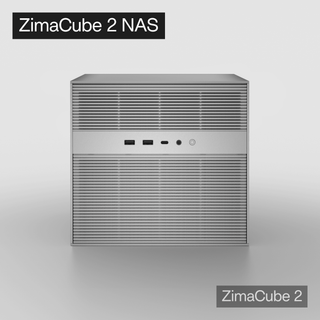
Readers comparing an integrated storage platform can review the ZimaCube 2 personal cloud NAS as a separate hardware option. It is not the creator’s machine. Start that comparison with the jobs to retain: private source hosting, file capacity, guest requirements and the process for replacing a failed installation.
FAQ
Which hardware actually runs ZimaOS here?
The owner reports a Dell PowerEdge R710 with dual Xeons, 192 GB RAM and a 250 GB SSD. Exact CPU models and a completed storage upgrade are not given.
Was AI being used to write the creator’s operating system?
No. The contribution explicitly describes AI testing as a server stress test rather than coding assistance. It supplies no reproducible model benchmark.
What was the main complaint about moving servers?
The creator wanted a smoother encrypted full-system backup and restore experience when migrating from a Mac mini. The report is historical feedback, not a statement of every current release’s capabilities.
Does the image show the physical rack server?
No. The original illustration is a ZimaOS dashboard screenshot. The two image URLs supplied with the post resolve to the same image, so it appears once in the article body.
Conclusion
The R710 gave this developer a private home for source code, general files and virtual-machine experiments. ZVM was the standout feature, while the move from a previous machine revealed how much the owner valued a complete recovery path.
The useful planning question follows directly from that experience: what would have to return on a replacement server for development to continue? Answering it connects repositories, application data and guest environments more clearly than a hardware specification alone.
Welcome to the ZimaSpace community! Share your setup, ask questions, and explore practical build guides, real user stories, and product updates with fellow self-hosters.

Recommended products
Zima Campaign Hub
More to Read
A First ZimaOS Media Server: Jellyfin, Pi-hole and a RAID Plan
Freeariello’s i5-8400 ZimaOS media server brings together Jellyfin and Pi-hole, with a two-drive RAID 0 setup and a larger RAID 5 array still planned.
A ZimaBoard 2 Becomes a Remote Build Server for a Small VPS
Dima’s ZimaBoard 2 grows from DNS and media experiments into a Dokploy build server, with Tailscale connectivity and a resource-allocated ZVM guest.
A ZimaBoard 2 Prototype with Two 22 TB Drives on the Test Bench
Explore sabitech2k’s early ZimaBoard 2 drive test, the reported power conditions, and the existing ZimaBoard used for Proxmox backups.


