
OpenSearchCon 2026: Why AI Agents Need More Than a Vector Database


OpenSearchCon North America 2026 arrives as “search” becomes a much bigger problem than finding similar documents. AI agents need to retrieve evidence, preserve useful context, call tools and explain what happened when a task goes wrong.
A vector database solves part of that problem. A serious agent also needs exact retrieval, metadata, freshness, memory, execution traces and permissions. The emerging AI data layer looks less like “embeddings in a database” and more like search + memory + observability.
OpenSearchCon 2026 Shows What Search Is Becoming
OpenSearchCon North America 2026 takes place September 22–24 in San Jose, California.
The agenda still includes relevance, Lucene, cluster operations and traditional observability, but much of the 2026 discussion now reaches into RAG, hybrid retrieval, vector performance, MCP and AI-agent observability.
That direction matches the project's 2026 roadmap, which treats AI agents as a new class of search user and includes agentic context, memory, tool routing and MCP.
The important shift is not that OpenSearch added AI features.
Search is becoming infrastructure for systems that retrieve information and then act on it.
A Serious AI Agent Needs Two Searchable Histories
Most RAG tutorials focus on one question:
What should the model know?
Long-running agents introduce another:
What did the agent actually do?
| Index | Main Question | Typical Data |
|---|---|---|
| Knowledge Index | What evidence should the agent retrieve? | Documents, chunks, embeddings, metadata, versions, permissions |
| Execution Index | What happened during the task? | Model calls, retrievals, tool calls, latency, tokens, errors, retries |
The first improves answers. The second makes the system diagnosable.
This matters because a final chat message can hide a failed workflow. An agent may claim a task is complete even if it retrieved the wrong context, selected the wrong tool or never performed the expected action.
OpenSearchCon has a session dedicated to exactly this problem: Watching AI Workers: OpenSearch Observability for OpenClaw and Hermes-agent.
The described failure case is important because the remedy was not a better chat transcript. It was operational telemetry: model invocations, context retrieval and tool calls represented as traces.
An agent creates two kinds of searchable history: what it knew and what it did.
Many RAG Failures Happen Before the LLM Sees Anything
When a RAG answer is wrong, replacing the language model is an obvious reaction. It may also be the wrong layer to fix.
OpenSearchCon's Fix Your Retrieval, Fix Your RAG session makes the argument directly: many apparent generation failures originate in the retrieval layer that decides which evidence ever reaches the model.
| Retrieval Failure | User Sees | Real Problem |
|---|---|---|
| Wrong document ranks first | Confident irrelevant answer | Ranking |
| Correct source ranks too low | Missing information | Recall |
| Old version wins | Outdated answer | Freshness and metadata |
| Chunk loses context | Partially correct answer | Chunking and structure |
| Exact identifier disappears | Wrong technical diagnosis | Lexical retrieval |
| No judged test set exists | “It feels better” | Retrieval evaluation |
The debugging rule is simple:
the model cannot reason over evidence that retrieval never placed in its context.
Production RAG also needs the result to be current, not merely semantically similar. A document for software version 2.0 may be very close in embedding space to version 4.0 while still giving the agent the wrong procedure.
Useful retrieval metadata can therefore include:
- version,
- publication date,
- product or environment,
- document status,
- source authority,
- and access permissions.
Retrieval quality is relevance in the correct context.
Keyword Search Did Not Lose to Vector Search
The vector-search boom encouraged a simple story: keyword search was old, embeddings were the replacement.
Technical retrieval makes that distinction much less clean.
| Query Type | Lexical Search | Vector Search |
|---|---|---|
| Error code | Excellent | Variable |
| Product/model number | Excellent | Variable |
| Function or API name | Excellent | Depends |
| Natural-language intent | Moderate | Excellent |
| Conceptually similar wording | Weak to moderate | Excellent |
A query such as RTX 5090 CUDA error 802 contains both semantic meaning and exact tokens that should not disappear into approximate similarity.
This is why OpenSearchCon continues to emphasize hybrid retrieval. The hard part is not merely running keyword and vector search together; it is deciding how their scores should be normalized, ranked and combined.
The useful choice is no longer keyword or vector. It is how much exactness and semantic meaning each query requires.
Vector Search Has Its Own Memory Budget
Local AI hardware discussions usually start with model RAM and VRAM. RAG introduces another memory consumer: retrieval.
Vector-search sessions at OpenSearchCon increasingly discuss graph memory, compression, recall, throughput and P99 latency together. At larger embedding scales, memory becomes part of search architecture rather than an implementation detail.
| Local AI Component | Primary Resource Pressure |
|---|---|
| LLM | RAM / VRAM |
| Embedding model | RAM / VRAM |
| OpenSearch | JVM heap and system memory |
| Vector indexes | Memory and storage |
| Document cache | Memory |
| Agent tools | CPU, RAM and service-specific resources |
The practical implication is straightforward:
a local RAG server needs a retrieval budget as well as a model budget.
“Can this machine load my model?” is no longer sufficient sizing guidance when the same host is also embedding documents, maintaining indexes and running agents.
Agents Turn Observability Into Part of the Data Layer
Traditional observability asks whether a request failed, which service was slow and what the logs say.
An agent adds model calls, retrieval decisions and tool execution.
| Traditional Software | Agentic System |
|---|---|
| Request | Agent task |
| Function call | Tool call |
| Service latency | Model + retrieval + tool latency |
| Error | Model, search or tool failure |
| Infrastructure usage | Infrastructure + token usage |
| Distributed trace | Agent execution trace |
The current OpenSearch Agent Traces uses OpenTelemetry conventions to represent agent, LLM, retrieval, embedding and tool operations.
This makes much more specific questions possible:
- Did retrieval take too long?
- Did the agent call the same tool repeatedly?
- Did a retry loop increase token usage?
- Did the model make a valid choice but the tool fail?
- Did a new agent version change execution behavior?
Persistent memory creates a related lifecycle problem. Keeping everything forever increases storage use and allows old context to remain searchable; deleting too aggressively makes the agent repeatedly relearn useful information.
That means agent memory needs explicit rules for:
- what becomes long-term memory,
- what can expire,
- what belongs in an audit history,
- and what should stop influencing future retrieval.
Agent memory is not only a retrieval feature. It is a data-lifecycle policy.
Search Becomes a Security Boundary When the Searcher Can Act
A human searching for failed backups and an agent searching for failed backups create different risk.
The human may inspect the result. The agent may use the result to call another tool.
OpenSearch includes an MCP server that can expose search, PPL, SQL and cluster information to compatible agents.
| Traditional Search | Agentic Search |
|---|---|
| Can this user access the index? | What can this agent retrieve? |
| Can this query be executed? | Which search tools can the agent call? |
| Can this record be read? | What action could follow from reading it? |
Once retrieval becomes part of an action loop, search permissions become part of the agent's capability boundary.
Three Real Self-Hosted AI Cases That Show Why the Data Layer Matters
The distinction between model, retrieval and agent state becomes easier to understand in real self-hosted systems.
1. A private RAG workspace has a data workload separate from inference
AnythingLLM is a useful example. The application can manage documents, embeddings and retrieval while the language model runs locally, remotely or through an API.
The current AnythingLLM RAG hardware guide makes the separation explicit: document ingestion, local embeddings, vector data and persistent storage create their own resource requirements, while local model inference must be sized separately.
This is exactly the mistake the OpenSearchCon discussion helps clarify.
A RAG system does not have one hardware requirement. It has at least two:
- the model workload,
- and the knowledge/retrieval workload.
As the document collection grows, ingestion, indexing, metadata and backup can become bottlenecks even when the language model does not change.
2. A 24/7 agent creates persistent execution state
OpenClaw illustrates the other side of the Two Indexes model.
A self-hosted OpenClaw gateway can maintain persistent conversations, run tool calls, execute scheduled tasks, receive webhooks and coordinate multiple agent workflows. The private AI agent gateway guide treats the agent as an always-on service rather than a chat window that disappears when a laptop closes.
That persistence creates operational questions that ordinary chat does not:
- Which tool did the agent call?
- Which task failed overnight?
- How many times was an operation retried?
- Which context was loaded before the decision?
- Did the agent report success without completing the action?
This is why the OpenSearchCon OpenClaw/Hermes observability session is particularly relevant to self-hosted agents. Once the agent works unattended, execution history becomes infrastructure, not debugging trivia.
3. Persistent memory becomes part of the workspace architecture
A real Hermes workflow shows a third pattern. Instead of putting everything inside one opaque agent database, a private AI agent workspace can separate the agent runtime, human-readable Markdown memory, Git history, communication channels and always-on storage.
That architecture is useful because “agent memory” is not necessarily one monolithic vector store.
Different information may deserve different lifecycle rules:
| Data | Reason to Keep It |
|---|---|
| Working context | Short-term task continuity |
| Curated notes | Long-term knowledge |
| Git history | Review and rollback |
| Agent traces | Operational investigation |
| Raw tool output | Temporary evidence or debugging |
The best memory architecture may not be “store everything forever.” It is deciding what type of state each piece of information actually is.
When Does Self-Hosting OpenSearch Actually Make Sense?
Those examples do not mean every local AI server should install OpenSearch.
| Use Case | OpenSearch Fit |
|---|---|
| Chat with a few dozen PDFs | Probably excessive |
| Small personal notes RAG | Simpler options usually exist |
| Large evolving document collection | Useful |
| Keyword + semantic retrieval | Strong fit |
| Several apps sharing a knowledge index | Strong fit |
| Logs, traces and search in one platform | Strong fit |
| Agent memory and execution analysis | Potentially strong fit |
OpenSearch itself is stateful infrastructure. Running it means owning indexes, JVM memory, persistent storage, snapshots, retention, permissions, upgrades and recovery.
The local OpenSearch Observability Stack can run through Docker Compose, but the official installation prerequisites already call for at least 8 GB of available RAM.
Before deploying it, ask:
- How much data am I actually indexing?
- Do I need keyword and semantic retrieval together?
- Will the same data platform also hold logs, traces or agent state?
- Am I willing to operate another stateful service?
The useful question is not “can I run OpenSearch at home?” It is “does my AI stack have enough retrieval and observability complexity to justify it?”
Size the AI Server for More Than the Model
Once local AI grows beyond a chat interface, hardware planning changes.
A larger RAG or agent server may need resources for:
- model inference,
- embeddings,
- search indexes,
- document storage,
- databases,
- agent runtimes,
- logs and traces,
- and backups.
The current Open WebUI hardware sizing guide illustrates the same pattern: application memory, document processing, embeddings and RAG storage are separate from the much larger memory or VRAM requirements of a local LLM.
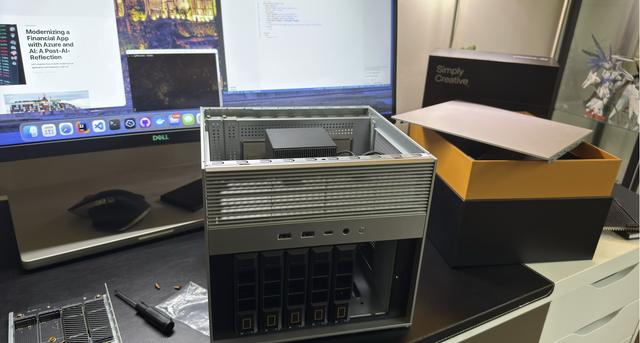
For workloads that genuinely need larger system memory, multi-drive datasets and compatible GPU inference on one machine, a storage-rich local AI server can consolidate those layers. But the hardware should be chosen from the actual model, vector corpus, retention period and concurrency rather than from the label “AI server.”
More GPU does not solve an undersized search index, and more storage does not solve insufficient model memory.
The AI Server Needs a Data Layer, Not Just a Bigger Model
Local AI discussions naturally focus on models because models dominate benchmark charts.
But long-running RAG and agent systems gradually accumulate another infrastructure layer:
- documents and metadata,
- lexical and vector indexes,
- agent memory,
- tool integrations,
- logs and execution traces,
- permissions,
- and retention policies.
The model generates the answer. The data layer determines what evidence reaches it, which context survives and whether anyone can explain what happened when the agent behaves unexpectedly.
This is the larger story behind OpenSearchCon 2026.
AI agents are turning search from a feature into infrastructure.
A serious agent therefore needs reliable answers to two persistent questions:
- What should this agent know right now?
- What did this agent actually do?
A vector database can help with the first. Production agent infrastructure eventually has to answer both.
FAQ
When is OpenSearchCon North America 2026?
OpenSearchCon North America 2026 takes place September 22–24 in San Jose, California. The conference covers open-source search, observability, vector retrieval, RAG and agentic AI.
Is OpenSearch a vector database?
OpenSearch can store and search vector embeddings, but it is broader than a dedicated vector database. It also supports lexical search, hybrid retrieval, metadata filtering, analytics and observability workloads.
Is OpenSearch good for RAG?
It can be a strong fit when RAG requires hybrid search, metadata and version filtering, relevance evaluation or a large changing document collection. Smaller personal RAG systems may be easier to operate with lighter infrastructure.
What is hybrid search in OpenSearch?
Hybrid search combines lexical signals such as BM25 with semantic or vector retrieval. It is especially useful when a query contains both exact technical identifiers and broader natural-language intent.
Can OpenSearch monitor AI agents?
Yes. OpenSearch Agent Traces uses OpenTelemetry-based telemetry to expose model calls, retrievals and tool use together with latency and token information.
Does OpenSearch support MCP?
Yes. OpenSearch provides MCP capabilities that allow compatible agents to access search, PPL, SQL and other data tools. Permissions remain important because retrieved information can feed directly into agent actions.
Do I need OpenSearch for a local RAG server?
Not necessarily. A small personal document collection can usually use simpler retrieval infrastructure. OpenSearch becomes more compelling when the system needs larger evolving indexes, hybrid search, shared knowledge, observability or multiple agent workloads.
How much RAM does self-hosted OpenSearch need?
Requirements depend on index size, vector dimensions, query load and retention. The current local OpenSearch Observability Stack lists at least 8 GB of available RAM as a prerequisite, while larger vector and telemetry workloads can require substantially more.

Recommended products

Zima Campaign Hub
More to Read
Programmers’ Day 2026: Why 256 Matters—and What to Build
Celebrate Day 256 with a 256-minute build challenge: solve one real problem, move beyond localhost, and keep one useful side project running.

National Video Games Day 2026: Build Your Own Gaming Home Server
Turn a home server into gaming infrastructure for retro libraries, PC streaming, private multiplayer servers and save backups.

IBC2026 Amsterdam: AI Media Workflows, Local Storage, and Creator Tech Trends
IBC2026 shows how AI indexing, agentic production, open media workflows and content provenance are reshaping media infrastructure. This guide translates those broadcast-scale trends into...


