
Consumer SSD vs CMR HDD Array for 24/7 Download Churn


A consumer SSD is best for a bounded, latency-sensitive active set; a CMR HDD array is usually better for large retained downloads and predictable capacity cost.
Continuous downloading is not automatically a high-endurance workload. The real variables are bytes written per day, temporary-file amplification, verification passes, random access from concurrent users, retention, and how quickly deleted space returns. Measure those before choosing media.
Translate Download Churn Into Daily Writes
Record completed bytes, temporary data, unpacking, repair, and rechecks for at least one busy week. A 500 GB daily download can create materially more device traffic if archives are unpacked on the same volume or the client rewrites pieces during verification.
For an SSD, compare projected writes with the model's TBW warranty and leave capacity free for garbage collection. TBW is a useful boundary, but SSD endurance and thermal throttling also vary with controller behavior, temperature, and the workload's write pattern.
For HDDs, daily writes are less useful than sustained duty, vibration, workload rating, and rebuild exposure. The correct comparison is the measured job against a specific drive specification, not a generic belief that one medium lasts forever.
Separate the Active Queue From the Retained Library
Download queues, unpack directories, and frequently rescanned metadata benefit from low latency. Completed media that is read sequentially and retained for months mainly needs capacity and adequate streaming throughput.
That split often makes a hybrid layout stronger than either pure option: a bounded SSD working tier for incomplete jobs and scratch activity, then an automated move to a CMR array after verification. The SSD is protected from becoming the entire archive, while the array avoids the noisiest small-write phase.
If the active set never exceeds a few terabytes and silence matters, an all-SSD pool may still win. If completed data rapidly outgrows the active queue, pay for HDD capacity and size the SSD only for the queue.
Compare Latency, Noise, and Failure Behavior
SSDs remove seek noise and handle many concurrent file operations well. HDD arrays can sustain large sequential transfers, but parity activity, verification, and multiple readers turn into head movement and audible vibration.
Failure statistics are population evidence, not a guarantee for one model. Operator data such as large-fleet SSD reliability observations is most useful for understanding failure modes and the importance of monitoring, not for predicting an exact home-server lifespan.
| Workload trait | Consumer SSD | CMR HDD array |
|---|---|---|
| Small random I/O | Strong | Mechanical seek penalty |
| Acoustics | Silent | Seek and vibration noise |
| Capacity cost | Higher | Lower |
| Write boundary | TBW and warranty | Model workload rating |
| Failure recovery | Fast copy if capacity is small | Longer rebuild at high capacities |

Make Recovery Time Part of the Choice
A download library may be replaceable, but configuration, watch state, private metadata, and irreplaceable uploads may not be. Put those roles on a protected application-data tier and back them up separately from the bulk queue.
An SSD failure can remove the entire active set instantly; an HDD failure can leave an array degraded for a long rebuild. Test restoring the download client database, then decide whether unfinished payloads are worth backing up or simply redownloading.
If small-file copies are a material part of the workload, use this small-file SMB testing workflow to distinguish network overhead from storage-media limits before spending money.
Choose by the Boundary That Breaks First
Choose consumer SSDs when projected warranty writes remain comfortable, the working set is bounded, random I/O affects users, and silence or compactness has real value. Keep spare capacity and monitor wear indicators.
Choose a CMR HDD array when retained capacity dominates, downloads are mostly sequential, and you can tolerate vibration, parity overhead, and longer rebuilds. Verify that every drive is CMR; mixing in drive-managed shingled media can make sustained rewrites and rebuilds unpredictable.
Use a hybrid tier when neither boundary is negotiable. Stop adding SSD capacity once archive growth, not queue latency, becomes the cost driver; stop adding HDDs when noise, power, or recovery time exceeds the room and backup plan.

Recommended products

Product Comparisons
More to Read
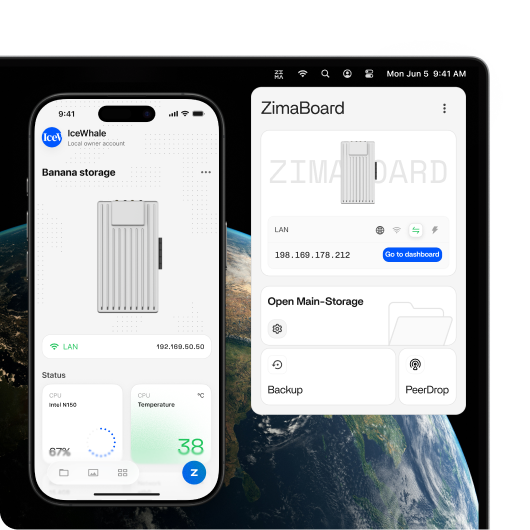
LXC vs Docker on Proxmox for App Updates and Rollbacks
Docker gives app-level version control; LXC gives guest-level rollback. The better fit follows the smallest state unit you can restore safely.
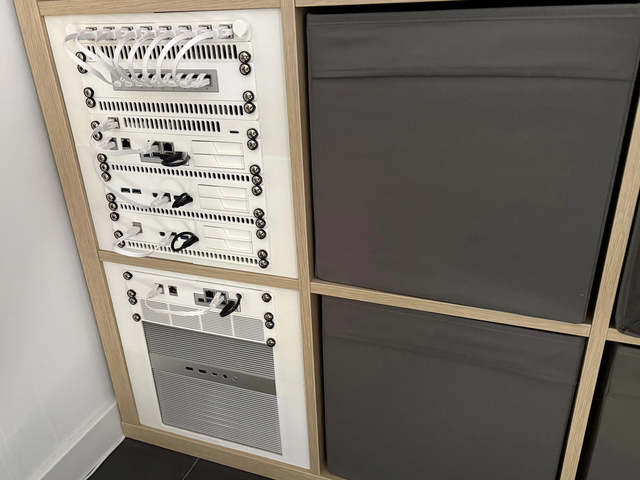
Docker vs LXC Security Boundaries for Privileged Home Services
Docker fits narrowly packaged apps; LXC fits fuller Linux services, but neither replaces a VM when shared-kernel risk is unacceptable.
Turnkey NAS OS vs Modular Linux for a First-Time Builder
Choose turnkey NAS software for guided storage operations; choose modular Linux when learning and explicit control justify more ownership.


