
What Is Atlas World Model? How AI Is Learning to Predict and Understand Environments


Atlas does not replace a language model; it adds a spatial prediction layer that models how an observed environment could look and change.
Imagine a home robot or camera agent that sees one side of a room but must reason about a route beyond the frame. Text knowledge alone cannot supply a measured map of that specific space. Atlas points toward systems that combine observations with camera geometry and depth, although its early-access status means the idea is currently easier to evaluate than to deploy.
What Is Atlas World Model?
Atlas is World Labs’ next-generation world model for spatial intelligence, introduced on September 1, 2026. It accepts several kinds of context and produces several kinds of world-related output. Instead of treating an image as a flat picture alone, the model relates visual observations to camera position, viewing direction, and depth so the requested output can remain connected to a scene.
World Labs describes the architecture as a multimodal autoregressive diffusion transformer. Multimodal means the same system can operate on text, images, image sequences, camera poses, and 3D depth maps. Autoregressive means it generates the next element from the preceding sequence. Diffusion supplies a way to form high-dimensional visual outputs through iterative denoising, while the transformer provides the scalable computation backbone.
The release is an early-access model for selected partners, not a generally downloadable checkpoint. Atlas is intended to power later versions of Marble and other World Labs products, but the announcement does not disclose parameter count, model weights, local hardware requirements, pricing, rate limits, or a general production service level. Those omissions prevent any responsible claim that Atlas itself can run on a home server today.
A World Model Does Not Replace an LLM
An LLM primarily learns relationships in token sequences and generates a likely continuation from its context. A world model targets some representation of an environment and how that state changes. The boundary is functional rather than architectural: both may use transformers, both may contain useful knowledge, and both are predictive. What changes is the state being represented, the available controls, and the output against which the prediction can be tested.
The influential 2018 World Models work showed why this distinction matters. Its agent learned a compressed spatial and temporal representation of an environment and could train a compact policy inside imagined rollouts before transferring that policy back to the actual environment. The key idea was not photorealistic video. It was that a learned dynamics model could provide consequences for candidate behavior without requiring every trial to occur in the real system.
That makes world models and LLMs complementary. An LLM can interpret a goal, decompose instructions, call tools, or explain a plan. A world model can estimate how a particular scene may evolve when the camera moves or an action changes state. A planner can compare those predicted futures, while sensors verify the selected action. The useful agent stack joins these roles instead of asking one model family to impersonate all of them.
How Atlas Turns Observations Into Spatial Context
Atlas begins with observations plus spatial grounding. Each image or depth map can be paired with an explicit camera pose, which tells the model where the observation was captured and how the camera was oriented. Multiple views therefore become more than a loose collage. They provide constraints on which pixels may correspond to the same surface, how objects are arranged, and which regions remain hidden.
The inputs are combined into a shared spatial context, then Atlas generates multimodal sequence elements one at a time. When the requested output is visual, its rectified-flow diffusion process turns noise into a conditioned image or frame. Because the sequence may mix different input and output types, the same underlying architecture can be asked for a novel view, depth-related structure, a temporal continuation, or another image grounded in prior observations.
Native camera geometry is the decisive control signal. A text-only instruction such as “crane upward and orbit left” leaves a video model to interpret both language and motion. A numerical camera path specifies the desired viewpoint more directly. Atlas can then condition each view on that path and its accumulated context. This improves controllability, but it does not reveal hidden reality; regions outside the evidence still have to be plausibly invented.

What Atlas Can Generate, Reconstruct, and Simulate
For camera-controlled generation, Atlas can use one to six reference images and a designed camera path to create new views, with the launch showing outputs up to one minute at 1440p. The important claim is not merely longer video. It is viewpoint adherence: the output should follow the supplied camera trajectory while keeping the observed scene coherent as the virtual camera moves beyond the original framing.
Spatial reconstruction asks a different question. Instead of returning only a convincing frame, the system estimates explicit scene structure, including a 3D point associated with input pixels and outputs suitable for representations such as point clouds or 3D Gaussian splats. More views reduce ambiguity because they expose surfaces from different angles. With sparse views, the system must infer more of the geometry, so reconstruction error matters more than visual polish.
Space-time simulation adds change. Atlas can use video observations to model a scene across time, reframe footage from new viewpoints, and support real-to-sim workflows. World Labs positions such simulations as environments for training and evaluating robot policies before real-world trials. That is a credible direction, but reconstructing a training scene is not the same as producing a reliable household robot; control policies, sensors, safety rules, and real-world feedback remain separate requirements.
Where Atlas Falls Short of Real Environment Understanding
A generated continuation can be spatially coherent and still be wrong. If one photograph hides the back of a cabinet, Atlas can create a plausible completion, but it cannot observe the actual hinges, cables, damage, or object behind it. The same problem expands over time: a longer rollout must preserve identity, geometry, and dynamics through more predicted steps, so small errors can accumulate into a convincing but false environment.
The published evaluations are task-specific and mainly reported by World Labs. The company says no single benchmark captures an omni world model, then reports camera-following preferences and 3D reconstruction error. Those results are relevant to the measured tasks, yet they do not establish general physical reasoning. The camera comparison also gives Atlas native pose inputs while competing video systems receive textual motion descriptions, so it tests a useful interface advantage rather than an architecture-neutral contest.
Access is a second boundary. Early partners can test Atlas, but ordinary developers cannot yet verify cost, latency, throughput, retention policies, failure rates, or integration constraints at production scale. There is also no published basis for estimating a local deployment. Until those details exist, Atlas should be treated as evidence that unified spatial models are advancing—not as proof that accurate, private, real-time environment intelligence is ready for a personal server.
How World Models Could Fit Into Future AI Agents
A useful world-model agent needs a closed loop. Sensors provide the current state; a renderer predicts observations, a simulator estimates state transitions, and a planner compares action sequences. The chosen action changes the real environment, so new sensor data must confirm or contradict the prediction. This renderer-simulator-planner distinction prevents a visually impressive generator from being mistaken for a complete decision system.
For a home agent, durable local data could remain valuable even when the frontier model is remote. A personal server can retain permissioned camera clips, room maps, device histories, calibration files, task logs, and the difference between predicted and observed outcomes. That local record is not a world model by itself. It is the governed evidence layer that lets an agent retrieve context, audit actions, recover state, and avoid sending an entire private archive to every model call.
This is an architectural inference, not an announced Atlas product. World Labs has demonstrated spatial generation, reconstruction, and simulation, while Atlas access is still selective. Nothing in the launch says it is a home automation controller or a locally hosted personal assistant. The near-term opportunity is therefore hybrid: keep observations, permissions, and durable memory under local control, and expose only the bounded context required by an approved spatial service.
A Practical Checklist for Evaluating Any World Model
Start with one bounded claim and a ground-truth scene. Keep the scene fixed, then change one variable at a time: camera path, input-view count, occlusion, action, or rollout length. Repeat the same test rather than selecting one attractive sample. Measure whether geometry, identity, temporal behavior, and requested control survive those changes, and record both average error and the worst failures that would matter to the intended workflow.
Match the test to the claimed role. A renderer should reproduce held-out views and follow camera poses. A reconstruction system should be compared with measured geometry. A simulator should predict state transitions after controlled actions, while a planner should improve task success when its choices return to the real environment. One score cannot substitute for these distinct obligations, and human preference for appearance cannot validate physical accuracy.
Set the deployment boundary before requesting access or integrating an API. Stop if the model lacks the required input control, if its output cannot be checked against ground truth, if tail failures create unacceptable consequences, or if data handling conflicts with your privacy model. Continue only when repeatable tests show that error, latency, cost, and access conditions fit the bounded task. That rule matters more than whether the demo carries the world-model label.
| Claim | Minimum useful test | Stop condition |
|---|---|---|
| Camera control | Repeat fixed paths across held-out scenes | Viewpoint drift or identity changes |
| 3D reconstruction | Compare output with measured geometry | Plausible views hide structural error |
| Space-time simulation | Apply controlled actions and compare outcomes | Dynamics fail outside familiar motions |
| Agent planning | Return chosen actions to the real environment | No closed-loop improvement or unsafe tail failures |

Recommended products

Tech & AI HUB
More to Read
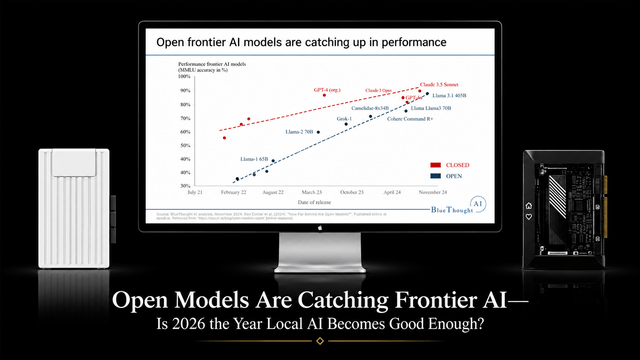
Open Models Are Catching Frontier AI—Is 2026 the Year Local AI Becomes Good Enough?
Open models are getting good enough for more local AI workloads, while frontier cloud models remain useful for the hardest reasoning and agent tasks.
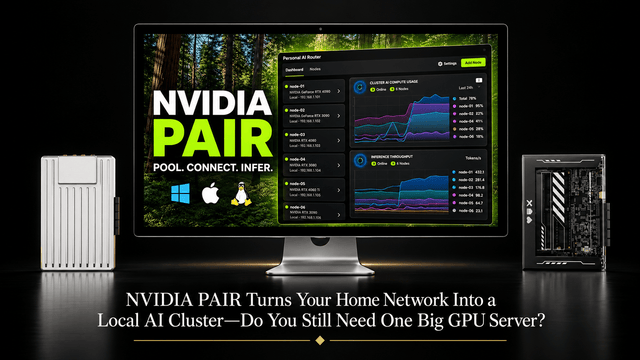
NVIDIA PAIR Turns Your Home Network Into a Local AI Cluster—Do You Still Need One Big GPU Server?
NVIDIA PAIR spreads local AI requests across multiple PCs, making compute more elastic while one home server can keep data and state persistent.
Why Does Immich Feel Faster on LAN Than on Remote Connections?
LAN requests usually take a shorter, lower-latency path. Remote access adds WAN capacity limits and may add DNS, TLS, proxy, VPN, or relay hops.


