
What Are the Warning Signs That a 10GbE Home NAS Adapter Is Overheating?


A hot 10GbE adapter becomes a thermal problem when heat repeatedly causes errors, throttling, link resets, or device disappearance.
In a compact home NAS, a passively cooled NIC, Thunderbolt adapter, or RJ45 SFP+ module may feel very warm during normal operation because the enclosure is designed to move heat to the surface. The useful warning signs are therefore behavioral: failures that appear under sustained 10GbE load, track rising temperature, disappear after cooling, and return when the same transfer is repeated.
Separate a Warm Enclosure From a Reproducible Fault
Measure the adapter at idle, during a sustained transfer, and after the workload stops. Record link speed, throughput, adapter temperature if exposed, case temperature, fan speed, and the time at which any symptom begins.
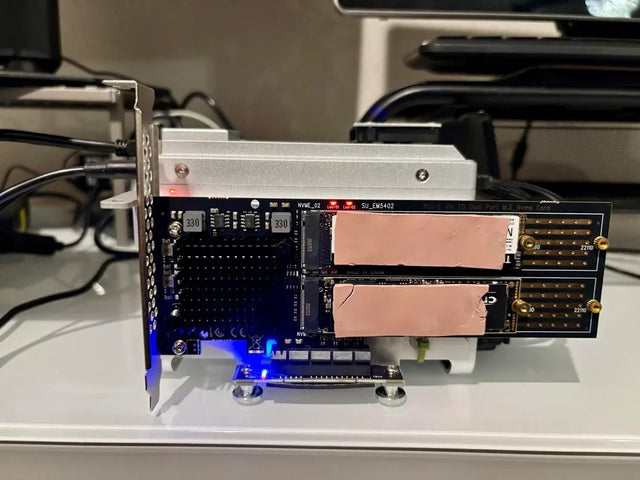
A HardForum discussion about a hot 10GbE M.2 adapter illustrates that heat alone is not proof of failure; compact cards often require airflow that a desktop or NAS enclosure does not provide by default.
Continue only when the adapter remains enumerated and the link is stable. Stop the test if there is a burning smell, discoloration, swelling, repeated hardware-overheat alerts, or a surface condition that suggests damage rather than ordinary heat transfer.
Watch for Throughput Collapse After a Repeatable Warm-Up Period
Run the same large sequential transfer long enough to move beyond RAM cache. A thermal symptom often starts fast, degrades after several minutes, and recovers only after the adapter cools or the link is reset.
An Apple support report recorded a direct hardware overheat warning for a 10GbE interface. A logged thermal alert is stronger evidence than a hand-feel estimate because it comes from the device or driver path.
Compare three runs with identical storage and network conditions. If the slowdown begins at a similar temperature or elapsed time and disappears with temporary airflow, the pattern supports a thermal diagnosis rather than random SMB or disk variation.
Check for Link Resets, Device Disappearance, and Error Growth
Monitor link-state events, driver resets, PCIe errors, USB or Thunderbolt disconnects, CRC counters, missed packets, and retransmissions during the warm-up test. Record which counter begins increasing before the transfer collapses.
An AnandTech forum case connected intermittent server drops with the possibility of an overheating transceiver or port and reported stability after the suspect path was changed.
If physical errors rise, test a known-good cable or optical module before blaming the controller. If the adapter disappears from the operating system or resets on the bus, focus on adapter cooling, power delivery, driver stability, and slot placement.

Inspect the Hottest Component, Not Only the NIC Heatsink
For 10GBASE-T, the hottest part may be the copper PHY or RJ45 SFP+ module rather than the controller heatsink. For Thunderbolt adapters, the enclosure may contain the NIC, bridge controller, and power-conversion components in one small thermal volume.
MikroTik community reports note that 10GbE-T modules run hot across brands because copper 10GbE conversion consumes more power than many optical modules.
Use a temperature probe or thermal image carefully without obstructing airflow. Test the module, controller, enclosure exhaust, and nearby drive area; cooling the wrong surface may lower the reading without changing the actual failing component.
Run a Controlled Airflow A/B Test
Add temporary directed airflow without changing the cable, port, driver, or workload. Repeat the same transfer and compare the temperature curve, time to failure, throughput, errors, and link stability.
A successful airflow test does not automatically justify a permanent improvised fan. It proves that the thermal environment changes the symptom and gives you a basis for selecting a better slot, larger heatsink, supported fan path, optical module, or adapter designed for the enclosure.
If cooling does not change the failure, restore the original setup and continue with driver, firmware, power, cable, and PCIe-lane tests. Do not label every 10GbE instability as overheating merely because the hardware feels warm.
Replace or Redesign the Adapter Path at the Stop Boundary
Stop using the adapter when it logs thermal faults, repeatedly resets, damages nearby components, requires unsafe contact temperatures, or cannot sustain the workload within the enclosure’s intended cooling design.
ZimaSpace’s guide to 10GbE NAS bottleneck testing helps separate a heat-triggered failure from a storage or CPU limit that merely appears during the same high-load transfer.
The adapter is acceptable only when repeated full-load tests complete without thermal alerts, link resets, growing errors, or unexplained throughput collapse. If the enclosure cannot provide that margin, move to a cooler interface type, better airflow, or a lower-power adapter rather than treating periodic disconnections as normal.

Recommended products

Support & Tips
More to Read
Live TV Recording Storage Guide for Capacity, Retention, and Cleanup
Measure real recordings, reserve headroom, combine age and capacity limits, and prove the oldest eligible program is removed before storage fills.
Home Media Metadata Recovery Workflow After a Database Restore
Protect the restored state, verify media identity and paths, then repair missing artwork or matches in a pilot library before broad metadata changes.
Jellyfin Client Compatibility Checklist for Audio, Video, and Subtitles
Test representative files one variable at a time and record Direct Play, remux, audio conversion, video transcode, or failure for every client.


