
Compact AI Lab vs Full AI NAS for People Starting Local AI


If you are just starting local AI, a compact AI lab is usually the safer first step. It lets you learn Ollama, Open WebUI, Docker apps, lightweight RAG, local APIs, and automation without committing to a large storage system before you know which workflows you will actually keep.
A full AI NAS becomes worth it when the project stops being “Can I run a model?” and becomes “Can I organize, index, back up, and search my private files, photos, videos, and models every day?” The best path is not always buying the biggest box first. It is starting small when you are learning, then building a real storage layer when local data becomes the center of the workflow.
The Short Answer: Start Compact for Learning, Go NAS When Data Becomes the Project
A compact AI lab is best when your main goal is experimentation. You want to test models, learn containers, try local chat tools, build small agents, or prototype private RAG before deciding what deserves permanent infrastructure.
A full AI NAS is best when your AI work depends on local data. That means large document libraries, photo and video collections, shared folders, backups, model files, vector databases, and always-on indexing jobs.
The upgrade path is the key. A compact lab should not be treated as a throwaway toy, and a NAS should not be treated as a magic inference machine. They solve different problems, and they can work together later.
What a Compact AI Lab Actually Solves
A compact AI lab gives beginners a low-risk place to learn. It can run local model tools, web frontends, APIs, automation scripts, Docker containers, and lightweight services without turning your main storage system into an experiment.
Ollama’s local API and Open WebUI’s Docker setup make a compact local AI lab for beginner experiments practical because the first goal is often interaction, testing, and workflow validation. You can learn what models feel useful, which tools you like, and whether your daily use is chat, RAG, coding, agents, or automation.
The limitation is that compact does not mean unlimited. Storage expansion, backups, large media libraries, multi-user access, and heavy GPU inference may quickly outgrow a small starter node.
What a Full AI NAS Actually Solves
A full AI NAS solves the data problem. It gives you a central place for private files, documents, photos, videos, model files, indexes, backups, shared folders, and self-hosted services.
For local RAG, this matters because the system is not just running a model. It stores documents, chunks, embeddings, metadata, vector indexes, and retrieved context. A RAG survey explains why a private RAG data layer on local storage is part of the system, not an optional extra.
This is where a NAS becomes more valuable than a small experiment box. When your local AI depends on always-available data, reliable storage, background indexing, and multiple devices, the storage layer becomes the project.
The Real Difference Is Compute-First vs Storage-First
A compact AI lab is compute-first. It is about running tools, testing models, exposing local APIs, and learning the software stack with less cost and less complexity.
A full AI NAS is storage-first. It is about keeping data organized, accessible, backed up, indexed, and available to other services. It may run AI tools, but its core value is not automatically faster generation.
Heavy local inference is a separate bottleneck. vLLM’s optimization guidance around GPU inference separated from NAS storage shows why memory, KV cache, batching, and concurrency become compute-layer problems. If you want large models, long context, or many users, you may still need a dedicated GPU node or hybrid setup.
Where Beginners Usually Hit the First Limit
Beginners often expect the first limit to be model size. Sometimes it is. But just as often, the first limit is storage, workflow confusion, container setup, indexing quality, backups, or mixing experiments with important data.
Docker’s resource constraint documentation explains why Docker resource limits for experimental AI workloads matter. Containers can consume host resources if left uncontrolled, which is not ideal when the same machine also protects family photos, documents, or backups.
This is why compact labs are useful early. They create a sandbox. You can break things, rebuild containers, test dev versions, and change tools without putting the long-term data layer at risk.
Expansion Paths: Add Storage, Add Compute, or Split the Roles
There are three clean ways to expand. You can add storage to the compact lab, move data-heavy workloads to a NAS, or split the roles between a NAS and a compute node.
Open WebUI can connect to Ollama running on a different server, which supports a local AI upgrade path from lab node to NAS. The lab can become the frontend, app node, automation controller, or light inference box while the NAS becomes the file and index layer.
That path reduces regret. If you start small, the starter device can still be useful later. If you start with a NAS, you can still add separate compute later when inference speed or GPU memory becomes the bottleneck.
Compact AI Lab vs Full AI NAS Fit Table
Use this table as a decision matrix. The question is not which setup is more powerful. The question is which bottleneck you are actually trying to solve first.
| Decision factor | Compact AI Lab | Full AI NAS | Buying meaning |
|---|---|---|---|
| Beginner cost | Lower entry cost | Higher upfront cost | Compact lab reduces wrong-buy risk |
| Learning curve | Easier for experiments | More setup and storage planning | Start small if workflow is unclear |
| Local LLM testing | Good for small models, APIs, and tools | Good when models connect to private data | Compute-first vs data-first |
| Docker apps | Good for learning services | Better for always-on stacks | NAS matters when services become permanent |
| Private RAG | Good for prototype | Better for large file libraries | NAS wins when data grows |
| Photo / video library | Limited by external storage | Built for large media storage | NAS wins for long-term data |
| Background indexing | Good for light jobs | Better for 24/7 indexing | Always-on workloads favor NAS |
| Backup safety | Safer as an experiment box | Better if storage and experiments are isolated | Do not let experiments endanger backups |
| GPU inference | Usually limited or external | Still may need separate GPU compute | NAS does not automatically mean fastest inference |
| Storage expansion | Limited | HDD bays and SSD expansion | NAS wins for future growth |
| Network access | Basic | Designed for multi-device access | NAS wins when shared access matters |
| Upgrade path | Can become app, frontend, or automation node | Can become the data layer | Hybrid prevents wasted hardware |
| Best first step | Learning and validation | Data-heavy local AI | Choose based on the first real bottleneck |
The table points to a staged decision. If you are still learning what you want, start compact. If your local AI already depends on a private library of files, photos, videos, indexes, and backups, start with the NAS.
Who Should Start With a Compact AI Lab?
Start with a compact AI lab if your biggest risk is buying too much before you understand your workflow. This applies if you are still comparing Ollama, Open WebUI, agents, small RAG pipelines, automation scripts, or self-hosted AI apps.
A device like the ZimaBoard 2 single board server fits this starter role because it is positioned around self-hosting, Docker-style services, local apps, PCIe/SATA expansion, dual 2.5G networking, and compact home server experimentation.
The boundary matters. A compact lab is not the right promise for heavy GPU inference, massive media storage, large multi-user RAG, or production backup storage. Its job is to help you learn cheaply and keep the upgrade path open.
Who Should Start With a Full AI NAS?
Start with a full AI NAS if your local AI project already depends on data. If you want private document search, family photo storage, video libraries, backups, shared access, media workflows, or always-on indexing, the storage layer should not be an afterthought.
A ZimaCube 2 Pro NAS fits this storage-first path because it is positioned as an open 6-bay personal cloud NAS with more CPU headroom, 10GbE, SSD expansion, self-hosting, media workflows, and room for more demanding active projects.
The boundary is also important here. A full AI NAS is not automatically the fastest LLM inference machine. It gives your AI workflows a stable data foundation, but heavy model serving may still belong on a separate GPU system.
Who Should Choose a Hybrid Path?
Choose a hybrid path if you want to start small but avoid painting yourself into a corner. This is often the best route for beginners who are serious about local AI but not yet sure which workloads will matter most.
The clean split is simple: NAS for files, backups, media, models, embeddings, and indexes; compact lab or GPU node for apps, frontends, inference, and experiments. This follows a NAS storage layer vs compact compute node pattern rather than forcing one machine to do every job.
Hybrid also protects your data. Experimental AI containers, new models, unstable plugins, and heavy indexing jobs can run away from the system that stores your critical backups and long-term files.
Where ZimaBoard 2 and ZimaCube 2 Pro Fit
The useful product pattern is staged growth. Start with a compact node when you are learning; move to a full NAS when data, indexing, storage, and always-on services become important; split compute and storage when heavier inference appears.
ZimaBoard 2 fits the compact lab side of that path. It is better framed as a starter server for local apps, Docker experiments, lightweight services, workflow validation, and future companion-node use. ZimaCube 2 Pro fits the full AI NAS side: private files, media libraries, document indexes, backups, self-hosted apps, shared access, and storage-first local AI workflows.
They are not exact replacements for each other. ZimaBoard 2 should not be positioned as a heavy inference workstation, and ZimaCube 2 Pro should not be treated as mandatory for every beginner. Together, they describe a practical upgrade path: learn first, store seriously when needed, and split roles when the workload grows.
FAQ
Should beginners start with a compact AI lab or a full AI NAS?
Beginners should usually start with a compact AI lab if they are still learning models, Docker apps, local APIs, Open WebUI, agents, or small RAG workflows. A full AI NAS is better if they already have large private data libraries, backups, media storage, shared folders, and always-on indexing needs.
Will a compact AI lab become useless when I upgrade later?
No. A compact lab can remain useful as a frontend, automation node, Docker host, light inference server, Open WebUI box, agent runner, or NAS companion. It only becomes wasted hardware if you expect it to replace every future storage and compute role.
When does a full AI NAS become worth the higher cost?
A full AI NAS becomes worth it when your local AI depends on data more than experimentation. If you need private RAG over many files, photo and video storage, backups, multi-device access, background indexing, and long-term self-hosted services, the NAS is no longer overkill. It is the foundation.
The safest local AI path is to buy for the bottleneck you actually have now while leaving room for the bottleneck you may hit later. Start compact when learning is the goal. Go full NAS when private data becomes the project. Use a hybrid setup when you want both low-cost experimentation and long-term expansion without forcing one machine to do everything.

Recommended products

Product Comparisons
More to Read
WireGuard Server vs Mesh VPN for Devices Behind CGNAT
Use mesh VPN for low-friction roaming devices; use a WireGuard relay when you want to own routing, keys, and the public endpoint.
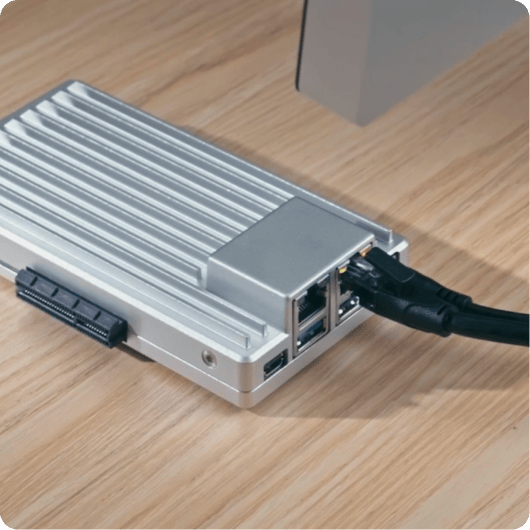
10GbE NAS on Gigabit Clients: Upgrade the Server or Endpoints First?
Upgrade the endpoint path for one slow workstation; upgrade the NAS uplink first when several gigabit clients saturate it together.
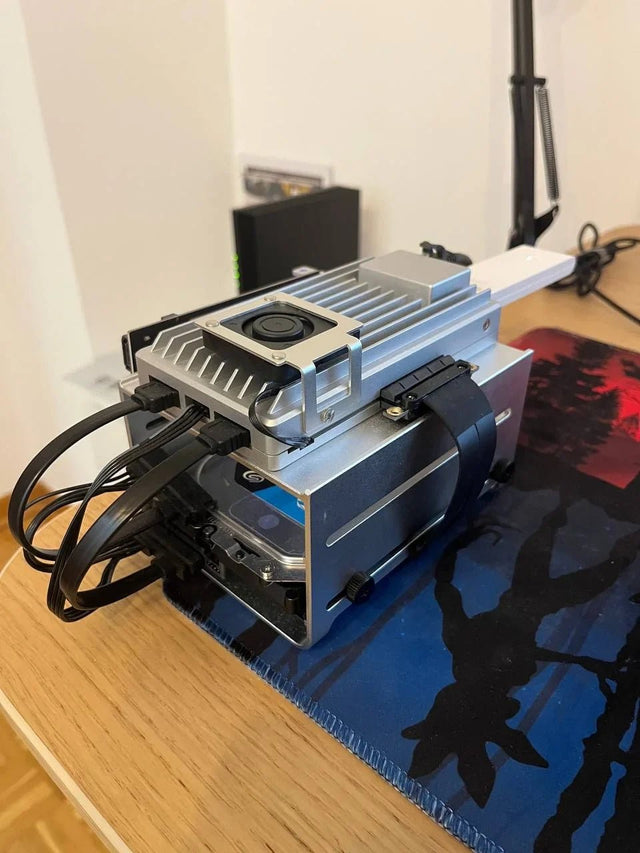
1GbE vs 2.5GbE for a Home Server: Which Workloads Cross the Line?
Keep 1GbE for light services and single streams; move to 2.5GbE when recurring transfers or combined clients sustain more than about 100 MB/s.


