
10 Best Google Photos Alternatives for Privacy and Self-Hosting in 2026


Google Photos is hard to replace because it does much more than store pictures. It automatically receives new phone photos, builds a timeline, recognizes people and places, makes years of media searchable, and keeps the library available across devices.
If privacy or data ownership is pushing you away from Google Photos, the real choice is not simply “cloud or NAS.” Immich comes closest to recreating the full Google Photos experience on your own server. ZimaOS Photos takes a different approach by turning photo folders already stored on your home server into a searchable private library. PhotoPrism is especially strong for existing photography archives, while Ente gives privacy-focused users end-to-end encryption without requiring them to run a server.

Best Google Photos Alternatives at a Glance
| Rank | Alternative | Best For | Hosting | Mobile Backup | Smart Search | Existing Folders |
|---|---|---|---|---|---|---|
| 1 | Immich | Closest self-hosted Google Photos replacement | Self-hosted | Excellent | Excellent | Strong |
| 2 | ZimaOS Photos | Existing photo libraries on a home server | Self-hosted | Strong | Local AI | Excellent |
| 3 | PhotoPrism | RAW files and large existing archives | Self-hosted | Via PhotoSync | Excellent | Excellent |
| 4 | Ente Photos | End-to-end encrypted photo backup | Cloud / self-hosted | Excellent | Strong | Moderate |
| 5 | Synology Photos | Existing Synology NAS users | Self-hosted | Excellent | Strong | Excellent |
| 6 | Nextcloud Memories | Existing Nextcloud deployments | Self-hosted | Via Nextcloud apps | Strong | Excellent |
| 7 | LibrePhotos | Open-source local photo discovery | Self-hosted | Android available | Excellent | Excellent |
| 8 | Piwigo | Albums, permissions, and shared collections | Cloud / self-hosted | Good | Traditional search | Strong |
| 9 | Photoview | Filesystem-first photo archives | Self-hosted | Limited | Moderate | Excellent |
| 10 | Lychee | Simple private photo galleries | Self-hosted | Limited | Basic | Moderate |
Quick answer: Choose Immich if you want the closest self-hosted equivalent to Google Photos. Choose ZimaOS Photos if your originals already live on a home server and you want to keep that storage structure while adding timeline browsing, local AI search, collections, and phone sync. PhotoPrism is particularly suited to photographers and large RAW archives. Ente is the strongest fit when encryption matters more than keeping every service inside your home.
What Should a Google Photos Alternative Actually Replace?
A photo gallery is not automatically a Google Photos replacement. Google Photos connects several jobs that are easy to overlook until you try to leave it: getting media off the phone, storing the originals, making thousands of files searchable, sharing them with other people, and resurfacing old memories without manually organizing every folder.
We ranked the alternatives around that complete workflow rather than GitHub popularity alone.
| Criteria | What We Looked For |
|---|---|
| Mobile backup | Whether new iPhone and Android photos can reach the library with minimal manual work |
| Privacy and ownership | Where originals, metadata, indexes, and AI processing live |
| Search and discovery | Timeline, faces, objects, locations, metadata, semantic search, and memories |
| Existing-library support | Whether an existing NAS folder can remain the source of truth |
| Portability | How easily originals and metadata can move into or out of the platform |
| Sharing | Albums, links, family accounts, permissions, and multi-user workflows |
| Maintenance | How much infrastructure the user must deploy, update, monitor, and recover |
This distinction matters because different users are replacing different parts of Google Photos. A phone-first household may care most about background uploads. A photographer may value RAW support and metadata more. Someone with 50,000 photos already sitting on a NAS may care less about importing them than about making those folders searchable.
For a deeper look at how recognition changes a local photo archive, ZimaSpace has also covered AI photo recognition on a NAS, including faces, semantic search, OCR, duplicates, and the processing requirements behind them.
Private Cloud vs Self-Hosted Photos: Know the Difference
“Private” and “self-hosted” describe different things.
A privacy-first cloud service can still store your library on infrastructure operated by someone else while using encryption to reduce what that provider can access. Ente follows this model in its hosted service.
Self-hosting moves the application and storage onto infrastructure you control. Immich, PhotoPrism, LibrePhotos, Photoview, and Nextcloud Memories can all run this way. NAS-integrated platforms such as ZimaOS Photos and Synology Photos go a step further by connecting photo management directly to their storage environments.
Self-hosting gives you more control over storage capacity, files, and local processing, but it also transfers responsibility for updates, disk health, backup, and recovery to you. A home server can replace Google Photos only when those surrounding workflows are considered as well.
The 10 Best Google Photos Alternatives in 2026
1. Immich — Best Overall Self-Hosted Google Photos Replacement

Immich is the strongest starting point for people who want Google Photos-like behavior without making the public cloud the primary home of their library.
Its mobile apps handle automatic photo and video backup, while the server combines timeline browsing, facial recognition, smart search, maps, memories, albums, partner sharing, duplicate detection, RAW files, Live Photos, and multi-user libraries. Existing folders can also be indexed through external libraries rather than forcing every file through a new upload workflow.
That breadth is why Immich ranks first. Phone capture, organization, discovery, and sharing live inside the same system instead of being assembled from several unrelated tools.
The price is maintenance. Immich includes application state, a database, generated assets, machine-learning indexes, and originals that need an intentional recovery strategy. Users comparing that responsibility with Google's managed approach can read the more detailed Immich vs Google Photos comparison.
If you decide Immich is the right model, ZimaSpace also has a practical guide to running Immich on ZimaOS.
Best for: A phone-first household that wants the closest complete self-hosted Google Photos experience.
Main trade-off: More application and backup maintenance than an integrated NAS photo app or managed service.
2. ZimaOS Photos — Best for Existing Photos on a Home Server

ZimaOS Photos starts from a different assumption: your photo files may already be where you want them.
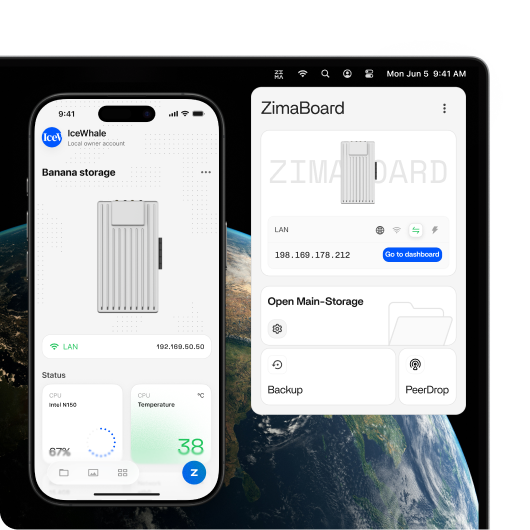
Instead of building another isolated storage destination, Photos can index folders already stored in ZimaOS. Originals remain in their existing locations while the application adds a photo wall, timeline, map, collections, metadata browsing, and local AI search.
That storage-first model is its main advantage. Camera archives, phone backups, action-camera footage, and older family folders can become one visual library without first reorganizing everything around the photo application.
It also handles formats that matter to mixed-device libraries, including common phone formats, Live Photos, 360° media, and a broad range of camera RAW files. Camera, lens, exposure, ISO, GPS, and other metadata remain available alongside the image.
Phone capture connects through ZimaClient background sync, so the library is not limited to media manually copied onto the server. New images can flow back into the same private storage used by the rest of the archive.
Local AI is another meaningful difference. Searching for a remembered scene can happen against the home-server library without requiring the photo archive to become useful only after cloud-side analysis.
This makes ZimaOS Photos particularly strong for users who want the NAS filesystem to remain the source of truth. The trade-off is ecosystem scope: it is designed around ZimaOS rather than as a distribution-independent photo server.
You can see that workflow in more detail in the existing private photo library overview.
Best for: People whose photo originals already live—or will live—on ZimaOS and who want search and modern browsing without rebuilding the archive.
Main trade-off: Less portable across operating systems than a standalone project such as Immich or PhotoPrism.
3. PhotoPrism — Best for RAW Files and Large Existing Archives

PhotoPrism moves up to third because it is especially good at a problem many Google Photos migration lists understate: making an established photography archive useful without abandoning its metadata and originals.
It indexes existing media, supports RAW formats, extracts EXIF and XMP metadata, recognizes faces, adds location context, detects duplicates, and provides detailed filters for properties such as labels, camera information, resolution, color, and location.
Google Photos migration is also relevant here. PhotoPrism can process metadata from Google Photos JSON sidecars, which makes it more naturally aligned with people bringing years of exported media back under their control.
Mobile backup is no longer a major omission. PhotoPrism recommends compatible tools such as PhotoSync for background uploads from iOS and Android, while WebDAV supports broader file access and synchronization workflows.
Immich still offers the more unified first-party phone-to-library experience. PhotoPrism's strength is the archive itself: photographers and NAS users who care about originals, RAW support, sidecars, and deep metadata have a strong reason to prefer it.
Best for: Photographers and NAS users with large, metadata-rich or RAW-heavy archives.
Main trade-off: Mobile backup relies more on companion workflows than Immich's integrated mobile experience.
4. Ente Photos — Best Privacy-First Cloud Alternative

Ente is the outlier in this ranking because you do not have to self-host it to change the privacy model.
Its hosted photo service uses end-to-end encryption while still providing automatic backups, cross-platform apps, face grouping, natural-language search, memories, album sharing, public links, and family features. AI features can operate without giving the service provider ordinary access to the photo contents.
For users leaving Google Photos primarily because of privacy rather than a desire to maintain infrastructure, that is a compelling middle ground.
Ente is also open source and self-hostable, so technically inclined users can operate the backend themselves. But those two deployment models solve different problems. Managed Ente is about stronger privacy with minimal maintenance; self-hosted Ente is about taking responsibility for the infrastructure as well.
Best for: People who want encrypted photo backup and modern apps without necessarily owning the server.
Main trade-off: Its biggest advantage is encryption and privacy, not direct management of an existing NAS folder tree.
5. Synology Photos — Best for Existing Synology NAS Owners

If you already own a compatible Synology NAS, Synology Photos is difficult to ignore because storage, user accounts, photo management, remote access, and backup live inside one appliance ecosystem.
The mobile app can automatically back up phone photos and videos. On the server, users get timeline and folder views, albums, sharing, metadata filters, places, face grouping, and subject recognition on supported hardware.
That integration reduces deployment work compared with assembling a Docker photo stack yourself. It also makes separate personal spaces and shared family libraries relatively straightforward.
The limitation is portability. Synology Photos depends on Synology hardware and DSM, and some recognition capabilities depend on supported models and memory. Moving away from the appliance means moving away from the photo application as well.
Best for: People who already own a Synology NAS and want a polished integrated photo workflow.
Main trade-off: Strong hardware and platform lock-in compared with portable self-hosted software.
6. Nextcloud Memories — Best for an Existing Nextcloud Private Cloud

Nextcloud Memories makes sense when photos are one part of a larger self-hosted cloud rather than the only workload on the server.
It builds a fast timeline and photo interface over files stored in Nextcloud, with albums, maps, sharing, metadata indexing, video handling, and integration with Nextcloud's Recognize app for local face and object recognition.
It also has a practical migration advantage: Memories includes tooling for Google Takeout imports. Automatic phone uploads can use the official Nextcloud mobile applications, allowing new photos to enter the same storage environment as documents and other private files.
The downside is architectural weight. If you only want a photo application, deploying and maintaining Nextcloud plus its supporting services may be more infrastructure than necessary.
Best for: Existing Nextcloud users who want Google Photos-style browsing inside the private cloud they already maintain.
Main trade-off: Overkill when photos are the only self-hosted service you need.
7. LibrePhotos — Best Fully Open-Source Local Photo Discovery

LibrePhotos deserves more attention in 2026 than older comparisons often give it.
It scans files already on your server and builds a timeline around them, with faces, places, events, object and scene detection, metadata search, semantic image search, memories, duplicate detection, multi-user support, and public album sharing.
Its recognition stack has also continued to evolve, including newer InsightFace/ArcFace-based face recognition and updated local machine-learning components. The important privacy point is straightforward: the photo and metadata analysis is designed to run on your own infrastructure.
LibrePhotos is especially interesting when local AI and open-source control matter more than having the most mature phone-first ecosystem. An Android application is available, but users who prioritize seamless cross-platform mobile backup should compare its workflow carefully with Immich, Ente, or NAS-integrated options.
Best for: Open-source users who want local face, event, scene, metadata, and semantic discovery over existing folders.
Main trade-off: The mobile ecosystem is not as mature as the leaders higher in this list.
8. Piwigo — Best for Albums, Permissions, and Shared Collections

Piwigo is less interested in imitating Google Photos and more interested in giving users structured control over a long-lived media library.
It supports self-hosting or a managed Piwigo Cloud deployment. Albums and sub-albums, tags, metadata, permissions, user accounts, sharing, synchronized directories, plugins, and mobile applications make it well suited to collections that need deliberate organization.
The official iOS and Android apps can upload media and manage albums, while administrators can decide who sees or contributes to different parts of the library.
This makes Piwigo attractive for families, photographers, clubs, and teams. It is less compelling when AI-generated memories, semantic search, and Google Photos-like automated discovery are the main objective.
Best for: Structured collections where albums, permissions, contributors, and long-term organization matter most.
Main trade-off: More gallery and collection management than AI-driven personal photo assistant.
9. Photoview — Best Filesystem-First Photo Browser

Photoview is built around a simple principle: the directories on your server should remain meaningful.
You point it at an existing media path, it scans the filesystem, generates thumbnails, and presents those directories as albums. RAW support, EXIF parsing, video, sharing, multiple users, and face recognition turn a normal storage tree into a much more usable browser.
Recent development has also restarted around the project, with updated deployment support and ongoing improvements rather than leaving it as a frozen gallery.
Its boundary is mobile ingestion. Photoview is strongest after the files have already reached the server. Users who use another synchronization tool may see that as an advantage; users expecting the photo app itself to handle every phone backup may not.
Best for: People who already have a carefully organized filesystem and want the software to respect it.
Main trade-off: It does not replace as much of the phone-to-cloud Google Photos workflow as the higher-ranked options.
10. Lychee — Best Lightweight Self-Hosted Gallery

Lychee earns the final spot because not every private photo library needs a large machine-learning stack.
It provides an open-source server for uploading, managing, viewing, and sharing photos through a clean gallery interface, with a comparatively straightforward Docker deployment path.
That smaller scope can be a feature. A user who wants private albums and convenient web access may not need face recognition, semantic search, automatic memories, or a collection of background ML services consuming server resources.
But that is also why Lychee ranks below the more complete alternatives. It replaces private photo hosting and gallery sharing better than it replaces Google Photos as an end-to-end phone backup and discovery system.
Best for: Users who want a simple, private gallery without building a full AI photo platform.
Main trade-off: Limited replacement for Google Photos' automated backup and intelligent discovery features.
Which Google Photos Alternative Is Best for You?
The ranking is useful, but your existing infrastructure should influence the decision more than a universal feature count.
| Your Priority | Best Starting Point | Why |
|---|---|---|
| Closest overall Google Photos replacement | Immich | Combines mobile backup, timeline, search, faces, maps, memories, sharing, and multiple users |
| Photos already stored on a ZimaOS server | ZimaOS Photos | Keeps existing folders while adding local search, timeline, map, collections, and phone sync |
| RAW and photography archive | PhotoPrism | Strong metadata, RAW, sidecar, Google Photos JSON, face recognition, and search support |
| Privacy without server maintenance | Ente Photos | End-to-end encrypted hosted photo service with modern apps and search |
| Existing Synology NAS | Synology Photos | Integrated mobile backup and photo management inside DSM |
| Existing Nextcloud deployment | Nextcloud Memories | Turns Nextcloud files into a modern photo timeline and supports Google Takeout migration |
| Open-source local AI discovery | LibrePhotos | Strong local faces, scenes, events, semantic search, and filesystem scanning |
| Shared structured collections | Piwigo | Strong albums, metadata, permissions, contributors, and sharing |
| Keep folders as the source of truth | Photoview | Maps the existing server filesystem directly into a fast photo interface |
| Simple private web gallery | Lychee | Smaller feature set and straightforward private photo management |
Moving From Google Photos to a Self-Hosted Library
Leaving Google Photos involves more than downloading JPEGs.
A Google Takeout archive can contain original media alongside JSON metadata and relationships that another application may interpret differently. Albums, edits, dates, locations, favorites, faces, Live Photos, and sidecar information do not automatically migrate with equal fidelity into every platform.
Before moving an entire library, test a smaller representative set: recent phone photos, older images, videos, edited files, screenshots, Live Photos or Motion Photos, RAW files, and media with location data. Check not only whether they appear, but whether capture dates and metadata survive correctly.
Phone behavior also deserves a separate test. iOS and Android control how long applications may run in the background, so an automatic-upload setting does not guarantee every file has reached the server. ZimaSpace's guide to backing up iPhone photos to a private home server covers the difference between simply seeing photos on the server and building a dependable intake workflow.
Finally, decide which system owns the originals. Immich can manage an application-centric library while also supporting external libraries. ZimaOS Photos, PhotoPrism, LibrePhotos, and Photoview can fit naturally into workflows where existing files remain central. That distinction matters the next time you migrate.
Self-Hosted Photos Still Need a Real Backup
Moving photos from Google to a server in your house gives you control. It does not automatically give you resilience.
A disk can fail. A storage pool can be damaged. Files can be deleted accidentally. Ransomware or a bad synchronization rule can affect mounted storage. And a photo application's database may contain albums, recognition data, shares, and other state that the original JPEG files alone cannot restore.
Your primary photo library should therefore be only one part of the protection plan. Keep another independent copy and, for irreplaceable family media, an offsite copy as well. The broader family photo storage guide explains why a NAS or home server should not become the only copy of the archive.
Is Self-Hosting Better Than Google Photos?
Not for everyone.
Google Photos remains difficult to beat when the priority is zero-maintenance mobile backup, mature sharing, cloud-scale search, and access without managing infrastructure. Ente offers another route for users who mainly want a stronger privacy model without running hardware themselves.
Self-hosting becomes more compelling when ownership is part of the requirement. Storage can grow with your own drives. Originals can stay in folders you control. Search and recognition can run locally. Changing photo software does not necessarily require moving the primary archive out of somebody else's cloud first.
The software should match the storage model you actually want.
Choose Immich when the goal is to reproduce as much of Google Photos as possible on a server you maintain. Choose PhotoPrism when the existing photography archive and its metadata come first. Use the photo layer already available in Synology or Nextcloud when that ecosystem is already the center of your private cloud.
And if the originals already live on ZimaOS, there is little reason to create another storage silo simply to gain a modern photo experience. ZimaOS Photos can keep those files where they are while adding timeline browsing, maps, collections, multi-device access, phone sync, and local AI search on top.
The most useful Google Photos alternative is therefore not necessarily the product with the longest feature list. It is the one that lets you keep control of the originals, reliably ingest new photos, find the memories you care about, and still leave again without rebuilding your entire library.

Recommended products

Product Comparisons
More to Read
LXC vs Docker on Proxmox for App Updates and Rollbacks
Docker gives app-level version control; LXC gives guest-level rollback. The better fit follows the smallest state unit you can restore safely.
Docker vs LXC Security Boundaries for Privileged Home Services
Docker fits narrowly packaged apps; LXC fits fuller Linux services, but neither replaces a VM when shared-kernel risk is unacceptable.
Turnkey NAS OS vs Modular Linux for a First-Time Builder
Choose turnkey NAS software for guided storage operations; choose modular Linux when learning and explicit control justify more ownership.


