
How Many Users and Background Jobs Should One Jellyfin Host Support?


A Jellyfin host should not be sized from registered users alone. One household with eight accounts may create less load than two remote viewers transcoding 4K video while a library scan, subtitle task, and backup run in the background. The useful capacity question is how much simultaneous foreground and background work the host can absorb before playback or administration stops meeting its target.
Build one workload budget that includes playback sessions, transcodes, scheduled tasks, storage activity, and co-hosted services. Then test the busiest normal overlap and stop increasing load when the first shared resource develops persistent queueing, errors, or user-visible delay.
Convert Users Into Playback Workloads
Count Direct Play, remux, audio conversion, and video-transcode sessions separately. Jellyfin clients report their supported codecs, resolutions, bitrates, and constraints, so two users watching the same source can ask the server to do very different work.
Jellyfin user policy can also change server demand. The current user-management controls can allow or restrict remote access, media playback, transcoding, and per-stream Internet bitrate. A user count therefore becomes useful only after it is translated into the playback permissions and modes expected at the same time.
Start with the hardest normal evening mix rather than the theoretical maximum number of accounts. If the household usually has two local Direct Play sessions and one remote conversion, that is the baseline the host must pass comfortably.
Add Scheduled Jobs to the Same Capacity Budget
Jellyfin performs work even when no one presses Play. Library scans, subtitle downloads, cache cleanup, plugin updates, chapter-image extraction, database optimization, and generated-media tasks can overlap with viewing.
The current scheduled-task list shows that Jellyfin can run scans, image extraction, plugin updates, database maintenance, subtitle work, cache cleanup, and other jobs in the background. Plugins may add more tasks.
Do not size the server from a quiet playback benchmark and then let every heavy task run during the same peak. Move deferrable jobs outside the viewing window first; include jobs that must overlap in the production test.
Find the First Shared Resource That Loses Margin
A host can fail on media-engine throughput, CPU, memory, SSD latency, HDD seek pressure, network bandwidth, or a dependency. More CPU cores do not help when a remote upload link is saturated, and more RAM does not fix a transcode that the selected GPU cannot accelerate.
The ZimaSpace analysis of Jellyfin capacity on a small home server uses the same workload-first model: concurrent demand and the first saturated resource matter more than an account-count ceiling.
Measure transcode speed, CPU or media-engine saturation, memory pressure, storage latency, and network throughput during the exact overlap. The limiting resource is the one whose pressure moves with the failure and improves when that pressure is removed.

Keep Background Work From Consuming Interactive Headroom
Playback has a deadline: the next segment must arrive before the client buffer empties. A library scan can usually finish later without harming anyone. That difference should shape scheduling and resource policy.
Reserve enough headroom that a normal playback start or seek remains responsive while unavoidable background work continues. If a database optimization or media-analysis job causes buffering, schedule it differently or constrain the job before buying a larger server.
On a shared host, repeat the test with other containers active. A downloader, photo indexer, backup engine, or local AI process can reduce Jellyfin capacity even though Jellyfin's own workload has not changed.
Use a Workload Matrix Instead of a User Limit
| Concurrent work | Main resource to watch | Failure signal |
|---|---|---|
| Direct Play streams | Media storage + network | Read or network queues grow |
| Video transcodes | Media engine / CPU + scratch | Transcode speed falls below real time |
| Library scan | CPU + metadata storage + media disks | Browsing or playback latency rises |
| Image / trickplay generation | CPU/GPU + storage writes | Interactive workload loses headroom |
| Backup or import | Storage + network | I/O contention or upload saturation |
Publish capacity as a tested workload, such as “three representative streams plus one scheduled scan remain inside the target,” not “this server supports ten users.” That result can be reproduced when the library, clients, and household usage change.

Recommended products

NAS & Server Setup
More to Read
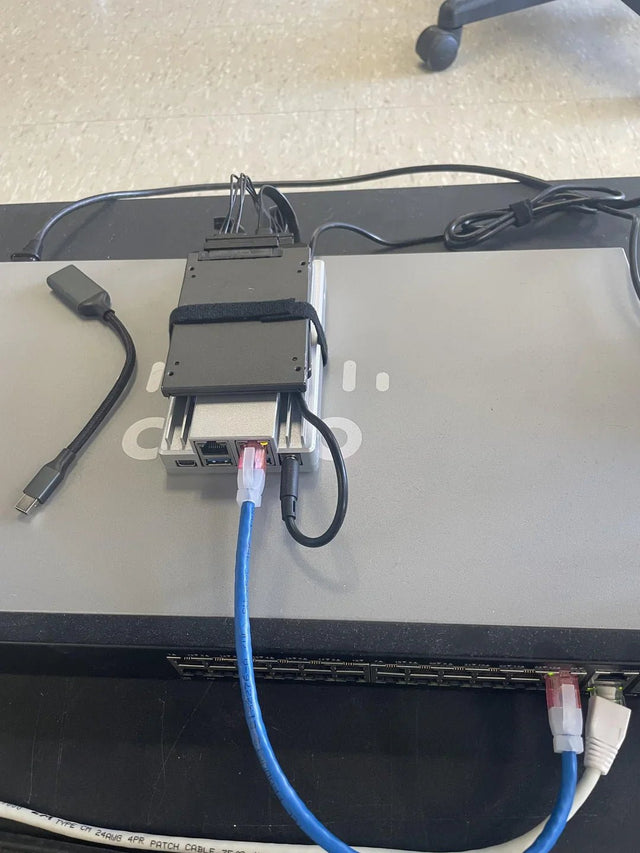
How AI-Like Analysis and Automation Change Jellyfin Storage and Compute Needs
Automation and adjacent AI analysis add scans, derived data, CPU/GPU work, cache, scratch space, and background scheduling beyond ordinary Jellyfin playback.
How to Integrate Jellyfin Into a Small Apartment or Rental Network
Build a rental-friendly Jellyfin network around stable local addressing, minimal wiring, quiet hardware, CGNAT-aware remote access, and reversible changes.
How to Reduce Heat and Drive Activity in an Always-On Jellyfin Setup
Lower Jellyfin heat and disk churn by reducing background work, using efficient acceleration, separating active app data, and testing standby.


