
Why Is Home Assistant Adding More Automation and Background Intelligence?


Home Assistant is adding background intelligence because a useful smart home must interpret continuous context, not merely wait for manual dashboard commands.
More devices produce overlapping events about presence, energy, climate, media, and security. Background processing can combine those signals, infer intent, detect anomalies, and choose an action without a person writing every branch. The tradeoff is architectural: more persistent models, queues, histories, permissions, and compute paths must remain observable, local where promised, and easy to override.
Automation Is Moving From Triggers to Context
Traditional rules map a named trigger to a fixed action. Context-aware automation evaluates several signals, recent state, household mode, time, and confidence before acting. That shift reduces brittle rule duplication, but it also turns state history and identity into active inputs rather than passive records displayed after the fact.
The broader project direction reflects demand for systems that remain understandable while becoming more capable. A roadmap discussion of automation roadmap themes describes attention to easier automation, dashboards, and voice, all of which require more background coordination than a simple device registry.
The useful boundary is explainability. A household should be able to identify which observation caused an action, which policy allowed it, and how to suspend it. Intelligence that cannot expose those three facts may be impressive in a demo but becomes difficult to trust during an unexpected event.
Local Processing Protects Latency and Private Context
Home context is unusually sensitive: presence, sleep, routines, access events, and energy use reveal daily life. Processing more of that context locally can reduce round trips and third-party disclosure while keeping basic actions available during internet loss. Locality, however, does not remove the need for permissions, retention, and secure updates.
Home Assistant's importance is often linked to its local-first model rather than to one interface feature. This account of the local-first architecture explains why keeping control and data near the household changes both privacy and resilience expectations.
A local model can still consume substantial CPU, memory, and storage, and an optional cloud model can still receive selected context. The architecture must label which inference runs where and what leaves the home. If that data path is unclear, disable the feature until its privacy and outage behavior are testable.
Background Work Adds New Resource Competition
Continuous classification, voice processing, history analysis, indexing, and prediction share CPU, memory, database, and storage bandwidth with time-sensitive automations. Average host utilization may remain low while a scheduled model load or database scan increases tail latency. Intelligence therefore needs budgets and scheduling, not only an enable switch.
Real installations already reveal how integrations can dominate startup or runtime work. An operator's method for finding slow integrations illustrates why new background features should be measured as independent consumers instead of attributed vaguely to Home Assistant.
The claim fails when background work delays a required control path, exhausts storage, or cannot recover after interruption. Keep a latency baseline for critical automations and pause nonessential analysis during backup, upgrade, or heavy neighboring workloads. Capability is valuable only while core control remains predictable.

Adopt Intelligence Through a Four-Gate Review
For each new feature, record its input data, execution location, resource budget, action authority, and fallback when the model or network is unavailable. Test it first in observe-only mode, compare recommendations with household expectations, then allow only reversible low-impact actions before expanding scope.
The existing ZimaSpace analysis of privacy-first home infrastructure supplies the governance context for deciding whether additional intelligence preserves the local-control promise.
Approve the feature only if inputs are necessary, outputs are explainable, critical actions retain manual control, internet loss has a defined behavior, and peak load stays inside measured headroom. Revoke its authority when any gate cannot be demonstrated; a background suggestion can remain useful without becoming an autonomous actuator.

Recommended products

Tech & AI HUB
More to Read

Open Models Are Catching Frontier AI—Is 2026 the Year Local AI Becomes Good Enough?
Open models are getting good enough for more local AI workloads, while frontier cloud models remain useful for the hardest reasoning and agent tasks.
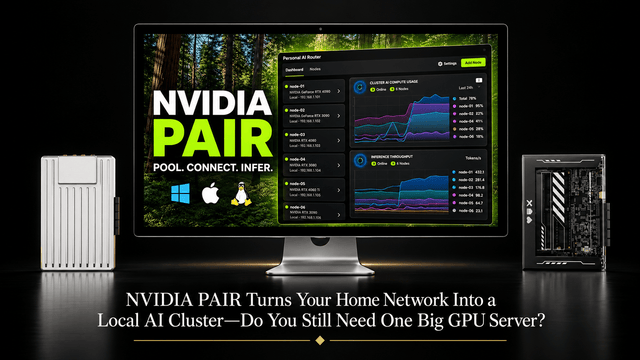
NVIDIA PAIR Turns Your Home Network Into a Local AI Cluster—Do You Still Need One Big GPU Server?
NVIDIA PAIR spreads local AI requests across multiple PCs, making compute more elastic while one home server can keep data and state persistent.
Why Does Immich Feel Faster on LAN Than on Remote Connections?
LAN requests usually take a shorter, lower-latency path. Remote access adds WAN capacity limits and may add DNS, TLS, proxy, VPN, or relay hops.


