
Open Models Are Catching Frontier AI—Is 2026 the Year Local AI Becomes Good Enough?


Open models are getting close enough to frontier AI that the most useful question is no longer whether they can beat the best cloud model on every benchmark. For local AI users, the more practical question is whether an open model can already handle the work they repeat every day: document search, summarization, writing, coding assistance, private RAG, and increasingly, agent workflows.
In 2026, the answer is becoming yes for a growing number of workloads—but not all of them. The strongest proprietary models still lead difficult reasoning and long-horizon tasks, while many of the most capable open-weight models remain too large for ordinary home hardware. Local AI is becoming “good enough” not because the frontier has stopped moving, but because more useful work can now be moved below it.
Are Open Models Really Catching Frontier AI?
Yes, but “catching the frontier” needs a careful definition. Open-weight models have improved rapidly in coding, reasoning, multimodal understanding, long context, and agentic tasks. At the same time, the leading proprietary models continue to advance, so the gap has narrowed without disappearing.
The September 2026 update to the Artificial Analysis Intelligence Index v4.2 is useful because the benchmark itself became harder. It added agentic knowledge work, long-document reasoning across thousands of PDF pages, more private test sets, and greater emphasis on held-out evaluations.
Under that updated methodology, Anthropic and OpenAI still occupy the top positions. Open-weight model developers including Moonshot AI and Z.AI sit further down the ranking rather than replacing the proprietary frontier outright.
That creates two different trends.
- Open models are catching yesterday's frontier faster. Capabilities that once required a top proprietary model increasingly appear in downloadable models.
- The live frontier is still moving. Proprietary labs continue improving difficult reasoning, tool use, coding, and long-running agent behavior.
So the strongest claim supported by current evidence is not that open models have fully caught up.
It is that the capability gap is becoming small enough that users should stop choosing models only by leaderboard position and start choosing them by workload. That same workload-first approach is useful when comparing frontier and local AI rather than treating either side as the universal default.
What Does “Good Enough” Local AI Actually Mean?
The phrase “good enough” can sound like accepting an inferior model, but that is not the useful definition.
For a local workload, a model is good enough when it can complete the task at an acceptable level of quality, speed, reliability, and cost without needing a materially stronger model for most requests.
That means benchmark parity is not required.
A local model does not need to become the best scientific reasoning system in the world to summarize private documents. It does not need to beat the best autonomous coding agent to explain a function, generate a script, or classify source files.
The relevant test is:
Does using a stronger frontier model change the result enough to justify sending this particular workload to it?
This shifts the comparison away from a single intelligence score and toward several practical dimensions:
- task quality,
- latency,
- privacy requirements,
- hardware requirements,
- repeated inference volume,
- agent reliability,
- and the cost of failure.
A model can therefore be “good enough” for private RAG while not being good enough for an autonomous 12-hour coding task. The same model can be appropriate for routine writing but inappropriate for a difficult scientific research workflow.
Local AI is not one workload, so “Is local AI good enough?” cannot have one universal answer.
Why Open-Weight Does Not Automatically Mean Local
This distinction becomes especially important in 2026 because some of the strongest open-weight models are enormous.
| Term | What It Actually Means |
|---|---|
| Open-weight | The model weights are available under the model's license |
| Self-hostable | You can operate the model on infrastructure you control |
| Locally practical | Your available hardware can run it at useful speed and context |
| Good enough | Its quality is sufficient for a specific workload |
Kimi K3 illustrates the difference clearly. Moonshot AI's official Kimi K3 model card describes a 2.8-trillion-parameter open-weight multimodal model with a one-million-token context window.
Making those weights available is important. It allows independent deployment, research, optimization, quantization, and new inference systems.
It does not mean an ordinary 32GB or 64GB home server suddenly has the memory required to run the full model comfortably. The practical difference between released weights and usable local inference becomes much clearer when examining Kimi K3 deployment limits.
The same principle applies to mixture-of-experts models. Only part of an MoE network may be active for a given token, which can reduce computation, but the full set of model weights still has to exist somewhere in the deployment architecture.
Active parameters affect compute. Total weights still matter for storage and memory planning.
This is why the open-model revolution and the local-AI revolution overlap without being identical.
Which Open Models Are Closing the Gap in 2026?
Rather than building another top-10 leaderboard, three current model families illustrate how the open ecosystem is changing.
GLM-5.3-Flash: More Capability Per Active Parameter
GLM-5.3-Flash is interesting because its design emphasizes efficiency instead of simply maximizing total model size.
The official GLM-5.3-Flash model card lists 320 billion total parameters but only 18 billion active parameters. Z.AI also describes it as the first natively multimodal model in the GLM-5 series and says the architecture was redesigned around capability and inference efficiency.
The important trend is not the vendor claim that one model beats another benchmark.
It is that increasingly capable behavior can come from architectures that activate a much smaller fraction of their total capacity for each token.
For local AI, that matters because useful performance depends not only on model intelligence but on how efficiently that intelligence can be served. Even an efficient MoE still has substantial memory and storage requirements, which is why the GLM-5.3-Flash hardware reality matters more than its active parameter count alone.
DeepSeek V4: Open Models Are Becoming Agent Models
DeepSeek V4 shows a second transition: open models are being designed for tool-driven agent workloads rather than only chat.
DeepSeek's official DeepSeek V4 release documentation describes two versions: V4-Pro with 1.6 trillion total and 49 billion active parameters, and V4-Flash with 284 billion total and 13 billion active parameters.
Both support a one-million-token context window, and DeepSeek has specifically optimized the models for agentic coding and integrations with agent environments.
This matters because the next question for local AI is no longer just:
Can this model answer the prompt?
It is increasingly:
Can this model repeatedly choose tools, interpret results, recover from mistakes, and continue a workflow?
That is a much higher bar than chatbot quality. It is also why the surrounding harness ecosystem matters; model capability becomes more useful when paired with reusable DeepSeek Harness plugins and other agent infrastructure.
Kimi K3: Open Weights Are Moving Into Frontier-Scale Models
Kimi K3 demonstrates the opposite end of the spectrum. Instead of making the model small enough for typical local hardware, Moonshot AI has released the weights of a very large system aimed at long-horizon coding, multimodal reasoning, and agentic knowledge work.
Its scale makes it an important open-model milestone while simultaneously showing why open does not mean lightweight.
A model can be openly deployable and still require infrastructure far beyond a conventional home AI box.
Together, these examples show three directions happening at once:
- models are becoming more compute-efficient,
- models are becoming more agent-capable,
- and frontier-scale weights are becoming more accessible.
All three trends expand local AI—but in different hardware classes.
Which AI Workloads Are Already Good Enough to Run Locally?
The strongest case for local AI is not the hardest possible task. It is the large volume of ordinary work that does not require the strongest possible model.
| Workload | Local AI in 2026 | Where Frontier Cloud Still Helps |
|---|---|---|
| Private document search and RAG | Strong fit | Difficult synthesis across ambiguous evidence |
| Summarization | Strong fit | Very complex or high-stakes source analysis |
| Extraction and classification | Strong fit | Unusual edge cases requiring deeper judgment |
| Everyday writing | Strong fit | High-end editorial or strategic reasoning |
| Coding assistance | Increasingly strong | Difficult repository-scale engineering |
| AI agents | Increasingly viable | Long-horizon planning and difficult recovery |
| Image and document understanding | Increasingly viable | Advanced multimodal reasoning |
| Long-running research | Mixed | Frontier models remain valuable |
| Hard scientific reasoning | Mixed | Frontier cloud remains a strong fit |
Document retrieval is a particularly good example.
A private knowledge assistant does not depend only on raw model intelligence. Its result may be determined just as much by:
- how files are indexed,
- which passages are retrieved,
- whether metadata is preserved,
- how the prompt is constructed,
- and whether the model can faithfully summarize the retrieved evidence.
Once the model clears a sufficient quality threshold, improving retrieval may produce more value than replacing it with a much more expensive frontier model. Practical document search and RAG workflows therefore matter just as much as model choice. :contentReference[oaicite:1]{index=1}
The same is true for repetitive workloads such as classification, extraction, formatting, translation, and routine summarization.
This is where local AI can become the default without first becoming the world's smartest AI.
Where Do Frontier Models Still Have a Clear Advantage?
The shrinking gap should not be confused with the disappearance of the gap.
Current independent evaluations still show leading proprietary systems ahead on difficult combined intelligence benchmarks. Artificial Analysis v4.2 is especially relevant because it increased the weight of realistic agentic knowledge work and long-document reasoning rather than relying only on older academic questions.
Frontier models can remain valuable when a task requires several capabilities at the same time:
- difficult reasoning,
- reliable tool selection,
- long-horizon planning,
- large-scale code understanding,
- complex multimodal analysis,
- or recovery from unexpected failures.
The distinction often appears at the edges of a task rather than its beginning.
A local model may produce a useful first draft of a program. The frontier advantage may become visible only after the agent has made six changes, encountered an unusual dependency conflict, inspected several repositories, and has to rethink its strategy.
A local model may summarize ten documents well. The harder problem may be detecting that two sources contradict each other and deciding which evidence should be trusted.
Those are precisely the cases where the additional intelligence of a frontier model can justify its cost.
This suggests a more useful architecture than forcing every request through the same model:
Routine work stays local. Difficult exceptions escalate.
That routing approach is also the basis of a practical hybrid AI cost model: repetitive work can remain local while higher-value exceptions use cloud intelligence only when needed. :contentReference[oaicite:2]{index=2}
Is Local AI Good Enough for Coding and AI Agents?
Coding is one of the areas where a simple yes-or-no answer becomes misleading.
Local and open-weight models are already useful for:
- explaining code,
- writing individual functions,
- generating scripts,
- creating tests,
- reviewing small changes,
- and debugging well-scoped problems.
Agentic software engineering is harder.
A coding agent may need to inspect a repository, run terminal commands, edit several files, read failures, revise its assumptions, and continue through dozens or hundreds of tool interactions.
At that point, the model is only one part of the system.
The agent also needs:
- a reliable harness,
- tool execution,
- working memory,
- task state,
- retry logic,
- permission controls,
- and an execution environment.
This leads to an important shift in how local AI should be evaluated.
The question is no longer only whether the local model is smart enough. It is whether the complete local agent system is reliable enough.
DeepSeek's current agent integrations are evidence that open-model developers are explicitly targeting this problem. Its agent integration documentation covers environments such as Claude Code, OpenCode, and OpenClaw rather than presenting V4 only as a chat endpoint.
For users evaluating the broader self-hosted ecosystem, current local AI agent projects show how much of the stack now sits outside the model itself. :contentReference[oaicite:3]{index=3}
That is a meaningful sign of where the open ecosystem is moving.
Is Local AI Good Enough for Multimodal Work?
Multimodal capability is also moving downward from cloud-only frontier models.
GLM-5.3-Flash is natively multimodal, while Kimi K3 combines text, image, and video understanding in one open-weight model. That makes workloads such as screenshots, scanned documents, images, and visual agent inputs increasingly relevant to local deployments.
But multimodal AI creates a second infrastructure challenge: input volume.
Processing a single screenshot is different from continuously processing:
- hours of video,
- large photo libraries,
- camera streams,
- or thousands of mixed documents.
As AI understands more than text, storage throughput, preprocessing, indexing, and retained media become part of the workload.
That means better open multimodal models may actually make local infrastructure more important rather than making infrastructure disappear.
How Much Hardware Does “Good Enough” Local AI Actually Need?
This is where model announcements meet physical reality.
The hardware required for useful local inference depends on much more than the model's headline parameter count.
Users need to consider:
- model weight size,
- quantization level,
- RAM and VRAM capacity,
- context length,
- KV cache requirements,
- number of concurrent users,
- prompt length,
- and expected generation speed.
A model technically loading into memory is not the same as a model being practical. Current Ollama hardware requirements are driven by the loaded model, quantization, context and concurrency rather than by a single universal RAM or VRAM minimum. :contentReference[oaicite:4]{index=4}
If an interactive assistant produces one token per second, it may be possible to run but unpleasant to use. If an agent repeatedly waits minutes for every reasoning step, a workflow that looks viable on a hardware compatibility chart may fail in daily use.
Good enough intelligence also requires good enough latency.
Long context makes the calculation harder. A model may support one million tokens in theory while a local deployment can only use a fraction of that context comfortably because KV cache and memory pressure increase with the working sequence.
Concurrency changes it again. A machine that performs well for one user may become slow when several agents or background jobs compete for the same accelerator.
That is why there cannot be one universal hardware specification for “local frontier AI.” A machine that works perfectly as a file server can also hit very different bottlenecks once home server AI workloads begin competing for memory, compute, storage and cooling. :contentReference[oaicite:5]{index=5}
Why Is Local AI Improving Even Without New Models?
The model is only half of the performance equation.
Inference runtimes, kernels, quantization methods, speculative decoding, attention implementations, and hardware schedulers can make the same model substantially more useful on existing hardware.
NVIDIA's September IFA update is a current example. The company announced new optimizations for llama.cpp and vLLM and reported up to 1.9× higher throughput in selected llama.cpp workloads on an RTX 5090, alongside smaller gains on other tested configurations.
These numbers come from NVIDIA's own tests and should not be interpreted as a universal 1.9× speedup. The more important point is that the improvements are arriving through widely used local inference stacks such as Ollama and LM Studio.
The NVIDIA local AI update also introduced PAIR, which distributes independent inference requests across compatible computers on a local network.
That illustrates two kinds of local AI progress happening simultaneously:
- Models are becoming more capable and efficient.
- Infrastructure is becoming better at serving those models.
As a result, the useful life of existing local hardware can improve even between major GPU upgrades.
Why Better Open Models Change the Role of a Home AI Server
If local models can handle more routine inference, the purpose of a home AI server begins to change.
The server no longer has to be viewed only as a machine attempting to reproduce a frontier cloud model.
It can instead become the persistent infrastructure around AI workloads:
- model serving,
- private file access,
- RAG indexes,
- vector databases,
- agent state,
- job queues,
- logs,
- media libraries,
- and long-running local services.
This distinction matters because the strongest model does not necessarily need to live on the same machine as the data.
A smaller local model may process routine work continuously. Another workstation may provide more capable local inference when available. A frontier API may handle the few tasks that genuinely require more intelligence.
The result is not a local replica of a cloud AI service.
It is a layered AI infrastructure where different workloads are sent to different levels of compute. Whether storage and inference should share one machine depends on workload intensity, which is why local AI and file storage need to be planned together rather than treated as unrelated services. :contentReference[oaicite:6]{index=6}
Should Frontier AI Become the Escalation Layer?
This may be the most important change created by better open models.
For years, AI architecture started with the frontier cloud model and treated local inference as an optional privacy or cost optimization.
As local capability improves, that order can be reversed.
The default layer can handle:
- document retrieval,
- summaries,
- routine writing,
- classification,
- private knowledge queries,
- background automation,
- and predictable coding tasks.
The system escalates only when it detects a problem such as:
- low confidence,
- repeated tool failures,
- hard reasoning,
- complex repository work,
- or a task whose value justifies frontier-model cost.
This is different from asking users to choose permanently between local AI and cloud AI.
Both can exist in the same workflow.
Local becomes the base load. Frontier becomes the exception path.
That architecture also makes future model changes less disruptive. The local data layer, retrieval system, files, and agent state can remain stable while the model assigned to each workload changes over time. The same principle appears in local knowledge base workflows, where persistent files and retrieval can remain under user control even as the model layer changes. :contentReference[oaicite:7]{index=7}
Is 2026 Really the Year Local AI Becomes Good Enough?
For a growing number of workloads, yes. For the hardest workloads, not yet—and local AI does not need to win everywhere for that to matter.
The strongest proprietary models still lead important evaluations. Huge open-weight models are not automatically practical on home hardware. Long-horizon agents still expose reliability gaps that a simple benchmark score can hide.
But the threshold has changed.
Private RAG, summarization, extraction, routine writing, coding assistance, multimodal document work, and increasingly agentic workloads can now be realistic local tasks instead of demonstrations reserved for enthusiasts.
That changes the economic and architectural question.
The goal is no longer:
How do I run the world's strongest AI model entirely at home?
A more useful question is:
How much of my AI workload still needs the world's strongest model?
If the answer keeps getting smaller, local AI does not need to catch the moving frontier completely.
2026 may not be the year local AI beats frontier AI everywhere. It may be the year it stops needing to.
FAQ: Open Models and Local AI in 2026
Can local AI replace ChatGPT or other frontier cloud models?
For many routine tasks, a capable local model can already replace cloud inference. Difficult reasoning, long-horizon coding, complex research, and unusual edge cases may still benefit from frontier models.
Does open-weight mean the same thing as open source?
No. Open-weight means the model weights are available under a specified license. The training data, complete training pipeline, source code, and other components may not all be open. The license should always be checked before assuming unrestricted use.
Can a 64GB home server run frontier open models?
It depends heavily on the model and quantization. Many useful smaller models can fit within that class of hardware, but frontier-scale open models with hundreds of billions or trillions of total parameters may require substantially more memory or distributed infrastructure.
Are MoE models easier to run locally?
They can reduce computation because only part of the network is active for each token, but the full weight set still affects deployment memory and storage. Low active-parameter counts should not be treated as the model's total memory requirement.
Is local AI good enough for coding?
It is increasingly strong for code explanation, scripts, tests, debugging, and bounded development tasks. Difficult repository-scale engineering and long-running autonomous coding can still reveal a larger gap between local and frontier models.
Should every AI task run locally?
No. A practical system can keep frequent, private, or predictable workloads local and escalate unusually difficult tasks to a frontier model when the extra capability is worth the cost.

Recommended products

Tech & AI HUB
More to Read
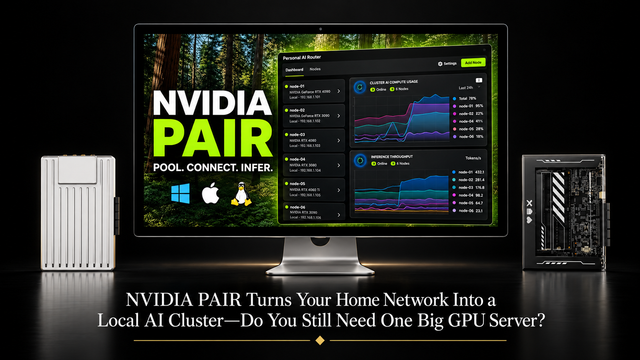
NVIDIA PAIR Turns Your Home Network Into a Local AI Cluster—Do You Still Need One Big GPU Server?
NVIDIA PAIR spreads local AI requests across multiple PCs, making compute more elastic while one home server can keep data and state persistent.
Why Does Immich Feel Faster on LAN Than on Remote Connections?
LAN requests usually take a shorter, lower-latency path. Remote access adds WAN capacity limits and may add DNS, TLS, proxy, VPN, or relay hops.
Does Immich Work Reliably Behind CGNAT or Double NAT?
CGNAT and double NAT do not break local Immich use. They mainly complicate direct inbound remote access and can force alternate or relayed paths.


