
GLM-5.3-Flash Locally: Hardware, RAM, VRAM, and Deployment Limits


GLM-5.3-Flash can be deployed from released weights, but its name should not be read as “small enough for an ordinary PC.” The model has 320 billion total parameters, activates about 18 billion parameters per token, and combines native multimodal input with a context window of up to one million tokens.
The practical question is therefore not whether GLM-5.3-Flash is open or whether a local server command exists. It is whether a system can store roughly 306 GiB of native FP8 weights, keep the full expert set accessible, provide enough RAM or accelerator memory for the chosen runtime, and still leave capacity for cache, activations, images, video, and operating headroom.
For most people, a full-GPU deployment remains an enterprise or advanced multi-GPU project. A documented CPU–GPU hybrid route makes local experimentation more accessible, but it calls for at least about 350 GB of available system memory and should not be confused with running a normal 18B model on one consumer GPU. The sections below separate those two deployment paths and identify where a workstation, home server, or hosted endpoint actually fits.
| Deployment Check | Current Answer |
|---|---|
| Are official weights available? | Yes. Z.ai publishes native FP8 and BF16 model variants. |
| Is GLM-5.3-Flash a normal 18B model? | No. It has 320B total parameters and activates about 18B per token. |
| How large are the native FP8 weights? | About 306 GiB before runtime state and KV-cache overhead. |
| Can one consumer GPU hold the complete model? | No. A single-GPU route depends on CPU–GPU offloading and very large system memory. |
| Which local runtimes are documented? | vLLM, SGLang, TokenSpeed, and KTransformers. |
What Is Available With the GLM-5.3-Flash Release?
GLM-5.3-Flash is the first natively multimodal model in the GLM-5 family. The current official model overview lists 320B total parameters, 18B activated parameters, image and video understanding, tool calling, structured output, context caching, and support for up to one million tokens. Its API model code is glm-5.3-flash, and its thinking mode remains enabled rather than offering a disabled setting.
The public open model card provides the released checkpoint and points to local serving paths for SGLang, vLLM, TokenSpeed, and KTransformers. Availability, however, does not create a consumer-scale memory profile. A runtime can expose a simple serve command while still expecting hundreds of gigabytes of accessible weights and a supported hardware topology.
That distinction matters for this article. Capability charts can explain why someone wants to use the model, but they do not answer how much RAM, VRAM, storage, or interconnect bandwidth a local deployment needs. Hardware planning must start from the released weights and the selected serving engine.
There is also useful context around how the model appeared before its public release. Before GLM-5.3-Flash was formally disclosed, an anonymous model labeled ox-alpha appeared on OpenCode and OpenRouter. At that stage, users could evaluate and route traffic to ox-alpha without the model being publicly identified as GLM-5.3-Flash. After the release, Z.ai connected that anonymous pre-release identity with GLM-5.3-Flash. In other words, ox-alpha is best understood as the undisclosed pre-release build or identity that preceded the public GLM-5.3-Flash release, rather than as a separate consumer model.

ox-alpha. This OpenRouter traffic snapshot from August 20–25, 2026 shows ox-alpha at 23.2T processed tokens, ranking first in the chart. At the time, the public chart showed only the anonymous ox-alpha name; its connection to GLM-5.3-Flash was disclosed later. The traffic volume indicates strong real-world usage during the anonymous preview, not lower local hardware requirements.The anonymous preview helps explain why the model had already attracted substantial usage before its public identity was known. It does not change the deployment math discussed in this guide: self-hosting the released checkpoint still depends on the full model size, runtime architecture, system memory, accelerator memory, context length, and concurrency. See the official GLM-5.3-Flash release article for the release context.
Benchmark results provide a different kind of signal. The Code Arena WebDev snapshot below places GLM-5.3-Flash around fifth overall with an AutoEval score of 1,634. That ranking is useful for understanding coding and web-development capability, but it should not be read as a hardware recommendation. Benchmark position measures task performance; it does not make a 320B-parameter checkpoint fit into ordinary consumer hardware.
 Arena Code WebDev leaderboard snapshot showing GLM-5.3-Flash at roughly #5 with a 1,634 AutoEval score. This is a capability benchmark for coding and web-development tasks, not evidence that the full model can be served efficiently on a normal PC or a single consumer GPU.
Why Does an 18B-Active Model Still Need More Than 300 GB?
GLM-5.3-Flash is a mixture-of-experts model. For each token, its router sends computation through a subset of the available experts, which keeps per-token compute closer to an 18B activated scale. The other experts do not disappear. A different token can need a different route, so the complete 320B weight set must remain stored and accessible to the inference system.
This is the same planning mistake that appears with other very large sparse models. The Kimi K3 hardware guide separates activated compute from the complete checkpoint for the same reason: active parameters estimate work performed per token, not the amount of model data that can be discarded.
| Published Number | What It Describes | What It Does Not Mean |
|---|---|---|
| 320B total parameters | The complete model weight set | Every parameter is computed for every token |
| 18B activated parameters | Approximate per-token compute scale | The full model fits like a dense 18B model |
| 8 of 288 experts | The routed expert pattern per token | Only eight experts need to be stored |
| 1M-token context | The supported maximum context capability | One million tokens is a free or sensible default |
How Does the Hybrid Attention Architecture Reduce Serving Cost?
The language model uses 45 layers, combining linear-attention layers with sparse-attention layers. Linear attention carries local and recurrent state efficiently, while sparse attention uses an indexer to retrieve globally relevant parts of a long context. IndexPool further compresses indexer cache vectors, and manifold-constrained hyper-connections, or mHC, support scaling across the architecture.
According to the current official documentation text, GLM-5.3-Flash reduces attention computation by 3.01 times and average KV-cache size by 4.44 times relative to GLM-5.3. Those improvements make long-context service less expensive; they do not reduce a 320B checkpoint to a desktop-sized model or eliminate runtime memory.
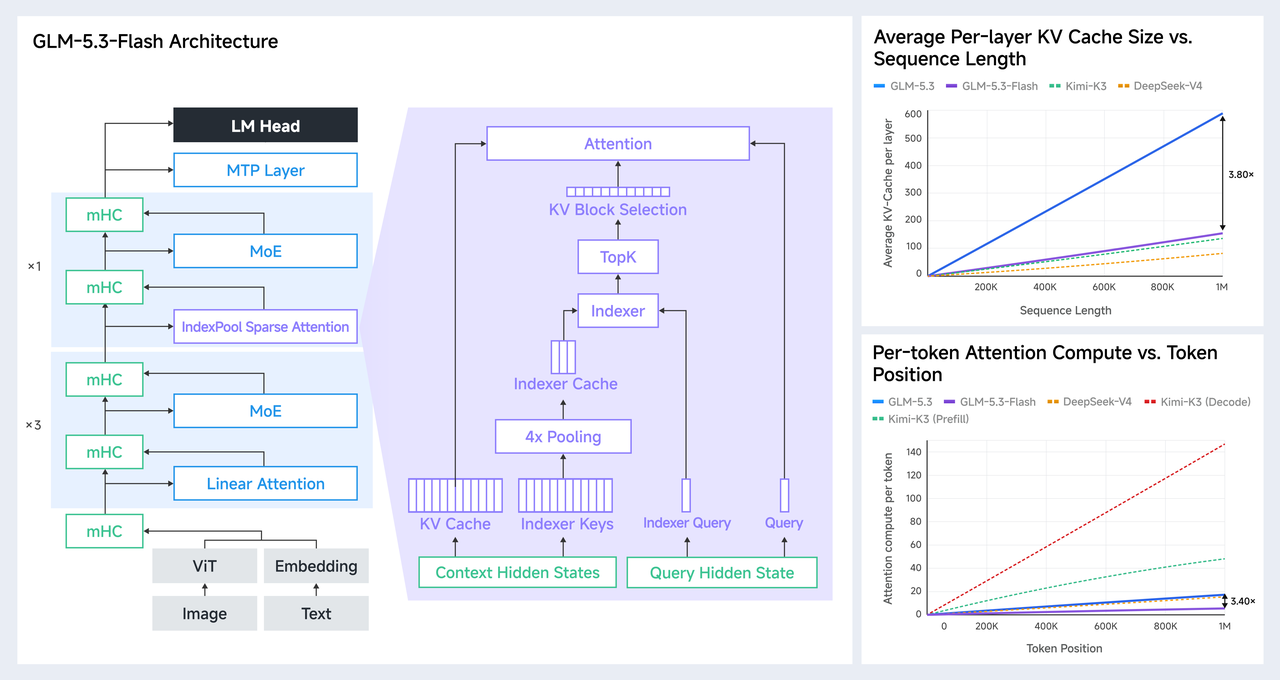
GLM-5.3-Flash hybrid attention architecture and long-context efficiency comparison. Source: GLM official documentation.
How Much Storage, RAM, and VRAM Does GLM-5.3-Flash Need?
The most useful published local-deployment number is the roughly 306 GiB footprint of the native FP8 weights. This is a weight figure, not a complete server-memory requirement. A working service also needs model metadata, attention state, KV cache, activations, communication buffers, multimodal encoder data, runtime kernels, graph capture, and spare capacity for failures or load variation.
The BF16 checkpoint requires roughly twice the weight memory of the native FP8 version. It should therefore be treated as a substantially larger deployment target rather than a drop-in option for the same machine. Disk planning must also allow for partial downloads, package caches, container images, logs, and temporary files instead of reserving exactly the checkpoint size.
| Resource Layer | Planning Figure | What It Excludes |
|---|---|---|
| Native FP8 weights | About 306 GiB | Cache, activations, runtime buffers, and headroom |
| Hybrid system memory | At least about 350 GB available | Application services and additional workload margin |
| BF16 weights | Roughly twice the FP8 weight footprint | All non-weight serving overhead |
| Persistent storage | More than the selected checkpoint | Downloads, containers, caches, logs, and temporary data |
| GPU VRAM | No universal minimum is published | Depends on runtime, offload split, context, and concurrency |
It would be misleading to turn the single-GPU KTransformers example into a claim such as “24 GB is the minimum VRAM.” The documented path proves that CPU–GPU expert inference is supported, but it does not certify one VRAM number across every GPU, context length, image workload, or performance target.
What Hardware Can Actually Run GLM-5.3-Flash Locally?
There are two materially different meanings of local. A GPU-resident service keeps the weights and serving state on enterprise accelerators and targets useful throughput. A hybrid service stores much of the expert data in system memory and uses CPU and GPU resources together. Both may run on hardware you control, but their latency, bandwidth requirements, and operating goals are not comparable.
| Hardware Class | Full-Model Feasibility | Main Boundary |
|---|---|---|
| Normal laptop, Mac, or desktop | Not practical | Insufficient memory for the complete FP8 weight set |
| One consumer GPU with ordinary RAM | Not sufficient | The GPU cannot hold the model, and normal RAM is too small for hybrid loading |
| RTX 40/50 system with 350GB+ available RAM | Documented hybrid path | CPU, memory bandwidth, and offloading limit performance |
| Enterprise multi-GPU server | Practical serving path | Requires supported kernels, enough aggregate HBM, and fast GPU links |
| Distributed accelerator cluster | Production-oriented path | Adds networking, orchestration, parallelism, and failure handling |
The documented KTransformers implementation supports NVIDIA SM89 and SM120 GPUs, corresponding to RTX 40- and 50-series paths, together with an AVX-512 FP8 CPU expert kernel. This compatibility statement describes the supported hybrid architecture. It does not promise that every CPU, motherboard, memory layout, or GPU in those families will deliver the same speed.
Why Does the Runtime Change the Hardware Requirement?
vLLM currently treats the default GLM-5.3-Flash checkpoint as native FP8 and documents an approximately 306 GiB weight footprint. Its current implementation supports NVIDIA Hopper and newer GPUs, with a published TP4 example on a GB200 tray. The vLLM serving recipe is a high-performance deployment reference, not proof that four arbitrary GPUs are sufficient.
KTransformers takes a different approach. It reads the official FP8 weights directly and supports heterogeneous CPU–GPU expert inference, including a documented single-GPU launch. The KTransformers tutorial says to reserve at least 350 GB of available system memory. That makes the model technically approachable on a specialized large-memory workstation, but weight movement and CPU execution can make it far slower than a GPU-resident service.
| Runtime Direction | Best Fit | Primary Tradeoff |
|---|---|---|
| vLLM | High-throughput GPU serving | Modern enterprise GPU and topology requirements |
| SGLang | Advanced and distributed serving | Configuration and accelerator complexity |
| KTransformers | Large-RAM local experimentation | CPU offload and memory-bandwidth limits |
| Hosted API | Users without suitable local hardware | External inference and ongoing usage cost |
How Do Context Length and Multimodal Inputs Raise the Budget?
A one-million-token context window is a maximum capability, not a recommended starting configuration. Longer prompts increase prefill work and stored attention state. Concurrency multiplies that pressure because the server must retain state for more than one active request. Batch size, output length, cache precision, and speculative decoding can all change the point at which a deployment runs out of memory.
The hybrid linear-and-sparse architecture reduces long-context growth compared with GLM-5.3, but it does not make one million tokens free. The KTransformers examples use a validated 501,025-token configuration rather than assuming every first run should immediately use the headline limit. A safer first test uses a much shorter context, batch size one, one active request, and text-only input.
Images and video add another resource layer. Local multimodal processing needs visual encoding and mixed prefill before text generation begins. The documented KTransformers request boundary allows text with up to eight images or text with one video, while images and video cannot be mixed in the same request. Those are software boundaries, not a guarantee that the largest allowed request will fit every local configuration.
What Role Can a Home Server Play?
A normal home server should not be presented as a full GLM-5.3-Flash inference node. It can still provide the surrounding service layer: storing documents and media, maintaining a private retrieval index, handling authentication, running an application UI, logging requests, and routing selected prompts to a workstation, accelerator server, or hosted endpoint.
This split is often more useful than forcing a frontier-scale checkpoint onto unsuitable hardware. The local AI server guide explains how storage, runtime, model execution, and application services can be separated instead of assuming that every part of an AI stack must run on the same machine.
In that architecture, ZimaCube 2 is better positioned as the data and service layer: it can centralize model files, private documents, RAG corpora, application data, backups, containers, retrieval services, and request orchestration while keeping those resources under local control. It should not be presented as a full GLM-5.3-Flash inference server. The native FP8 checkpoint alone is about 306 GiB, and the documented CPU–GPU hybrid path calls for at least about 350 GB of available system memory, so full-model inference belongs on a workstation, accelerator server, or hosted endpoint that actually meets the selected runtime's requirements.
That boundary still leaves a useful local role for ZimaCube 2. Smaller models that fit the installed CPU, memory, and accelerator configuration can run locally, while larger models such as the complete GLM-5.3-Flash release can be accessed through a separate inference host or API. This keeps storage, retrieval, applications, and orchestration local without implying that a NAS-class system can hold or serve a 320B checkpoint by itself.

How Can You Run GLM-5.3-Flash Locally?
Local deployment should begin with capacity and topology validation, not with copying the shortest serve command.
- Select the checkpoint. Use the native FP8 release unless a BF16-specific requirement justifies roughly doubling the weight footprint.
- Plan storage. Reserve more than the checkpoint size for downloads, caches, containers, logs, and temporary data.
- Choose the deployment class. Decide between GPU-resident serving and large-RAM CPU–GPU hybrid inference before buying or assigning hardware.
- Verify compatibility. Match the exact GPU architecture, CPU instruction support, runtime build, attention kernels, and quantization path.
- Start below the maximum. Use short context, batch size one, low concurrency, and text-only prompts for the first validated load.
- Measure the real system. Record load time, first-token latency, generation speed, host-memory use, GPU-memory use, and failure behavior.
- Add features gradually. Increase context, concurrency, image inputs, video, and speculative decoding one variable at a time.
A successful model load is only the first checkpoint. Interactive use also depends on token speed, prompt-prefill time, thermal stability, memory bandwidth, and whether the system can recover cleanly after an out-of-memory error. If the hybrid route loads but responds too slowly, a hosted endpoint or a smaller local model may be the more honest design.
FAQ
Can I run GLM-5.3-Flash on a normal PC or Mac?
Not as the complete released model at useful speed. The native FP8 weights alone are about 306 GiB, before cache and runtime overhead. A typical PC or Mac does not have enough accessible memory for the full checkpoint, and the documented hybrid route expects a specialized large-memory system.
How much RAM does GLM-5.3-Flash require?
For the documented KTransformers CPU–GPU path, reserve at least about 350 GB of available system memory. This is a deployment-specific recommendation, not a universal minimum for vLLM, SGLang, every context length, or every multimodal workload.
How much VRAM does GLM-5.3-Flash require?
There is no single official minimum VRAM number for every deployment. A GPU-resident service must accommodate the weights across supported accelerators plus runtime state. A KTransformers hybrid system can keep much of the expert data in RAM, so its VRAM requirement depends on the offload split, context, and configuration.
Can one RTX 4090 or RTX 5090 run GLM-5.3-Flash?
One such GPU cannot hold the complete model in VRAM. KTransformers documents single-GPU CPU–GPU inference on supported RTX 40- and 50-series paths, but the host still needs at least about 350 GB of available system memory. Performance will depend heavily on the CPU, memory bandwidth, and workload.
Why does 18B active not mean 18B model memory?
The router activates a subset of experts for each token, which reduces computation. The complete 320B expert set must remain available because later tokens may select different experts. Activated parameters describe per-token work, while total parameters determine the weight set that must be stored and accessed.
Can Ollama or LM Studio run GLM-5.3-Flash?
Community quantizations and application support may change quickly, but an entry in a model catalog does not remove the underlying memory requirement. Verify that the selected build supports the model architecture, multimodal components, quantization, and complete local weights rather than silently routing requests to a hosted service.
Does one-million-token context work on every local setup?
No. One million tokens is the model's maximum context capability. The usable local context depends on cache precision, available RAM and VRAM, concurrency, runtime support, and multimodal inputs. Start with a shorter limit and increase it only after measuring memory and latency.
Final Takeaway
GLM-5.3-Flash is more efficient than its 320B total parameter count might suggest, but it is not a desktop-sized 18B model. About 18B parameters are activated per token; the complete native FP8 weight set is still about 306 GiB, and the documented CPU–GPU path calls for at least about 350 GB of available system memory.
For high-performance serving, plan around supported enterprise GPUs, fast accelerator links, and a runtime-specific topology. For local experimentation, a specialized large-RAM workstation can use KTransformers to trade accelerator residency for CPU and memory-bandwidth limits. For everyone else, keep private files, retrieval, and application services local while using a hosted endpoint or a smaller model that matches the actual hardware.

Recommended products

Tech & AI HUB
More to Read
Can a Local LLM Resume Generation After Its Process Restarts?
A mechanism-first explanation of llm generation resume, its shared-resource tradeoffs, three query-fanout FAQs, and a practical verification protocol.
Can a Home Server Run Embeddings and Video Transcoding on the Same Integrated GPU?
A mechanism-first explanation of shared igpu embeddings and transcoding, its shared-resource tradeoffs, three query-fanout FAQs, and a practical verification.
How Does Access-Token Lifetime Affect Security and Household Friction?
A mechanism-first explanation of access-token lifetime, its shared-resource tradeoffs, three query-fanout FAQs, and a practical verification protocol.


