
The Secret-Zero Problem: Why a Home AI Agent Still Needs an Initial Trust Root


The observable effect usually appears because the first identity or decryption step needs a preexisting trusted root, with shared resources and timing determining its practical size.
In a home-server workflow, the secret-zero problem can change both interactive behavior and background resource use. The visible effect appears only after the request crosses several processing stages, so one average number can hide where the delay, quality loss, or failure began. Separating transport, compute, storage, and application state makes the relationship testable under otherwise identical conditions.
Tracing The Secret-Zero Problem Through the System
Following the request from input to output shows that the first identity or decryption step needs a preexisting trusted root. That step changes what the next component receives, so the observed result cannot be assigned to the final interface or model alone. Holding the input and workload constant makes this early transformation visible.
The artifact provenance model provides a concrete way to interpret this stage: the first identity or decryption step needs a preexisting trusted root. Its practical value is separating the changed variable from later buffering, scheduling, storage, or rendering effects that can produce a similar symptom.
Once the first stage changes, hardware keys, offline enrollment, or operator approval bootstrap later secrets. The consequence may appear as latency, accuracy, energy, capacity, or perceived smoothness depending on the article question, but the causal path still starts before the final output is shown.
Why Concurrent Work Changes the Outcome
Concurrent work changes the result because hardware keys, offline enrollment, or operator approval bootstrap later secrets. Concurrent AI, storage, media, or automation jobs can therefore amplify an effect that looks small in a single-request benchmark. Tail behavior matters more than an idle-system average.
The signature verification mechanism connects the shared-resource layer to the result: hardware keys, offline enrollment, or operator approval bootstrap later secrets. Measuring this layer separately prevents throughput, cache hits, acknowledgements, or optimistic status updates from being mistaken for completed user-visible work.
The interaction continues because automating bootstrap merely moves the root into another component. This is why two home servers with the same headline hardware or network rate can behave differently when queue depth, data layout, cache state, or policy differs.
Where the Causal Claim Falls Short
The causal claim has a defined failure condition. In this case, the system has no secrets and trusts every local process equally. Another bottleneck can set the ceiling before a change to the secret-zero problem becomes measurable.
The software provenance relationship helps distinguish the expected mechanism from a competing explanation. A controlled test must keep source data, hardware, concurrency, cache state, and software versions fixed while changing only the title variable. This dependency should remain visible in a repeatable home-server test.
The failure boundary is reached when the system has no secrets and trusts every local process equally. Beyond that point, more aggressive tuning can add cost, risk, or instability without improving the outcome promised by the title.

FAQ About The Secret-Zero Problem
Is The Secret-Zero Problem the Main Bottleneck?
Not automatically. It is the main bottleneck only when changing it moves the result while hardware keys, offline enrollment, or operator approval bootstrap later secrets and other conditions stay fixed. If the output does not respond, another stage is setting the ceiling.
Can Caching Hide the The Secret-Zero Problem Effect?
Yes. Warm caches, retained sessions, resident models, buffered media, and optimistic interface updates can bypass the stage being studied. Cold and warm runs should be reported separately. The result must be evaluated separately from adjacent pipeline stages.
Which The Secret-Zero Problem Metric Matters Most?
The useful measurements are root copies, bootstrap events, rotation success, recovery path. Average values should be paired with tail latency, errors, quality, or resource cost so a smoother-looking result is not mistaken for a better system.
Run a Controlled The Secret-Zero Problem Test
Create a representative workload and record root copies, bootstrap events, rotation success, recovery path before changing the secret-zero problem. Run cold and warm trials, include realistic concurrency, and preserve the same data, versions, hardware, and user-visible success criterion across every comparison.
Use the related mechanism in the secret-zero problem to define the expected direction before testing. Change one variable at a time, record median and tail behavior, and keep the failed or degraded case so the result includes its operational boundary.
Adopt the change only when the measured benefit persists across repeated trials and the stated boundary remains acceptable. If another stage dominates, leave the secret-zero problem unchanged and test that competing bottleneck instead of inferring causality from correlation.

Recommended products

Tech & AI HUB
More to Read
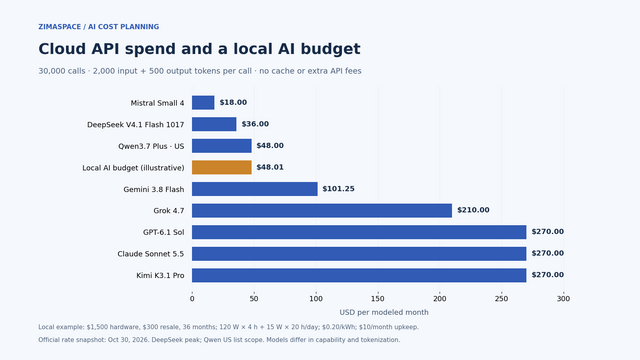
Cloud AI API Pricing vs Local AI: What Does Your Workload Really Cost?
Compare cloud API token charges with local AI hardware, electricity and upkeep. Work through a monthly example and use the free ZimaSpace cost calculator.

Workload Identity Federation: How Local Services Avoid Shared API Keys
A mechanism-first explanation of workload identity federation, its shared-resource tradeoffs, three query-fanout FAQs, and a practical verification protocol.

Restore-Point Catalogs: How Dependency Manifests Rebuild a Private AI Stack
A mechanism-first explanation of restore-point catalogs, its shared-resource tradeoffs, three query-fanout FAQs, and a practical verification protocol.


