
Fanless Home Server Thermal Risk Assessment


Buy a fanless server only when independent sustained-load evidence and your placement plan leave thermal margin for the CPU, SSD, and power delivery in the hottest expected room conditions.
Define the Sustained Workload and Hottest Room
List the longest simultaneous jobs: media transcodes, backups, checksum scans, photo indexing, compression, or local AI inference. Short burst benchmarks do not represent a sealed chassis working for an hour.
Use the warmest realistic ambient temperature, not the temperature on purchase day. A unit that is comfortable in winter may throttle inside a shelf during summer while a backup also heats its SSD.
Reject the candidate if no review shows sustained behavior near your workload or if the vendor provides no credible operating envelope.
Read Throttling and Surface Temperature Together
A passive case is itself a heat sink, so a warm exterior can be expected. The decision variable is whether internal temperatures stabilize while clocks, error rates, and storage performance remain acceptable.
A long-form fanless mini-PC review documents case design, component temperatures, and performance behavior rather than treating silence as the only result. Use that sustained thermal evidence as the standard for judging a candidate.
Fail the purchase if stable temperature is achieved only through severe clock collapse that would make the intended workload miss its time window.
Treat the SSD and Power Adapter as Thermal Components
CPU temperature alone misses two common constraints. An NVMe SSD can heat under indexing or write-heavy work, and an external adapter may run in a poorly ventilated location even when the computer case is exposed.
An independent silent-PC review measured performance, emissions, and component behavior as a system. Its component-level temperature measurements illustrate why every heat source needs evidence.
Require an SSD heatsink or airflow plan when sustained writes are part of the job, and keep the power brick off insulating fabric or enclosed cable boxes.

Make Placement Part of the Purchase Test
Passive cooling needs open air around the heat-spreading surfaces. A vertical orientation, clearance from a wall, and separation from another warm device can matter more than a small difference in processor specification.
Plan a post-purchase acceptance test in the exact location: run the longest workload, log CPU and SSD temperatures, check clock stability, then repeat with the room warmer or the shelf door closed if that is realistic.
Use the ZimaSpace guide to size cooling headroom for an always-on server before accepting a placement that leaves no seasonal margin.
Pass, Add Active Airflow, or Reject
Pass a fanless design when the workload stabilizes with margin, the SSD remains healthy, and the intended location can shed heat continuously.
Choose a slow, replaceable fan when small airflow produces a large safety margin and absolute silence is less important than sustained performance. A quiet active design can be more predictable than an overworked passive one.
Reject the fanless candidate if reviews show unexplained throttling, the enclosure will sit in a closed cabinet, or summer conditions cannot be simulated before the return window closes.
Final Takeaway
Silence is valuable only when it survives the longest real workload. Require sustained thermal evidence, storage margin, and a placement test before keeping the system.

Recommended products

Buying Guide
More to Read
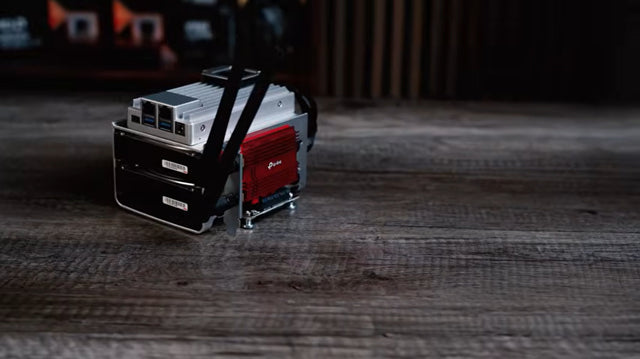
Used Enterprise Server Noise and Power Risk Guide
A used enterprise server is a bargain only when measured noise, idle power, parts, and placement costs fit the home for its full service...
Drive Bay Expansion Risk Assessment for a Value NAS
A value NAS is expansion-ready only when its pool rules, power budget, rebuild plan, and total enclosure cost pass before purchase.
Multi-Bay NAS Checklist Before Choosing Hot-Swap Bays
Choose hot-swap bays only when the backplane, controller, software, cooling, labels, spare policy, and live-replacement procedure all pass.


