
How INFO SPEED HARDWARE Builds a Direct 10GbE Link for ZimaBoard 2


Thank you to INFO SPEED HARDWARE for demonstrating a practical way to add 10GbE to a ZimaBoard 2 NAS without replacing the entire home network or purchasing a multiport 10GbE switch.
The idea is straightforward: keep ZimaBoard 2 connected to the existing local network through one of its onboard Ethernet ports, then install a compatible 10GbE network adapter in the PCIe slot and connect that adapter directly to a second 10GbE interface in a Windows PC.
The normal network continues to provide internet access, administration, and connectivity for other devices. The dedicated cable creates a separate point-to-point path for large file transfers between the workstation and NAS.
INFO SPEED HARDWARE’s test reaches approximately 6.84Gbps of aggregate throughput in iPerf3. That is substantially faster than a 1GbE connection, although it remains below the 10Gbps link rate and does not mean every file transfer will reach the same speed.
Watch before reading: The original Spanish-language video explains the existing NAS bottleneck, the direct-link topology, network-address configuration, iPerf3 test, and final ZimaBoard 2 hardware arrangement.
Source note: This article reorganizes the configuration and results presented in INFO SPEED HARDWARE’s direct 10GbE homelab video. Network performance depends on the adapters, drivers, PCIe interface, cable, operating system, protocol settings, storage devices, processor load, and test method. The measured result should be treated as one build’s outcome rather than a guaranteed transfer speed.
Why a 1GbE Network Becomes a NAS Bottleneck
A home NAS can contain fast processors, SSD storage, and multiple hard drives while still feeling slow from a workstation. The problem is often not the server itself but the network path between the two devices.
Standard 1GbE has a theoretical link rate of one gigabit per second. In practical file transfers, this commonly produces approximately 110–125MB/s under favorable conditions. Once the connection reaches that limit, installing a faster SSD in the NAS does not make the transfer substantially faster.
The ZimaBoard 2 configuration shown by INFO SPEED HARDWARE contains an Intel N150 processor, 16GB of memory, onboard system storage, an SSD, and a large-capacity hard drive. Its two onboard 2.5GbE interfaces already provide an upgrade over 1GbE, but the existing switch and connected clients can still restrict the complete path to a slower negotiated rate.

The original NAS design includes an SSD, a large hard drive, SMB shares, and a conventional switched network that can limit clients to around 1GbE speeds.
This is an important diagnostic step. Before buying faster networking equipment, identify whether the current limit comes from the network, storage pool, CPU, protocol, or client device. A 10GbE upgrade will not correct a storage system that can only read data at 150MB/s.
The Difference Between 10Gbps and 10GB/s
10GbE refers to 10 gigabits per second, not 10 gigabytes per second. Because one byte contains eight bits, the theoretical conversion is:
10Gbps ÷ 8 = 1.25GB/s
That 1.25GB/s figure is a raw theoretical maximum. Ethernet framing, TCP/IP overhead, SMB or NFS processing, storage latency, driver behavior, and system load reduce the useful application-level throughput.
The approximately 6.84Gbps result shown in the video corresponds mathematically to about 855MB/s before considering file-sharing and storage overhead. That is still many times faster than the practical ceiling of a 1GbE connection.
Why Use a Direct 10GbE Connection?
A normal multi-device 10GbE network places a 10GbE switch between the NAS, workstation, server, and other high-speed clients. That is the most flexible design, but it also requires a compatible switch and potentially wider network upgrades.
A direct connection removes the switch from one high-speed path:
| Connection | Purpose | Hardware Path |
|---|---|---|
| Existing home network | Internet access, administration and access from normal clients | ZimaBoard 2 onboard Ethernet → existing switch or router |
| Direct 10GbE link | High-speed transfers between the NAS and one workstation | ZimaBoard 2 PCIe 10GbE adapter → Windows PC 10GbE adapter |
This topology is attractive when only one workstation needs faster NAS access. A video-editing PC, backup workstation, virtualization host, or primary desktop can receive a dedicated storage path while phones, laptops, televisions, and other devices continue using the existing network.
The tradeoff is that the 10GbE connection primarily serves those two endpoints. Adding more high-speed devices later normally requires a switch or a more complex routed topology.
Using ZimaBoard 2 PCIe Expansion for 10GbE
ZimaBoard 2 includes two onboard 2.5GbE interfaces, but reaching a 10GbE link rate requires a separate compatible network adapter.
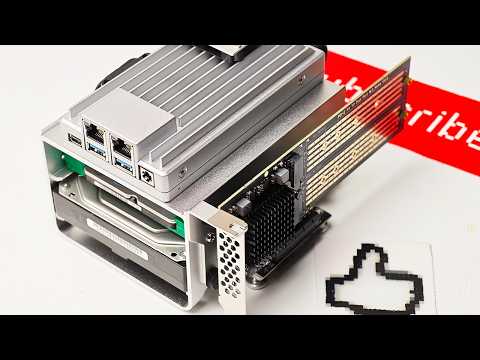
The board’s open PCIe interface provides the expansion path. INFO SPEED HARDWARE installs a 10GbE adapter in this slot and uses one of the onboard network ports for the normal LAN connection.
This approach preserves two independent paths:
- The onboard Ethernet interface receives an address from the normal home network.
- The PCIe 10GbE interface receives a separate static address for the direct connection.
- The Windows PC also receives a static address on that dedicated subnet.
- Traffic addressed to the direct subnet travels through the 10GbE cable instead of the regular switch.

What Hardware a Direct 10GbE Link Requires
The exact adapter model can vary, but both endpoints need interfaces that can establish the same 10GbE connection type.
| Component | Role | Compatibility Check |
|---|---|---|
| ZimaBoard 2 | Runs the NAS and provides PCIe expansion | Operating-system and driver support for the selected NIC |
| PCIe 10GbE adapter | Adds a dedicated 10GbE interface to the NAS | PCIe requirements, physical fit, chipset support and cooling |
| PC 10GbE adapter | Provides the workstation endpoint | Available PCIe, Thunderbolt or other supported interface |
| Compatible cable | Connects the two endpoints directly | RJ45 copper, SFP+ DAC or optical components must match both adapters |
| Fast storage | Supplies or receives data at multigigabit speed | Single HDD, RAID pool, SSD or NVMe performance |
For 10GBASE-T adapters with RJ45 ports, Cat6a is the predictable choice for longer permanent runs. Cat6 can also support 10GbE over shorter suitable installations. Cable quality, termination, interference, and distance all affect link stability.
SFP+ adapters can instead use a DAC cable for short rack connections or compatible transceivers and fiber for longer paths. The adapters and cable type must match; an RJ45 connector cannot be directly attached to an SFP+ port without the correct transceiver.
Check Operating-System Support Before Buying the NIC
The same channel previously documented driver difficulties when adding a 10GbE adapter to a TrueNAS-based ZimaBoard 2 NAS. This is a useful reminder that PCIe compatibility involves more than the physical connector.
Before purchasing an adapter, check:
- Whether the NIC chipset is supported by the selected TrueNAS, Linux, Windows or ZimaOS version
- Whether the operating system includes the driver or requires a separate installation
- Whether the card negotiates the intended speed with the adapter at the other endpoint
- Whether the PCIe interface provides enough lanes and bandwidth
- Whether the card requires additional airflow during continuous operation
Server-oriented 10GbE cards can become hot under load. They were often designed for rack servers with continuous chassis airflow, so a passive card placed in an open homelab build may still need a nearby fan.
Assigning a Separate Subnet to the Direct Link
A direct cable does not normally rely on the home router’s DHCP server. INFO SPEED HARDWARE assigns static addresses to the NAS and Windows interfaces on a separate subnet.
The iPerf3 screen shows addresses in the following range:
-
NAS direct interface: an address such as
30.30.30.2 -
Windows direct interface: an address such as
30.30.30.3
The exact private addresses can be different. The important requirement is that both direct interfaces use the same dedicated subnet and do not conflict with the main home network.
A typical point-to-point configuration does not need a default gateway or DNS server on the direct interface. The main LAN adapter should retain the gateway and DNS settings used for internet and normal network access.
Adding a second default gateway can cause Windows or the NAS to send traffic through the wrong interface. The high-speed adapter should be treated as a dedicated local data path unless the builder intentionally designs a routed network.
Make Sure SMB Uses the 10GbE Address
A computer with two network paths to the same NAS may continue using the normal LAN address unless the user deliberately connects through the direct interface.
For example, an SMB share should be opened using the hostname or IP address associated with the 10GbE link. If the normal home-network address is used, the transfer may remain limited by the onboard interface or existing switch.
Windows users can map the NAS share by its direct-link address, while keeping the normal address available for administration and lower-speed clients. Giving the connection a recognizable name helps prevent confusion between the LAN and 10GbE paths.
Testing Network Throughput With iPerf3
INFO SPEED HARDWARE validates the direct connection with iPerf3. Unlike a file-copy test, iPerf3 measures network throughput without making the storage devices the primary bottleneck.
One endpoint operates as the iPerf3 server, and the other initiates the test. The screenshot shows multiple parallel TCP streams. Individual streams report different rates, while their combined result reaches approximately 6.84Gbps.

Multiple parallel iPerf3 streams produce an aggregate result of approximately 6.84Gbps across the direct link.
Parallel streams can reveal more available bandwidth when one TCP connection does not fully utilize a fast link. They can also increase CPU and memory-processing demand, so the result should be documented together with the stream count and test direction.
A more complete test plan would include:
- A single-stream test to measure normal TCP behavior
- A multistream test to estimate aggregate link capacity
- Tests in both directions
- A longer run to reveal thermal or stability problems
- CPU monitoring on both endpoints
- A real SMB or NFS transfer using representative files
Why the Test Does Not Reach the Full 10Gbps
A negotiated 10GbE link does not guarantee a 10Gbps benchmark result. Several parts of this compact setup can reduce throughput:
- TCP/IP and Ethernet protocol overhead
- NIC chipset and driver efficiency
- PCIe lane configuration and controller behavior
- Intel N150 CPU load while processing multiple network streams
- Memory bandwidth and data-copy operations
- Interrupt handling and offload settings
- Operating-system network configuration
- Thermal limits during sustained transfers
The 6.84Gbps result confirms that the direct connection moves well beyond 1GbE and 2.5GbE territory. It does not necessarily indicate a fault simply because it falls below 10Gbps.
Network Speed and File-Copy Speed Are Different
iPerf3 can generate network traffic in memory, but a real NAS transfer must read data from one storage device and write it to another.
| Storage Type | Likely Effect on a 10GbE Transfer |
|---|---|
| Single mechanical hard drive | Usually becomes the bottleneck well before the 10GbE link is saturated. |
| Multiple HDD RAID pool | Can increase sequential throughput, depending on RAID layout and drive count. |
| SATA SSD | Can exceed 1GbE and 2.5GbE but remains below the theoretical 10GbE ceiling. |
| NVMe SSD or fast SSD pool | Has a better chance of approaching the useful capacity of a 10GbE connection. |
Small-file transfers can also remain much slower than large sequential transfers because each file introduces metadata, filesystem, permission, and protocol operations.
Users expanding a high-capacity NAS can review the related ZimaBoard 2 storage expansion guide for additional planning around drives, controllers, power, and physical layout.
The Completed ZimaBoard 2 Network Setup
The final build keeps ZimaBoard 2 inside its compact metal drive frame. The NAS connects upward to the existing switch for ordinary network access, while a separate cable runs from the PCIe 10GbE adapter directly to the workstation.

The completed topology preserves the ordinary LAN connection while adding a separate high-speed path between the NAS and workstation.
This hybrid arrangement avoids upgrading every device at once. The household can retain its current router and switch, while the one computer that moves the largest files receives a faster direct connection.
When a Direct 10GbE Link Makes Sense
A point-to-point upgrade is most useful when one system consistently needs high-speed access to the NAS.
- Video editing: Moving large source files, project caches, and completed exports.
- Workstation backup: Creating or restoring large disk images.
- Virtualization: Transferring VM images and accessing high-performance network storage.
- Photography: Importing and processing large RAW libraries stored on the NAS.
- Software development: Moving large datasets, container images, and build artifacts.
- NAS migration: Copying data between a workstation and a replacement storage pool.
A 10GbE switch becomes more appropriate when several workstations, servers, or NAS devices require high-speed communication with one another. Direct links can become difficult to manage as the number of endpoints grows.
What INFO SPEED HARDWARE’s Test Demonstrates
| Finding | What the Video Demonstrates | Remaining Limitation |
|---|---|---|
| PCIe expansion | ZimaBoard 2 can add a compatible 10GbE network interface. | The selected NIC still needs operating-system driver support. |
| Direct connection | One workstation can receive a high-speed NAS path without a 10GbE switch. | Other clients do not automatically gain access to that bandwidth. |
| Dedicated subnet | The high-speed link can operate separately from the ordinary home LAN. | Addresses and routes must be configured without conflicting with the main network. |
| iPerf3 result | The tested configuration reaches approximately 6.84Gbps in a multistream test. | Single-stream and file-copy performance may be lower. |
| NAS performance | The network bottleneck can be raised well beyond 1GbE. | HDD, SSD, filesystem and SMB performance still determine real transfer speed. |
A Focused 10GbE Upgrade Without Rebuilding the Whole Network
INFO SPEED HARDWARE’s project shows that moving beyond Gigabit Ethernet does not always require a complete network replacement. ZimaBoard 2 retains its normal LAN connection while its PCIe slot provides a dedicated 10GbE path to the workstation that needs it most.
The approximately 6.84Gbps iPerf3 result is well below the theoretical 10Gbps link rate, but it is still a major increase over a conventional 1GbE connection. The project also exposes the practical limits behind network benchmarks: the NIC, PCIe connection, CPU, drivers, protocol, cable, and storage pool all contribute to the final result.
Watch INFO SPEED HARDWARE’s complete 10GbE tutorial for the original network explanation, IP configuration, throughput test, and completed hardware setup.

INFO SPEED HARDWARE concludes the direct 10GbE homelab test after validating the connection with iPerf3.
If you are adding faster networking to your ZimaBoard 2 NAS or troubleshooting a PCIe network adapter, join the ZimaSpace community to share your NIC model, operating system, storage configuration, and measured results.
FAQ
Can ZimaBoard 2 use a 10GbE network card?
Yes, a compatible network adapter can be connected through PCIe. Compatibility depends on the card’s chipset, PCIe requirements, operating-system drivers, power consumption, and cooling.
Do I need a 10GbE switch for one PC and one NAS?
No. The two 10GbE interfaces can be connected directly and assigned addresses on a dedicated subnet. A switch is more useful when three or more high-speed devices need to communicate.
Can the normal home network and direct 10GbE link work together?
Yes. The onboard Ethernet port can remain connected to the home LAN while the PCIe adapter handles the direct storage link. Only the main LAN interface normally needs a default gateway.
Why does a 10GbE link not transfer at exactly 10Gbps?
10Gbps is the link rate. Protocol overhead, drivers, PCIe behavior, CPU load, network configuration and the test method reduce measured throughput. Real file transfers can be limited further by storage performance.
What does the 6.84Gbps iPerf3 result mean?
It is the combined network throughput measured across multiple parallel TCP streams in the demonstrated configuration. It does not mean every SMB file transfer will run at 6.84Gbps.
Can one hard drive saturate a 10GbE connection?
Usually not. A single mechanical drive generally becomes the bottleneck first. Fast SSDs, NVMe storage, or multi-drive pools are better suited to high-throughput 10GbE transfers.
Should jumbo frames be enabled for a direct 10GbE link?
Jumbo frames can reduce processing overhead in some environments, but they are not required for 10GbE. If used, both endpoints must support and use the same MTU. A mismatched MTU can cause connectivity and performance problems.

Recommended products

Zima Campaign Hub
More to Read

How Giorgio Cappello Di Paglia Tests Gaming Like It Is 1997 on ZimaBoard 2
Giorgio Cappello Di Paglia uses ZimaBoard 2 and Batocera to ask whether modern players can still adapt to games designed like those released in...

How YOTECH Evaluates ZimaBoard 2 as a Compact Home Server
YOTECH examines ZimaBoard 2 as a compact home-server platform, covering its aluminum passive-cooling enclosure, included cables, optional fan, metal drive rack, SATA storage, dual...
How Arthur From Hobby Support Runs Home Network Services on ZimaBoard 2
Arthur from Hobby Support Int. assembles a ZimaBoard 2 home server with SATA storage, active cooling, and PCIe expansion, then explores how ZimaOS simplifies...


