
WireGuard Server vs Mesh VPN for Devices Behind CGNAT


Choose a mesh VPN when the home server and remote devices are behind CGNAT and you do not control a publicly reachable endpoint; NAT traversal and relay infrastructure are exactly the missing pieces. Choose a plain WireGuard server when you can provide a stable public endpoint—at home, on IPv6, or on a VPS—and you prefer direct ownership of peer keys, routes, firewall rules, and the hub topology. CGNAT does not make WireGuard unusable, but it changes what infrastructure you must supply around it.
CGNAT Removes the Assumption That Your Home Router Owns a Public IPv4 Address
A conventional home WireGuard server expects remote peers to send packets to an endpoint that the internet can reach. With ordinary router NAT and a public WAN address, port forwarding can map that endpoint to the WireGuard host. Under carrier-grade NAT, the ISP performs another translation upstream, so the home router may not control the public mapping that outside peers need.
RFC 6598 defines 100.64.0.0/10 as shared address space for Carrier-Grade NAT. Seeing a WAN address in that range is one strong sign that an ISP-side translation exists between the home and the public internet. The practical consequence is that a port-forward rule on the home router may not create a globally reachable IPv4 endpoint.
This is the first decision gate. If the ISP provides a public IPv4 address, a usable public IPv6 path, or a service that lets you create the required inbound mapping, a self-hosted WireGuard server remains straightforward. If no public path exists, the comparison shifts from “which VPN protocol is better” to “who provides traversal or a relay.”
A WireGuard Server Wins When You Can Supply One Reachable Hub
Plain WireGuard is deliberately small. Each peer knows its private key, allowed IP ranges, and the public key and endpoint of the peer it must contact. A home-server hub is easy to reason about when the hub has a stable reachable address and remote devices can initiate toward it.
WireGuard's Quick Start documentation on endpoints and persistent keepalives explains how a peer behind NAT can keep its mapping alive by periodically sending traffic. That helps a client remain reachable through its existing NAT mapping, but it does not grant a CGNAT home server a public IPv4 endpoint that the subscriber does not control.
The WireGuard-server route therefore fits three common home-lab designs: the ISP gives the home a public endpoint; the home exposes the service over usable IPv6; or a small VPS becomes the reachable WireGuard hub and the home initiates an outbound tunnel to it. In all three cases, you own the routing model and do not depend on a mesh coordination service for peer discovery.
Mesh VPNs Win When Traversal and Endpoint Discovery Are the Real Problem
A mesh VPN wraps encrypted tunnels with coordination. Devices enroll into the overlay, discover one another, exchange connection information, and attempt NAT traversal without requiring the owner to hand-write a public endpoint for every changing network. This is especially valuable when laptops, phones, and the home server all move between NAT types the owner does not control.
Tailscale's current connection model starts with a relayed path, exchanges direct-connection details, attempts NAT traversal, and upgrades to a direct peer-to-peer UDP connection when possible. If direct traversal fails, the connection can remain relayed. The value is not a different encryption claim; it is an automated connectivity system around WireGuard-based links.
Choose the mesh route when you want devices behind unrelated CGNAT, hotel Wi-Fi, mobile networks, or restrictive home routers to connect without first building a public hub. The choice becomes weaker when you specifically want no external coordination dependency or when predictable direct routing through your own infrastructure matters more than enrollment convenience.

Relay Fallback Solves Reachability but Can Become the Performance Boundary
A relayed VPN can remain functionally connected when direct peer-to-peer traversal fails, but the data path now crosses an intermediary. Latency increases with relay location and route, and throughput may be lower than a direct tunnel. That distinction matters for SMB, remote backups, large photo libraries, or high-bitrate media more than it does for SSH and dashboards.
ZeroTier's NAT and relaying guidance states that hard NAT and CGNAT can force connections through relay servers, with higher latency and limited throughput compared with direct paths. Different mesh products implement relays differently, but the architectural tradeoff is the same: traversal convenience can move the bottleneck to relay geography and capacity.
This can flip the choice for a heavy remote-storage workflow. A home connection that cannot accept WireGuard directly may still benefit from a user-controlled VPS hub near the home or user, because that creates a predictable relay you can size and monitor. For light administrative access, the managed mesh fallback may be simpler and completely adequate.
Mesh VPNs Add Identity and Policy That Raw WireGuard Leaves to You
WireGuard's peer model is cryptographic and route-oriented. If you want user login, device enrollment, named groups, centralized access policies, key rotation workflows, or a searchable device inventory, those functions must be built around the protocol. A mesh platform normally provides some or all of that control plane.
NetBird's architecture describes a platform that combines WireGuard tunneling with NAT traversal, authentication, ACLs, and network management. This demonstrates the real comparison axis: a mesh VPN is not merely “WireGuard with a different UI”; it adds coordination and policy services that raw WireGuard intentionally does not define.
For one administrator and three stable devices, handwritten WireGuard peers can be simpler than operating or trusting a larger control plane. For a family with changing phones, several laptops, subnet routers, and role-based access, mesh enrollment and centralized policy can reduce the number of peer files and firewall exceptions the owner maintains manually.
Self-Hosting the Mesh Control Plane Trades Provider Dependency for Infrastructure Ownership
The choice is not limited to a hosted mesh provider versus raw WireGuard. A self-hosted control plane can preserve the mesh connection model while moving coordination under your administration. That narrows provider dependency but adds a public service, database or state, backups, upgrades, certificates, and recovery work.
Headscale describes itself as a self-hosted implementation of the Tailscale control server. Its documentation also supports self-hosted DERP options, which shows the ownership tradeoff clearly: you can own more of the coordination and relay path, but then you must keep that path reachable and recoverable.
Do not choose self-hosted mesh only because the word “self-hosted” matches the rest of the lab. Use it when control-plane ownership, policy storage, provider independence, or custom relay placement is important enough to justify another internet-facing service. Otherwise a hosted mesh can remove exactly the availability problem CGNAT made difficult in the first place.
Choose by Reachability, Data Path, and Control-Plane Ownership
Choose a WireGuard server when one reliable public endpoint exists and you want a transparent hub-and-spoke design with explicit keys and routes. This is strongest for a small number of stable peers, owners comfortable with firewall and DNS work, or a VPS-assisted design where relay location and capacity are under your control.
Choose a mesh VPN when the devices live behind CGNAT or changing NATs, enrollment needs to be easy, and automatic path discovery or relay fallback is worth introducing a coordination layer. For heavy file access, verify whether the session is direct or relayed because the answer can change throughput enough to matter.
The ZimaSpace comparison of reverse proxy, WireGuard, and Tailscale for remote family services covers the broader remote-access choice. Within the private-VPN branch, the stopping rule here is narrower: if you can provide the reachable endpoint and prefer manual ownership, WireGuard is enough; if reachability itself is the recurring problem, a mesh VPN earns its extra control plane.

Recommended products

Product Comparisons
More to Read
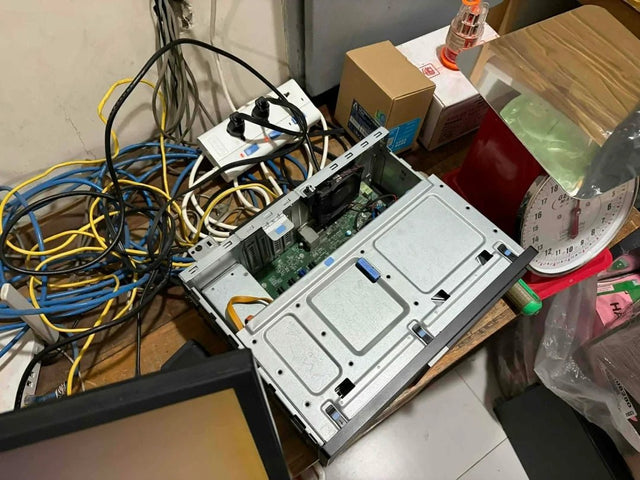
WireGuard Server vs Mesh VPN for Devices Behind CGNAT
Use mesh VPN for low-friction roaming devices; use a WireGuard relay when you want to own routing, keys, and the public endpoint.
10GbE NAS on Gigabit Clients: Upgrade the Server or Endpoints First?
Upgrade the endpoint path for one slow workstation; upgrade the NAS uplink first when several gigabit clients saturate it together.
1GbE vs 2.5GbE for a Home Server: Which Workloads Cross the Line?
Keep 1GbE for light services and single streams; move to 2.5GbE when recurring transfers or combined clients sustain more than about 100 MB/s.


